On eBird ↗
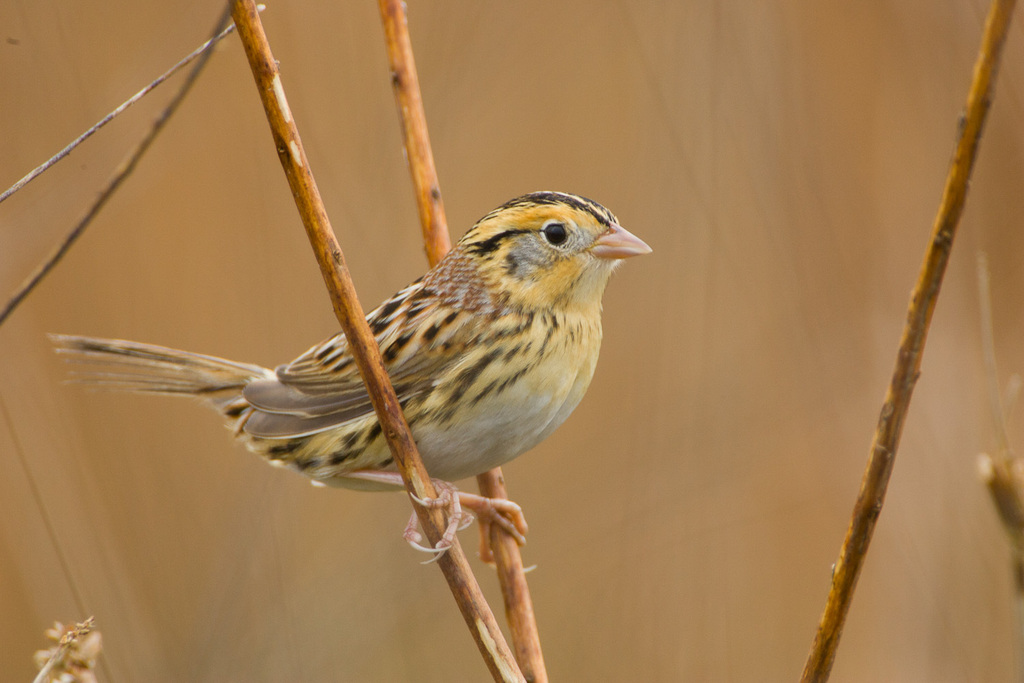
LeConte's Sparrow
Live sightings near you, the range map, bar charts of when it is seen, and Macaulay Library photos and recordings.
LeConte's Sparrow
Ammospiza leconteii
LeConte's sparrow (Ammospiza leconteii), also known as LeConte's bunting, is one of the smallest New World sparrow species in North America.
From the article LeConte's sparrow on Wikipedia (CC BY-SA), quoted section by section
Description
LeConte's sparrow is a small sparrow with a relatively large head, short grey bill and short pointed tail. It has a buffy yellow-orange face with grey cheeks, and a dark brown crown with a white central stripe. The nape of the neck is lilac grey with chestnut streaks, and the back is streaked with brown and beige. Its belly is off white, while the breast and sides are a buffy orange-yellow with dark brown streaks. The feet and legs are a brownish-pink colour.
Measurements. The measurements for both sexes are:
Length: 4.7 in/ 12 cm Wingspan: 7.1 in/18 cm Weight: 0.4–0.6 oz/ 12–16 g
Similar birds. LeConte's sparrow is commonly mistaken for other small sparrows, such as the Nelson's sparrow (Ammospiza nelsoni), grasshopper sparrow (Ammodramus savannarum), Henslow's sparrow (Centronyx henslowii), saltmarsh sparrow (Ammospiza caudacuta), and Baird's sparrow. (C. bairdii).
Range & habitat
LeConte's sparrow breeds in select areas of Canada, such as northeastern British Columbia, across Alberta, Saskatchewan and southern Manitoba as well as central Ontario and into Quebec; and as far south as northern Michigan, Montana and Minnesota. It winters in the southeastern United States; as far west as central Texas and as far north as central Illinois and Missouri.
Wikipedia: “Range”
What it does
It is a very secretive bird that prefers to spend most of its time on the ground under the cover of tall grasses. They are typically very difficult to flush, often only flushing at a distance of 1–3 m (3–10 ft) as they prefer to run across the ground. When they do emerge they rarely fly more than a foot or two above the grass and often descend again within a few meters. Because it is so rarely seen, there are still many gaps in knowledge about LeConte's sparrow. Nests are often very hard to find, and individuals are more often identified by sound than by sight. For example, one survey of LeConte's sparrows identified 86 males by sound, but only 8 of those males by sight. For the same reason, very few LeConte's have ever been banded. Between 1967 and 1984, only 355 were actually banded, and none were ever re-captured.
Vocalizations. The male's song resembles a grasshopper buzz with a short squeaky introductory note and ending with a short chirp. It is often described as tika-zzzzzzzzzzzz-tik while the call is a short tsip. It is most commonly confused with the song of the Nelson's sparrow. The male generally sings from a concealed location, but can also be seen singing from the top of protruding grass stems, or occasionally in flight.
Diet. Their diet in the summer is mostly insects such as weevils, leafhoppers, leaf beetles, stinkbugs, caterpillars, moths and spiders. …
Wikipedia: “Behaviour”
Listen
Looking for field recordings…
Where it lives
Recorded sightings
—
geo-referenced records in GBIF, from museums, herbaria and field observers.
Drag the globe to turn it. Dots are where records exist, not a range map; darker means more records.
In the stacks
Searching the stacks…
Every page naming Ammospiza leconteii in the Biodiversity Heritage Library →
This page is assembled live from iNaturalist, GBIF, Wikipedia, the Source Library and the Internet Archive. It is not yet part of the hand-edited codex. iNaturalist taxon 437602.