On eBird ↗
Caspian Gull
Live sightings near you, the range map, bar charts of when it is seen, and Macaulay Library photos and recordings.
Caspian Gull
Larus cachinnans
The Caspian gull (taxon Larus cachinnans) is a large gull and a member of the herring and lesser black-backed gull complex. The scientific name is from Latin. Larus appears to have referred to a gull or other large seabird, and cachinnans means "laughing", from cachinnare, "to laugh".
From the article Caspian gull on Wikipedia (CC BY-SA), quoted section by section
Description
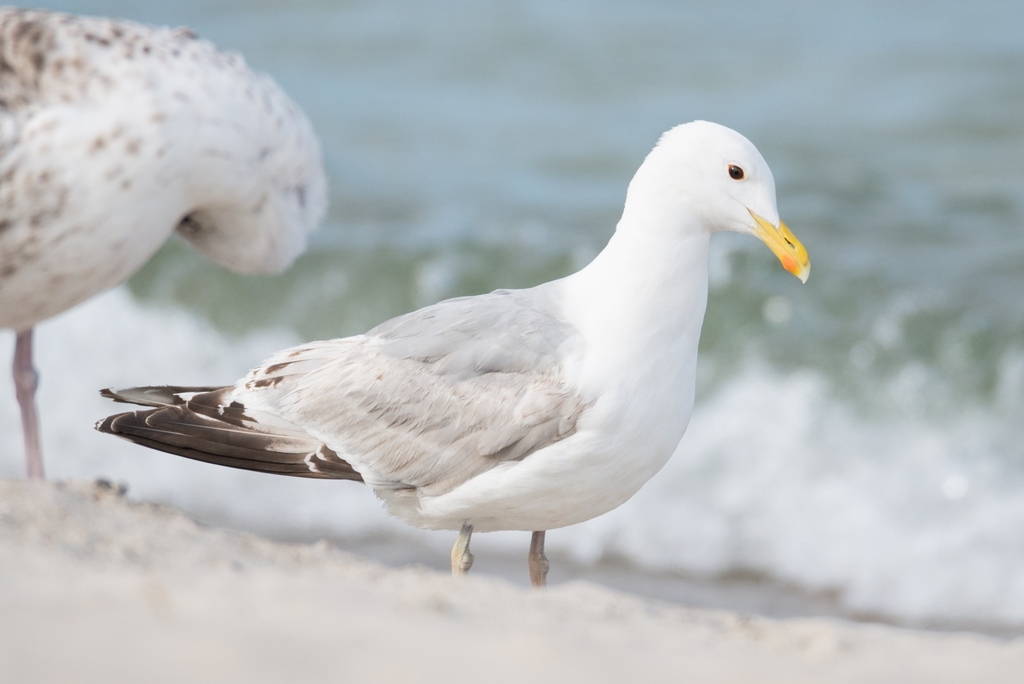
It is a large gull at 56–68 cm (22–27 in) long, with a 137 to 155 cm (54 to 61 in) wingspan and a body mass of 680–1,590 g (1.50–3.51 lb). Among standard measurements, the wing chord is 38.5 to 48 cm (15.2 to 18.9 in), the bill is 4.6 to 6.4 cm (1.8 to 2.5 in) and the tarsus is 5.8 to 7.7 cm (2.3 to 3.0 in). The Caspian gull has a long, slender bill, accentuated by the sloping forehead. The legs, wings, and neck are longer than those of the herring gull and yellow-legged gull. The eye is small and often dark, and the legs vary from pale pink to a pale yellowish colour. The back and wings are a slightly darker shade of grey than the herring gull, but slightly paler than the yellow-legged gull. The outermost primary feather has a large white tip and a white tongue running up the inner web. First-winter birds have a pale head with dark streaking on the back of the neck. The underparts are pale and the back is greyish. The greater and median wing coverts have whitish tips forming two pale lines across the wing.
Range & habitat
The Caspian gull breeds around the Black and Caspian Seas, extending eastwards across Central Asia to north-west China. In Europe, it has been spreading north and west and now breeds in Poland, eastern Germany, southern Russia and all year round in Ukraine. Some birds migrate south as far as the Red Sea and Persian Gulf, while others disperse into Western Europe, in countries such as Sweden, Norway and Denmark or the Benelux and even North of France. Small numbers are now seen regularly in Britain, especially in South-east England, East Anglia, and the Midlands.
Wikipedia: “Distribution”
What it does
They are scavengers and predators with a very varied diet. During the breeding season, they often eat rodents such as ground squirrels, flying some distance into the steppes to find them.
Wikipedia: “Feeding”
Listen
Looking for field recordings…
Where it lives
Recorded sightings
—
geo-referenced records in GBIF, from museums, herbaria and field observers.
Drag the globe to turn it. Dots are where records exist, not a range map; darker means more records.
In the stacks
Searching the stacks…
Every page naming Larus cachinnans in the Biodiversity Heritage Library →
This page is assembled live from iNaturalist, GBIF, Wikipedia, the Source Library and the Internet Archive. It is not yet part of the hand-edited codex. iNaturalist taxon 4389.