- Animals
- ›Chordates
- ›Vertebrates
- ›Mammals
- ›Therians
- ›Placental Mammals
- ›Primates, Rodents, and Allies
- ›Rodents
- ›Beavers, Pocket Gophers, and Allies
- ›Kangaroo Rats and Pocket Mice
- ›Pocket Mice
- ›Chaetodipus
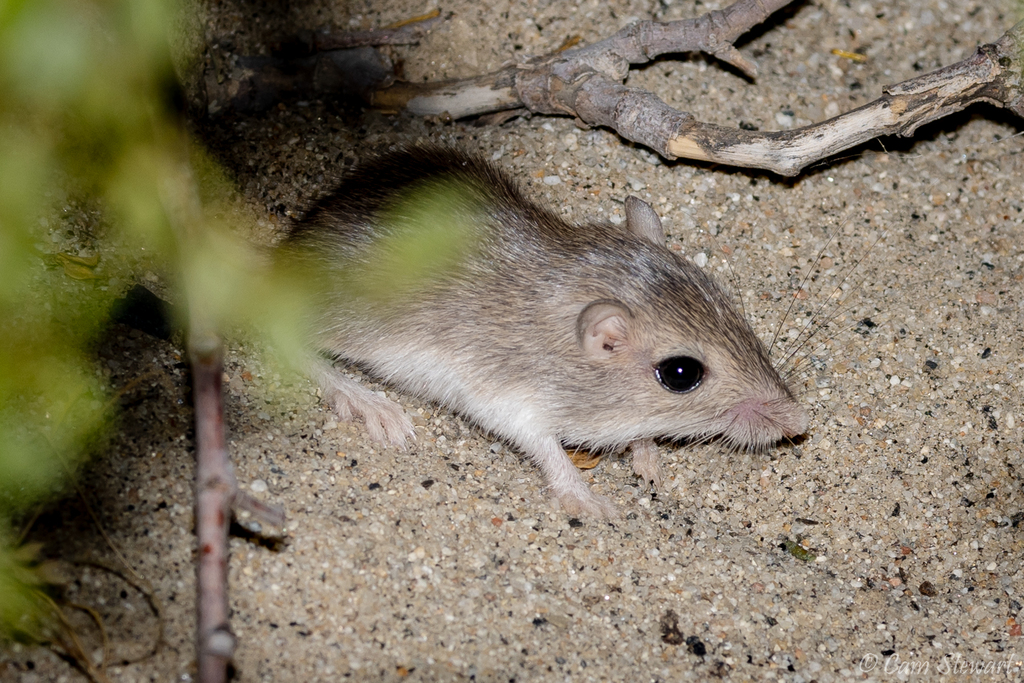
Desert Pocket Mouse
Chaetodipus penicillatus
The desert pocket mouse (Chaetodipus penicillatus) is a North American species of heteromyid rodent found in the southwestern United States and Mexico. True to its common name, the medium-sized desert pocket mouse prefers sandy, sparsely vegetated desert environments.
From the article Desert pocket mouse on Wikipedia (CC BY-SA), quoted section by section
Description
Chaetodipus penicillatus is a medium-sized pocket mouse. The total length of adults usually does not exceed 180 mm. Coloration is grayish brown to yellowish gray and may be sprinkled with black. The pelage is coarse. This species lacks rump spines but has numerous, elongate rump hairs which are darker dorsally and lighter laterally. There is no lateral line. The underparts of the body and tail are whitish. The tail is heavily crested and is longer than the head and body, with average tail length being 109 mm. The soles of the hind feet are whitish and average hind foot length is 25 mm.
Range & habitat
Chaetodipus penicillatus occurs in the southwestern United States and northern Mexico. The northern limit of its range is southern Nevada. It extends southwest into California and the northern Baja Peninsula and northwestern Mexico. Eastward it stretches into the southwesternmost parts of Colorado. From southern Nevada and southwestern Colorado the range of C. penicillatus proceeds southeast into Arizona, through southern New Mexico and southwestern Texas, and into northeastern Mexico. The desert pocket mouse prefers various arid, open desert environments, usually where the vegetation is rather sparse. These may include desert wash, desert succulent shrub, desert scrub, and alkali desert scrub. It prefers soft alluvial, sandy, or silty soils along stream bottoms, desert washes, and valleys, rather than rocky terrain. These pocket mice live in soils that may be vegetated with creosote bush, palo verde, burroweed, mesquite, cholla and other cacti, and short, sparse grass, as well as in lower edges of alluvial fan with yucca, mesquite, grama, and prickly poppy. Six subspecies are currently recognised:
C. pencillatus pencillatus - south-central Arizona C. pencillatus angustirostris - southern California, eastern Baja California C. pencillatus pricei - southern Arizona, Sonora C. pencillatus seri - Tiburón Island C. pencillatus sobrinus - southern Nevada C. …
Wikipedia: “Geographic range and habitat”
What it does
Chaetodipus penicillatus may be active all year round in some areas, though it is inactive in the winter in southern Arizona. This species is mainly nocturnal. It is aggressively solitary, with a home range of less than 1 acre. Pocket mice can burrow into hard-crusted soils by actually physically chewing their way through the hard portions of the soil. Their burrows, however, are usually excavated in silty, sandy, or gravelly soil and are used for refuges, seed storage, and neonatal care. The average lifespan of C. penicillatus is around one year.
Wikipedia: “Behavior”
Listen
Looking for field recordings…
Where it lives
Recorded sightings
—
geo-referenced records in GBIF, from museums, herbaria and field observers.
Drag the globe to turn it. Dots are where records exist, not a range map; darker means more records.
In the stacks
Searching the stacks…
Every page naming Chaetodipus penicillatus in the Biodiversity Heritage Library →
This page is assembled live from iNaturalist, GBIF, Wikipedia, the Source Library and the Internet Archive. It is not yet part of the hand-edited codex. iNaturalist taxon 44094.