- Animals
- ›Chordates
- ›Vertebrates
- ›Mammals
- ›Therians
- ›Placental Mammals
- ›Primates, Rodents, and Allies
- ›Rodents
- ›Beavers, Pocket Gophers, and Allies
- ›Kangaroo Rats and Pocket Mice
- ›Kangaroo Rats and Mice
- ›Dipodomys
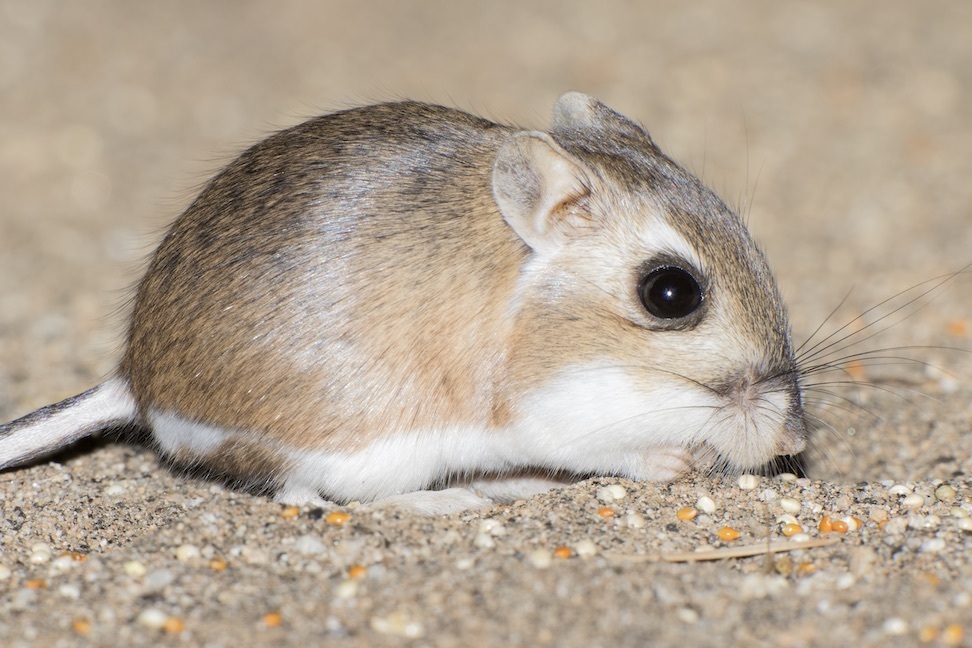
Dulzura Kangaroo Rat
Dipodomys simulans
The Dulzura kangaroo rat, or San Diego kangaroo rat (Dipodomys simulans) is a species of rodent in the family Heteromyidae. It is found in Baja California, Mexico, and in the Colorado Desert and elsewhere in California in the United States. It is a common species and the IUCN has assessed its status as being of "least concern".
From the article Dulzura kangaroo rat on Wikipedia (CC BY-SA), quoted section by section
Description
This is a medium-sized kangaroo rat with a length of 265 to 319 mm (10.4 to 12.6 in) including a tail of 155 to 203 mm (6.1 to 8.0 in). The upper parts are dark brown and the underparts white. There are five toes on the hind feet which are 43 to 46 mm (1.7 to 1.8 in) long (some related species have four toes). The tail is well-haired and has a dark streak along its under surface. Like other kangaroo rats, this species proceeds in a series of hops, using only its hind legs, and stabilising itself with its long tail. The front legs are used for digging.
Range & habitat
The species is native to southern California and northwestern Mexico, being present in much of Baja California. Its typical habitat is sandy and gravelly soils in semi-desert, dry grassland and scrub, and chaparral near the coast; it is also sometimes found in forests of pine, oak and fir.
Wikipedia: “Distribution and habitat”
What it does
The Dulzura kangaroo rat lives in a burrow which has several entrances, some of which may be at the base of shrubs. It is nocturnal, spending the day in its burrow (often blocking up the entrances) and emerging for a few hours at night. It feeds mainly on seeds, but also eats green plant material and insects, its diet varying with what is available at the time of year. It carries its food back to the burrow in its cheek pouches. It is solitary, the female defending a territory against intruders. Breeding can take place at any time of year but is more common in winter or spring. There is a single litter in the year, usually consisting of two to four offspring.
Wikipedia: “Ecology”
Listen
Looking for field recordings…
Where it lives
Recorded sightings
—
geo-referenced records in GBIF, from museums, herbaria and field observers.
Drag the globe to turn it. Dots are where records exist, not a range map; darker means more records.
In the stacks
Searching the stacks…
Every page naming Dipodomys simulans in the Biodiversity Heritage Library →
This page is assembled live from iNaturalist, GBIF, Wikipedia, the Source Library and the Internet Archive. It is not yet part of the hand-edited codex. iNaturalist taxon 44104.