- Animals
- ›Chordates
- ›Vertebrates
- ›Mammals
- ›Therians
- ›Placental Mammals
- ›Primates, Rodents, and Allies
- ›Rodents
- ›Beavers, Pocket Gophers, and Allies
- ›Kangaroo Rats and Pocket Mice
- ›Kangaroo Rats and Mice
- ›Dipodomys
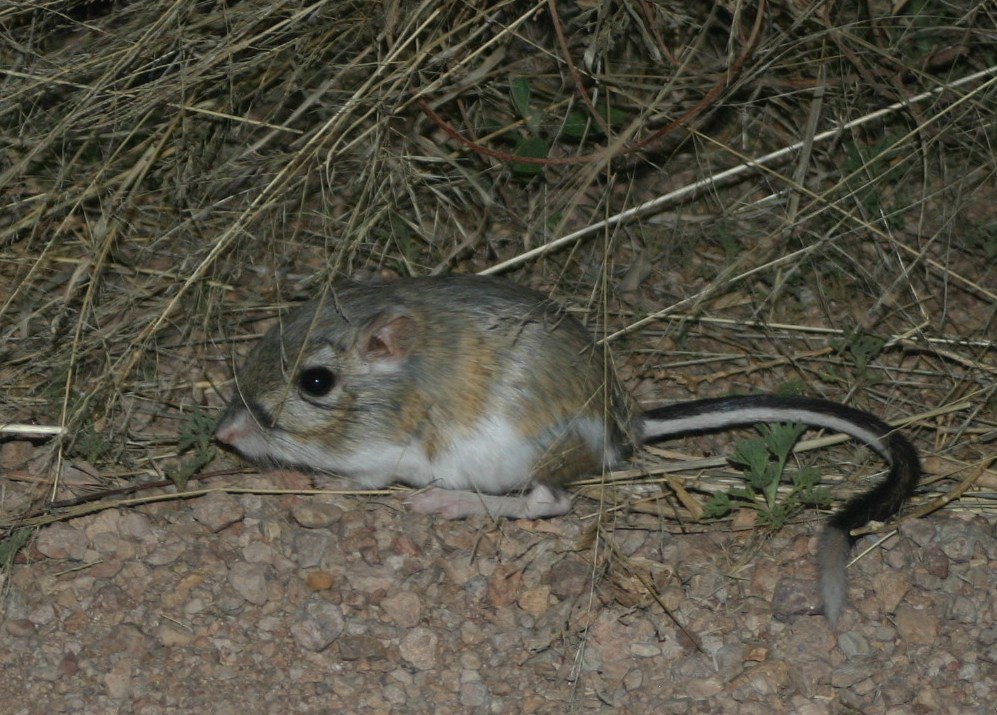
Banner-tailed Kangaroo Rat
Dipodomys spectabilis
The banner-tailed kangaroo rat (Dipodomys spectabilis) is a species of rodent in the family Heteromyidae. It is found in arid environments in the southwestern United States and Mexico where it lives in a burrow by day and forages for seeds and plant matter by night.
From the article Banner-tailed kangaroo rat on Wikipedia (CC BY-SA), quoted section by section
Description
The banner-tailed kangaroo rat can grow to a length of about 34 cm (13 in). The dorsal surface is ochre-buff with some black-tipped hairs and the underparts are white. The species' most distinctive characteristic is the black-banded, white-tipped bushy tail which is waved like a banner. The hind legs of the kangaroo rat are much longer than its forelegs and locomotion is by hopping.
Range & habitat
The banner-tailed kangaroo rat is found in the southwestern United States and Mexico in two isolated populations. The range of the larger northern population includes arid parts of western Texas, much of Arizona and northern New Mexico, and the Mexican states of Sonora, Chihuahua and Zacatecas. The southern population occurs mostly in the Mexican states of Aguascalientes and San Luis Potosí. This kangaroo rat inhabits desert grassland with isolated scrubby bushes. It dies out of an area if the shrub cover increases to over 20%.
Wikipedia: “Distribution and habitat”
What it does
The banner-tailed kangaroo rat is nocturnal and spends the day in a complex excavated burrow. On the surface, a characteristic mound develops as the animal digs and repairs tunnels, and removes old bedding, spoiled food and seed husks. The excavated material is ejected from one of several entrances and a mound builds up over time. Observations of a newly constructed tunnel system showed that a mound 3 m (10 ft) in diameter and 40 cm (16 in) high was created in about two years and that each burrow system is occupied by a single kangaroo rat. The silky pocket mouse (Perognathus flavus) sometimes shares a burrow with the banner-tailed kangaroo rat. The banner-tailed kangaroo rat feeds on seeds and other parts of plants, most notably grass seeds in the form of whole seed-heads. It caches surplus food in its burrow, and is the most assiduous hoarder among the kangaroo rats. In a research study where the rats were fitted with radio-tracking equipment, individuals had a home range of about 450 m2 (4,844 sq ft) which overlapped slightly with that of its neighbours. Kangaroo rats emerged from their burrows soon after sunset and bounded swiftly to feeding areas, foraged for two or three hours and then hurried back to its burrow where it remained. Another burst of activity occurred a couple of hours before dawn. …
Wikipedia: “Behavior”
Listen
Looking for field recordings…
Where it lives
Recorded sightings
—
geo-referenced records in GBIF, from museums, herbaria and field observers.
Drag the globe to turn it. Dots are where records exist, not a range map; darker means more records.
In the stacks
Searching the stacks…
Every page naming Dipodomys spectabilis in the Biodiversity Heritage Library →
This page is assembled live from iNaturalist, GBIF, Wikipedia, the Source Library and the Internet Archive. It is not yet part of the hand-edited codex. iNaturalist taxon 44105.