- Animals
- ›Chordates
- ›Vertebrates
- ›Mammals
- ›Therians
- ›Placental Mammals
- ›Primates, Rodents, and Allies
- ›Rodents
- ›Beavers, Pocket Gophers, and Allies
- ›Kangaroo Rats and Pocket Mice
- ›Kangaroo Rats and Mice
- ›Dipodomys
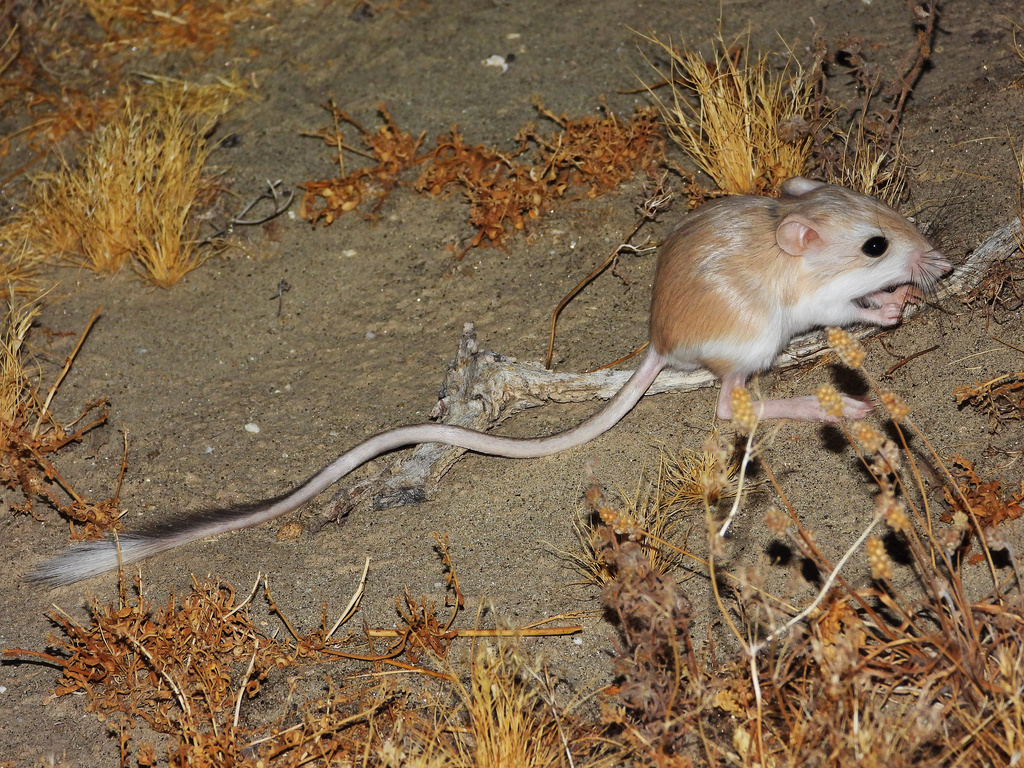
Desert Kangaroo Rat
Dipodomys deserti
The desert kangaroo rat (Dipodomys deserti) is a rodent species in the family Heteromyidae that is found in desert areas of southwestern North America. It is one of the large kangaroo rats, with a total length greater than 12 inches (300 mm) and a mass greater than 3.2 ounces (91 g).
From the article Desert kangaroo rat on Wikipedia (CC BY-SA), quoted section by section
Range & habitat
The desert kangaroo rat is found in arid parts of southwestern North America, including Death Valley, the Great Basin, the Mojave Desert, and portions of the Sonoran Desert. Though kangaroo rats persist in a variety of soils, desert kangaroo rats live exclusively in areas with loose sand, often dune terrain. The places on this list constitute some of the most extreme deserts in the United States including Death Valley, which has the record for the hottest place on the continent.
Wikipedia: “Range”
What it does
Seeds are the dominant component of the diet of desert kangaroo rats. The size of the seeds consumed by the species tends to be larger than seeds consumed by other, sympatric heteromyids. When presented with patches with variation in seed sizes and densities—which in combination vary total profitability—desert kangaroo rats tend to choose large-seed patches but reduce profitability of a set of patches to similar levels. Seed selection also appears correlated with nutritional content, with this species choosing seeds with high carbohydrate content. Although some kangaroo rats will consume green vegetation, desert kangaroo rats do not. Feeding occurs in fits and starts of movement and at relatively discrete locations, with an average distance of ~7 m (22 ft.) between stops.
Wikipedia: “Foraging ecology”
Listen
Looking for field recordings…
Where it lives
Recorded sightings
—
geo-referenced records in GBIF, from museums, herbaria and field observers.
Drag the globe to turn it. Dots are where records exist, not a range map; darker means more records.
In the stacks
Searching the stacks…
Every page naming Dipodomys deserti in the Biodiversity Heritage Library →
This page is assembled live from iNaturalist, GBIF, Wikipedia, the Source Library and the Internet Archive. It is not yet part of the hand-edited codex. iNaturalist taxon 44120.