- Animals
- ›Chordates
- ›Vertebrates
- ›Mammals
- ›Therians
- ›Placental Mammals
- ›Primates, Rodents, and Allies
- ›Rodents
- ›Beavers, Pocket Gophers, and Allies
- ›Kangaroo Rats and Pocket Mice
- ›Pocket Mice
- ›Perognathus
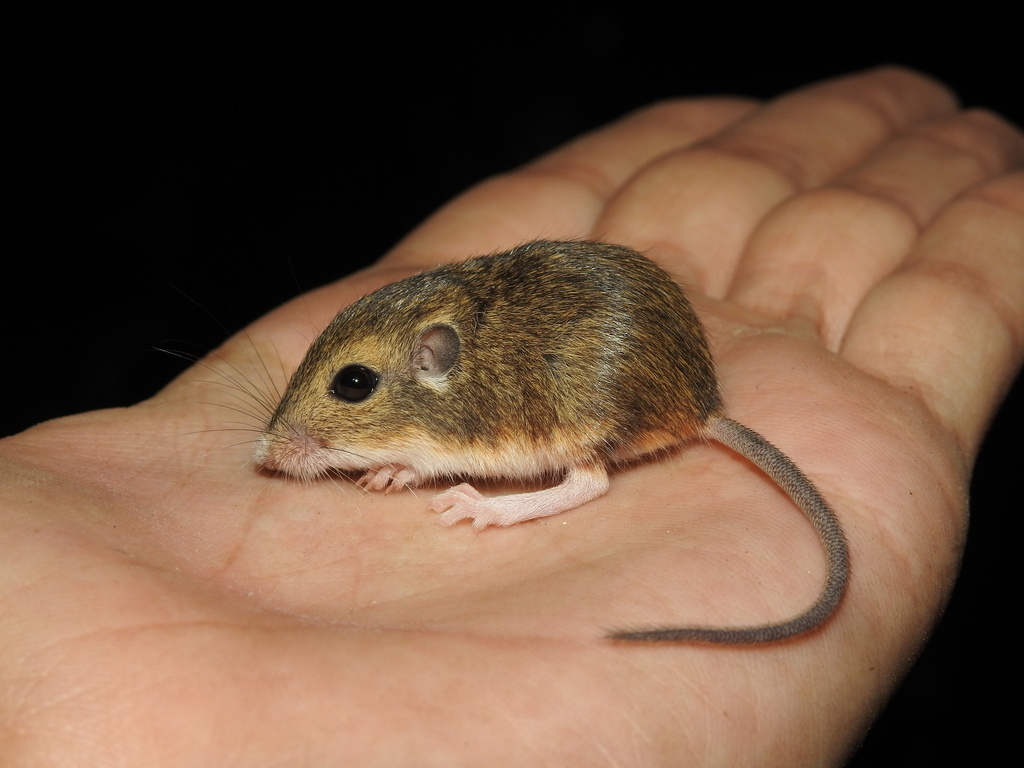
Merriam's Pocket Mouse
Perognathus merriami
Merriam's pocket mouse (Perognathus merriami) is a species of rodent in the family Heteromyidae. It is found in northeast Mexico and New Mexico, Oklahoma and Texas in the United States. Its habitat is shortgrass prairie, desert areas with scrub and arid shrubland. The species is named to honor Clinton Hart Merriam, a biologist who first described several other members of the genus Perognathus, and first elucidated the principle of a "life zone" as a means of characterizing ecological areas with similar plant and animal communities.
From the article Merriam's pocket mouse on Wikipedia (CC BY-SA), quoted section by section
Description
Merriam's pocket mouse is a small species with a smooth silky coat. Adults average 115 mm (4.5 in) in total length including a tail averaging 65 mm (2.6 in) but the size and shade vary across the animal's range. The general color is yellowish with a dark sheen caused by the longer guard hairs having black tips. The underparts, legs and feet are white or creamy in color, and the tail is paler on its undersurface. There are dark streaks on the side of the face and a pale ring surrounds the eye. There is a white spot on the inner margin of the ear, a white patch under the ear and a small buff one behind it.
What it does
Merriam's pocket mouse is mainly nocturnal and spends the day in a shallow burrow with several entrances. It excavates tunnels by digging with its forefeet and pushing soil backwards with its hind feet, spreading the spoil over the surface of the ground. There are short side tunnels, some used for depositing fecal pellets and others for storing seeds. The mouse has a home range with several burrows located within it, and sometimes conceals itself under rocks or fallen mesquite trees. An entrance to a burrow is often located at the base of a grass tussock or other plant, the roots of which stabilise the earth, and is loosely plugged with soil when the mouse is inside. In one of the burrows is a nest chamber. This has food stores round the edge and a nest of grass, small twigs and husks at one side. In Texas, breeding takes place between March and November. A litter normally consists of three to six young and there may be more than one litter in the year. At temperatures below 10 °C (50 °F) Merriam's pocket mouse becomes torpid and in some parts of Texas it may become dormant or hibernate in winter. Animals caught by live trapping on a cold night can appear dead in the morning but soon recover when warmed. The diet consists primarily of seeds which it carries back to its burrow in its cheek pouches and consumes there, leaving a littering of husks on the floor. …
Wikipedia: “Behavior”
Listen
Looking for field recordings…
Where it lives
Recorded sightings
—
geo-referenced records in GBIF, from museums, herbaria and field observers.
Drag the globe to turn it. Dots are where records exist, not a range map; darker means more records.
In the stacks
Searching the stacks…
Every page naming Perognathus merriami in the Biodiversity Heritage Library →
This page is assembled live from iNaturalist, GBIF, Wikipedia, the Source Library and the Internet Archive. It is not yet part of the hand-edited codex. iNaturalist taxon 44148.