On eBird ↗
Black Guillemot
Live sightings near you, the range map, bar charts of when it is seen, and Macaulay Library photos and recordings.
Black Guillemot
Cepphus grylle
The black guillemot or tystie (Cepphus grylle) is a medium-sized seabird of the Alcidae family, native throughout northern Atlantic coasts and eastern North American coasts. It is resident in much of its range, but large populations from the high arctic migrate southwards in winter. The bird can be seen in and around its breeding habitat of rocky shores, cliffs and islands in single or smalls groups of pairs. They feed mainly by diving towards the sea floor feeding on fish, crustaceans or other benthic invertebrates. They are listed on the IUCN red list as a species of least concern.
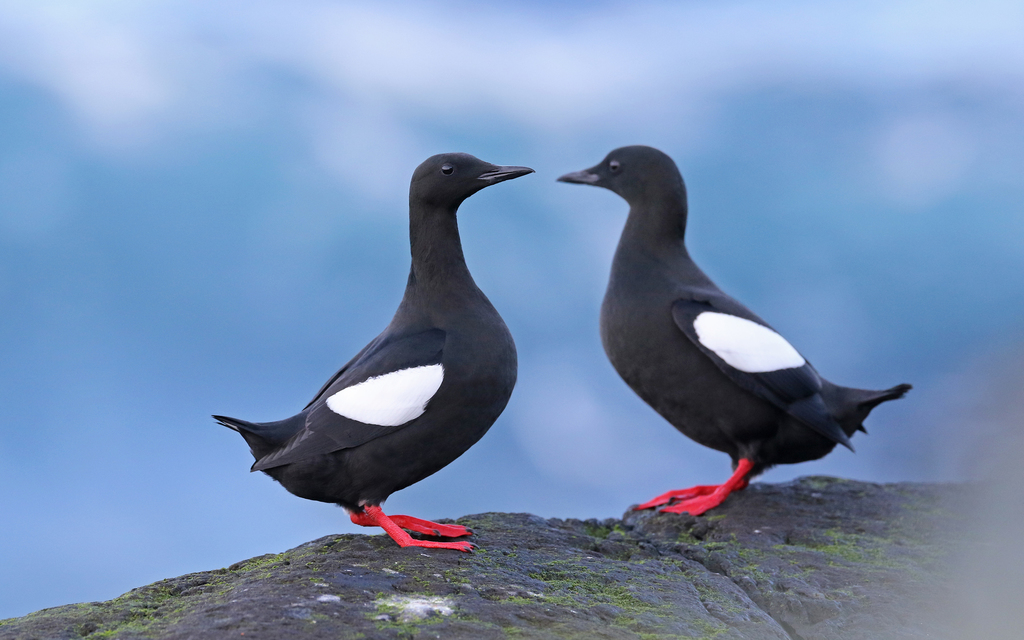
Both sexes have very similar appearances with black plumage and a large white patch on the upper side of their wings in summer. The bill is also black, being rather long and slender, while the feet are coral-red. In winter adult underparts are white and the upperparts are a pale grey with the back and shoulders exhibiting barred light grey and white patterning.
From the article Black guillemot on Wikipedia (CC BY-SA), quoted section by section
Description
The black guillemot is a medium-sized bird with adults normally 30 to 32 centimetres (12 to 12+1⁄2 inches) in length and with wingspans of 52 to 58 cm (20+1⁄2 to 23 in). The bodyweight can range from 300 to 460 grams (10+1⁄2 to 16 ounces). Adults have both summer and winter plumage and there is no sexual difference in this that can be identified in the field. The English common name "Black Guillemot" references their strikingly black breeding summer plumage which is totally black except for a large white patch on the upper side of their wings. During the summer plumage, their legs, feet and inside of the mouth are all a bright coral-red, and their beak is black. Adults lose their summer plumage in an early fall moult where their upper plumage become barred with light grey and white, their head is a pale grey, their underparts white, and legs and feet a pale red. They retain their white wing patch, black beak and red inside their mouth. The call in the breeding season is a high whistle. The red gape is also prominent then. Juveniles and immatures can easily be identified by the spotting of the white wing patch with grey or brown feathers and is easy to see even at far distances in the field.
Range & habitat
The black guillemot is a circumpolar species distributed in the boreal, low arctic and high arctic regions of the north Atlantic and arctic oceans and breeding between 43° and 82°N. The 5 listed subspecies inhabit different parts of this range. In North America, they can be found as far south as the Gulf of Maine and New England and across parts of the northern coast of North America as far as Alaska, where they are replaced by the pigeon guillemot in the North Pacific. In Europe and Asia, they are found from the British Isles and Northward across the northern coast of Asia. They are one of the few birds to breed on Surtsey, Iceland, a new volcanic island. It is a fairly common breeding bird around the coast of Ireland, and in western and northern Scotland. In the remainder of Britain, they only breed at St. Bees Head in Cumbria, the Isle of Man and on east Anglesey in north Wales. Approximately 40% of the population breeds in the high arctic where the largest colonies are found, 30% in the low arctic, and 30% in boreal waters. In the winter, some of the birds in the high arctic waters are forced south by the winter ice making them seasonal migrants, but in more temperate zones the species is essentially resident. Typically restricted to rocky shores, black guillemots utilize the cliffs, crevices and boulders for their nests, hunting the inshore waters for benthic prey. …
Wikipedia: “Distribution and habitat”
What it does
One of the early ornithologists that described aspects of the behaviour of the black guillemot was Edmund Selous (1857–1934) in his book The Bird Watcher in the Shetlands (1905). In the chapter titled 'From the Edge of a Precipice' he writes for instance that sometimes the black guillemots carry a fish they have caught in their beak for hours. He also gives further details about the behaviour. Black guillemots are coastal foragers with diets typically associated with benthic and kelp-forest prey. They dive between 15-20m to catch their prey, but can dive to a depth of at least 43m. They use their wings to propel themselves forward and their feet to steer. Small prey are swallowed underwater whole. Guillemots bring larger prey to the surface to soften in their bill before swallowing whole. Guillemots are single-prey loaders, meaning they bring single prey items back to their chicks during the chick-rearing period. This limits the spatial range that parents can forage for food, as chicks must receive a high number of energy-rich prey items throughout each day. Black guillemot diets include sculpins, butterfish, rock gunnel, northern sandlance, herring, jellyfish, mollusks, and other small crustaceans.
Wikipedia: “Behaviour”
Listen
Looking for field recordings…
Where it lives
Recorded sightings
—
geo-referenced records in GBIF, from museums, herbaria and field observers.
Drag the globe to turn it. Dots are where records exist, not a range map; darker means more records.
In the stacks
Searching the stacks…
Every page naming Cepphus grylle in the Biodiversity Heritage Library →
This page is assembled live from iNaturalist, GBIF, Wikipedia, the Source Library and the Internet Archive. It is not yet part of the hand-edited codex. iNaturalist taxon 4418.