- Animals
- ›Chordates
- ›Vertebrates
- ›Mammals
- ›Therians
- ›Placental Mammals
- ›Primates, Rodents, and Allies
- ›Rodents
- ›Mice, Rats, and Hamsters
- ›Muroids
- ›Hamsters, Voles, Lemmings, and Allies
- ›South American Mice and Rats
- ›Rice Rats
- ›Oryzomys
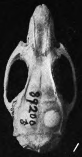
Tres Marías Rice Rat
Oryzomys nelsoni
Oryzomys nelsoni, also known as the Nelson’s rice rat, is an extinct rodent of María Madre Island, Nayarit, Mexico. Within the genus Oryzomys of the family Cricetidae, it may have been most closely related to the mainland species O. albiventer. Since its first description in 1898, most authors have regarded it as a distinct species, but it has also been classified as a mere subspecies of the marsh rice rat (O. palustris).
After its discovery in 1897, it has never been recorded again and it is now considered extinct; the presence of introduced black rats on María Madre may have contributed to its extinction. O. nelsoni was a large species, distinguished in particular by its long tail, robust skull, and large incisors. It was reddish to yellowish above and mostly white below. Its diet may have included plant material and small animals.
From the article Oryzomys nelsoni on Wikipedia (CC BY-SA), quoted section by section
Description
O. nelsoni was a large and long-tailed Oryzomys; its tail was longer than that of any other western Mexican Oryzomys. The upperparts were ochraceous to buff, most richly so on the rump, and paler further to the front and low on the flanks. On the head and the back, blackish hairs somewhat darkened the overall color. The underparts were white, with lead-colored underfur that was visible in some places. The ears were covered on both sides with scanty grayish hairs. The large hindfeet were sparsely covered with pale hairs. The tail was largely dark, but the underside of the basal one third to one half was light yellow. O. nelsoni was distinctive in its large skull with broad, well-developed incisors and a strong front part (rostrum) that is strongly curved downwards. In O. albiventer, the rostrum and incisors were not as massive, but the molars are larger. The interparietal bone, part of the roof of the braincase, was broad and the incisive foramina, which perforated the palate between the incisors and the molars, were relatively short. Total length in the four known specimens is 282 to 344 mm (11.1 to 13.5 in), averaging 322 mm (12.7 in); head and body length is 122 to 153 mm (4.8 to 6.0 in), averaging 140.5 mm (5.53 in); tail length is 160 to 191 mm (6.3 to 7.5 in), averaging 181.5 mm (7.15 in); and hindfoot length is 35 to 39 mm (1.4 to 1.5 in), averaging 37.3 mm (1.47 in).
What it does
Nelson and Goldman found the species only in a damp, herbaceous site now known as the "Sacatal" near a spring high on María Madre Island, the largest of the Islas Marías off the coast of Nayarit, western Mexico, and Nelson wrote that it was rare. He gave the elevation of this place as 1800 ft, which Álvarez-Castañeda and Méndez converted to 550 m, but in his 1918 paper, Goldman gave 800 ft instead, which Carleton and Arroyo-Cabrales in 2009 converted to 245 m. The next survey of small mammals on the island took place in March 1976 by a team led by Don E. Wilson. They failed to collect O. nelsoni and instead found only the introduced black rat (Rattus rattus) at the locality where Nelson and Goldman had collected O. nelsoni; this species may have contributed to the decline of the indigenous rodent. The species is now considered extinct, although as late as 2002 the Mexican government listed it as "threatened". Another Islas Marías endemic, the deermouse Peromyscus madrensis, still occurred on María Madre in 1976. O. nelsoni is thought to have fed on plant material such as weeds, fruit, and seeds, and more rarely on animals such as fish and invertebrates.
Wikipedia: “Ecology and extinction”
Listen
Looking for field recordings…
Where it lives
Recorded sightings
—
geo-referenced records in GBIF, from museums, herbaria and field observers.
Drag the globe to turn it. Dots are where records exist, not a range map; darker means more records.
In the stacks
Searching the stacks…
Every page naming Oryzomys nelsoni in the Biodiversity Heritage Library →
This page is assembled live from iNaturalist, GBIF, Wikipedia, the Source Library and the Internet Archive. It is not yet part of the hand-edited codex. iNaturalist taxon 44454.