- Animals
- ›Chordates
- ›Vertebrates
- ›Mammals
- ›Therians
- ›Placental Mammals
- ›Primates, Rodents, and Allies
- ›Rodents
- ›Mice, Rats, and Hamsters
- ›Muroids
- ›Old World Mice and Rats
- ›Murines
- ›Typical Old World Rats
- ›Rattus
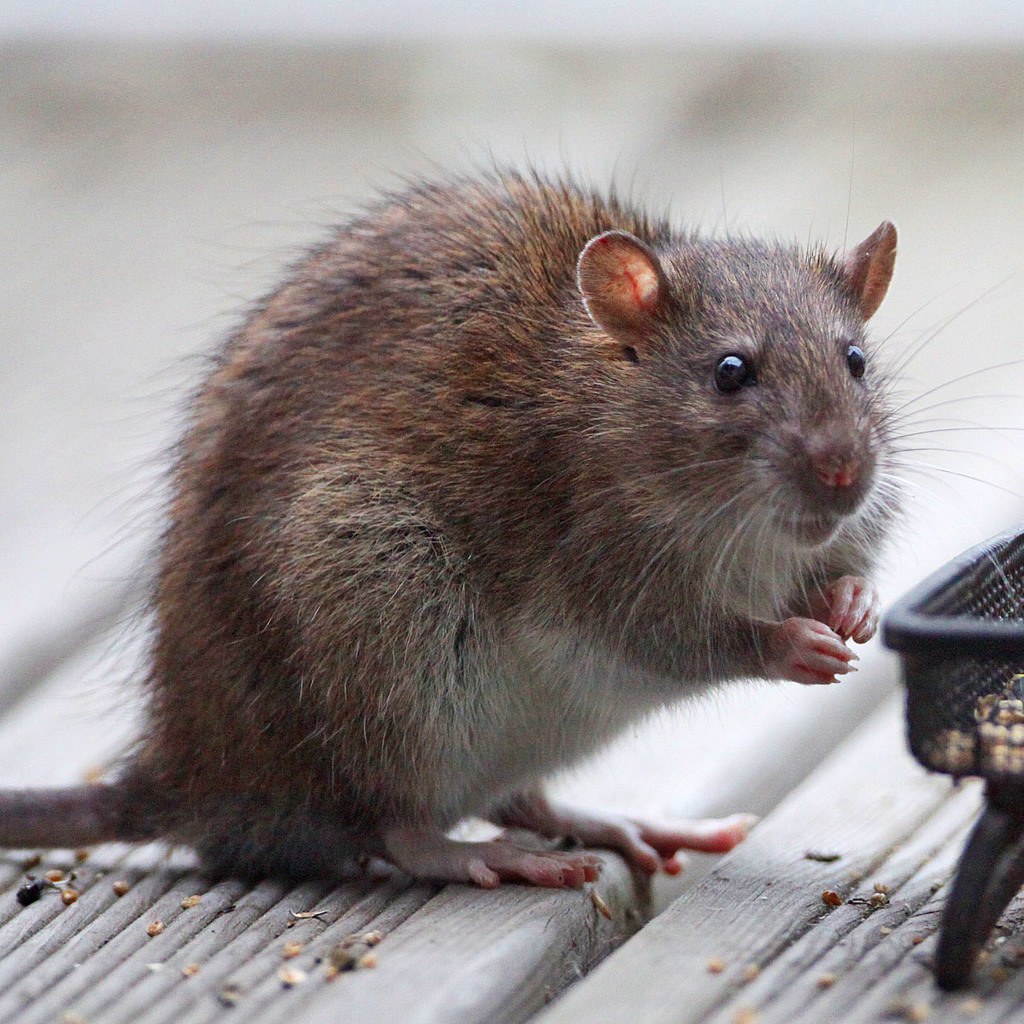
Brown Rat
Rattus norvegicus
The brown rat (Rattus norvegicus), also known as the common rat, street rat, sewer rat, wharf rat, Hanover rat, Norway rat and Norwegian rat, is a widespread, common species of rat. One of the largest muroids, it is a brown or grey rodent with a body length of up to 28 cm (11 in) long, and a tail slightly shorter than that. It weighs between 140 and 500 g (4.9 and 17.6 oz). Thought to have originated in northern China and neighbouring areas, it has now spread to all continents except Antarctica, and is the dominant rat in Europe and much of North America, having become naturalised across the world. With rare exceptions, the brown rat lives wherever humans live, particularly in urban areas. It is omnivorous, reproduces rapidly, and can be a vector for several human diseases.
Selective breeding of the brown rat has produced the fancy rat (rats kept as pets), as well as the laboratory rat (rats used as model organisms in biological research). Both fancy rats and laboratory rats are of the domesticated subspecies Rattus norvegicus domestica. Studies of wild rats in New York City have shown that populations living in different neighborhoods can evolve distinct genomic profiles over time, by slowly accruing different traits.
From the article Brown rat on Wikipedia (CC BY-SA), quoted section by section
Description
The brown rat's fur is usually brown or dark grey, while the underparts are lighter grey or brown. The brown rat is a rather large murid and can weigh twice as much as a black rat (R. rattus) and many times more than a house mouse (Mus musculus). The head and body length ranges from 15 to 28 cm (5.9 to 11.0 in) while the tail ranges in length from 10.5 to 24 cm (4.1 to 9.4 in), therefore being shorter than the head and body. Adult weight ranges from 140 to 500 g (4.9 to 17.6 oz). Large individuals can reach 800 g (28 oz) but are not expected outside of domestic specimens. Stories of rats attaining sizes as big as cats are exaggerations, or misidentifications of larger rodents. It is common for breeding wild brown rats to weigh less than 300 g (11 oz). The heaviest live brown rat on record is 822 g (29 oz) and they can reach a maximum length of 482.5 mm (19 in). The brown rat has acute hearing, is sensitive to ultrasound, and possesses a very highly developed olfactory sense. Its average heart rate is 300 to 400 beats per minute, with a respiratory rate of around 100 per minute. The vision of a pigmented rat is poor, around 20/600, while a non-pigmented with no melanin in its eyes has both around 20/1200 vision and a terrible scattering of light within its vision. …
Range & habitat
Possibly originating from the plains of northern China and Mongolia, the brown rat spread to other parts of the world sometime in the Middle Ages. The question of when brown rats became commensal with humans remains unsettled, but as a species, they have spread and established themselves along routes of human migration, and they now primarily share their habitat with humans. The brown rat may have been present in Europe as early as 1553, a conclusion drawn from an illustration and description by Swiss naturalist Conrad Gessner in his book Historiae animalium, published 1551–1558. Though Gesner's description could apply to the black rat, his mention of a large percentage of albino specimens—not uncommon among wild populations of brown rats—adds credibility to this conclusion. Reliable reports dating to the 18th century document the presence of the brown rat in Ireland in 1722, England in 1730, France in 1735, Germany in 1750, and Spain in 1800, becoming widespread during the Industrial Revolution. It did not reach North America until around 1750–1755.
As it spread from Asia, the brown rat generally displaced the black rat in areas where humans lived. In addition to being larger and more aggressive, the change from wooden structures and thatched roofs to bricked and tiled buildings favored the burrowing brown rats over the arboreal black rats. …
Wikipedia: “Distribution and habitat”
What it does
The brown rat is nocturnal and is a good swimmer, both on the surface and underwater, and has been observed climbing slim round metal poles several feet in order to reach garden bird feeders. Brown rats dig well, and often excavate extensive burrow systems. A 2007 study found brown rats to possess metacognition, a mental ability previously only found in humans and some other primates, but further analysis suggested they may have been following simple operant conditioning principles.
Communication. Brown rats are capable of producing ultrasonic vocalizations. As pups, young rats use different types of ultrasonic cries to elicit and direct maternal search behavior, as well as to regulate their mother's movements in the nest. Although pups produce ultrasounds around any other rats at the age of 7 days, by 14 days old they significantly reduce ultrasound production around male rats as a defensive response. Adult rats will emit ultrasonic vocalizations in response to predators or perceived danger; the frequency and duration of such cries depends on the sex and reproductive status of the rat. The female rat also emits ultrasonic vocalizations during mating. Rats may also emit short, high frequency, ultrasonic, socially induced vocalization during rough and tumble play, before receiving morphine, or mating, and when tickled. …
Wikipedia: “Biology and behavior”
At the table
Selective breeding of white-marked rats rescued from being killed in a now-outlawed sport called rat baiting has produced the pink-eyed white laboratory rat. Like mice, these rats are frequently subjects of medical, psychological and other biological experiments, and constitute an important model organism. This is because they grow quickly to sexual maturity and are easy to keep and to breed in captivity. When modern biologists refer to "rats", they almost always mean Rattus norvegicus.
Wikipedia: “Uses in science”
In human culture
The brown rat was originally called the "Hanover rat" by people wishing to link problems in 18th-century England with the House of Hanover. It is not known for certain why the brown rat is named Rattus norvegicus (Norwegian rat), as it did not originate from Norway. However, the English naturalist John Berkenhout, author of the 1769 book Outlines of the Natural History of Great Britain, is most likely responsible for popularizing the misnomer. Berkenhout gave the brown rat the binomial name Mus norvegicus, believing it had migrated to England from Norwegian ships in 1728. By the early to the middle part of the 19th century, British academics believed that the brown rat was not native to Norway, hypothesizing (incorrectly) that it may have come from Ireland, Gibraltar or across the English Channel with William the Conqueror. As early as 1850, however, a new hypothesis of the rat's origins was beginning to develop. The British novelist Charles Dickens acknowledged this in his weekly journal, All the Year Round, writing:
It is frequently called, in books and otherwise, the 'Norway rat', and it is said to have been imported into this country in a ship-load of timber from Norway. …
Wikipedia: “Naming and etymology”
Listen
Looking for field recordings…
Where it lives
Recorded sightings
—
geo-referenced records in GBIF, from museums, herbaria and field observers.
Drag the globe to turn it. Dots are where records exist, not a range map; darker means more records.
In the stacks
Searching the stacks…
Every page naming Rattus norvegicus in the Biodiversity Heritage Library →
This page is assembled live from iNaturalist, GBIF, Wikipedia, the Source Library and the Internet Archive. It is not yet part of the hand-edited codex. iNaturalist taxon 44576.