- Animals
- ›Chordates
- ›Vertebrates
- ›Ray-finned Fishes
- ›Spiny-rayed fishes
- ›Blennies, Damselfishes and Allies
- ›Blennies
- ›Kelp Blennies
- ›Cirrhibarbis
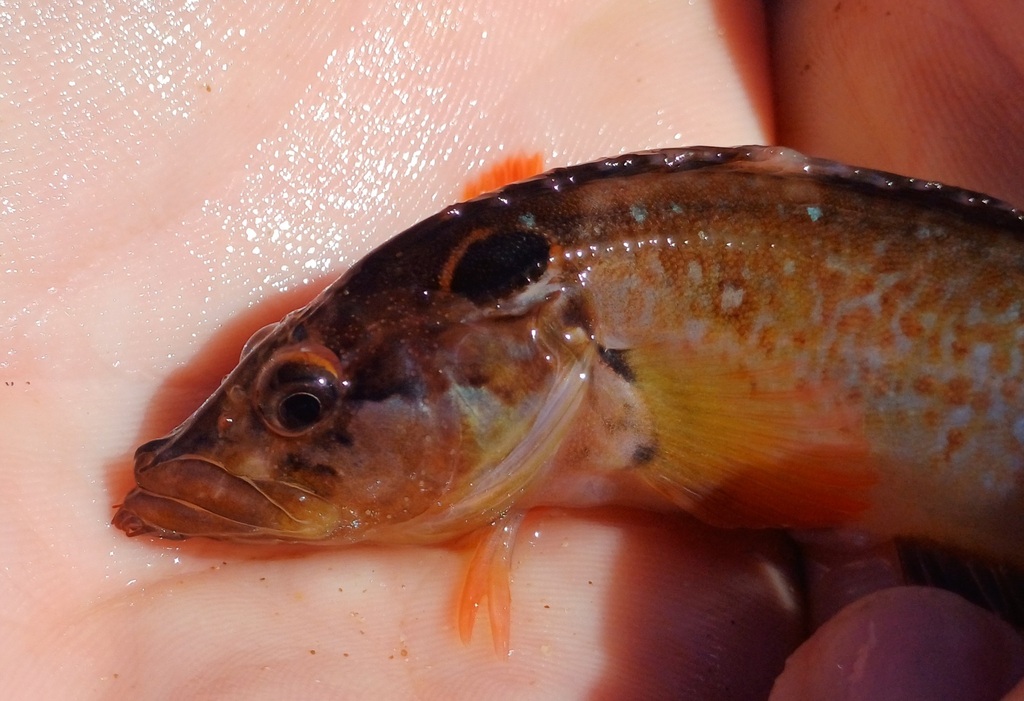
Barbelled Klipfish
Cirrhibarbis capensis
Cirrhibarbis capensis, the barbelled klipfish, is a species of clinid found in subtropical waters of the Atlantic Ocean around South Africa. This species can reach a maximum length of 36 centimetres (14 in) TL. This species preys primarily on benthic crustaceans, mostly amphipods and isopods. It is currently the only known member of its genus.
From the article Cirrhibarbis on Wikipedia (CC BY-SA), quoted section by section
Description
Fins: Dorsal fin spines 37 to 44, rays 5 to 9; Anal fin spines 2, rays 26 to 34; Pectoral fin rays 12 to 14; Ventral fin spines 1, rays 2 to 3. Gill rakers (2 to 3)+(5 to 7). Vertebrae (18 to 21)+(32 to 37). Lateral line with about 30 vertical pairs of pores in front. Body depth 5 to 6 in Standard length. Head length 3.5 to 4.5 in Standard length. Eye 3.5 to 5.5 diameters in head length. Caudal peduncle 20 to 30% head length, depth 18 to 26% head length. Shape: The body is elongate and slightly compressed. The head profile is straight or slightly concave, with a long and pointed snout. Pores on the head are clearly visible. The mouth is wide, with thick lips. The jaws are slightly pointed and the lower jaw projects beyond the upper jaw which has a row of 3 plain barbels at the front, which are joined at the base and spread widely once separated. The 8 barbels on the chin are usually arranged in a circular group of 6, but sometimes in 2 rows of 3 each, with 2 barbels a little to the rear and further apart individually. The space between the eyes is convex. There is a prominent short palmate tentacle with from 4 to 12 cirri at the end at the upper rear of each eye, and a large, spatulate, tentacle at each forward nostril. with about four shallow, flat lobes at the tip. …
Range & habitat
South African endemic. Rare west of Cape Point to Lamberts Bay, common from False Bay to East London. Seen mostly in False Bay, from Fish Hoek to Batsata rock, all locations, but especially the wreck of the Clan Stuart and at Windmill and A-Frame. Rarer on Atlantic seaboard, but have been seen at the V&A waterfront off Oceana Powerboat club, and along the Sea Point coast. Depth of these sighting were from close to the surface to about 15m depth. Juveniles were seen in very shallow water (1m or less) at the Knysna Heads. Extreme juveniles and young specimens were seen in shallow water, under rocks, and in rock pools.
Wikipedia: “Distribution”
In human culture
Capensis: from Cape, referring to the region where originally caught.
== References ==
Wikipedia: “Etymology”
Where it lives
Recorded sightings
—
geo-referenced records in GBIF, from museums, herbaria and field observers.
Drag the globe to turn it. Dots are where records exist, not a range map; darker means more records.
In the stacks
Searching the stacks…
Every page naming Cirrhibarbis capensis in the Biodiversity Heritage Library →
This page is assembled live from iNaturalist, GBIF, Wikipedia, the Source Library and the Internet Archive. It is not yet part of the hand-edited codex. iNaturalist taxon 445781.