- Animals
- ›Chordates
- ›Vertebrates
- ›Ray-finned Fishes
- ›Spiny-rayed fishes
- ›Butterflyfishes, Angelfishes, and Allies
- ›Seabreams and Porgies
- ›Crenidens
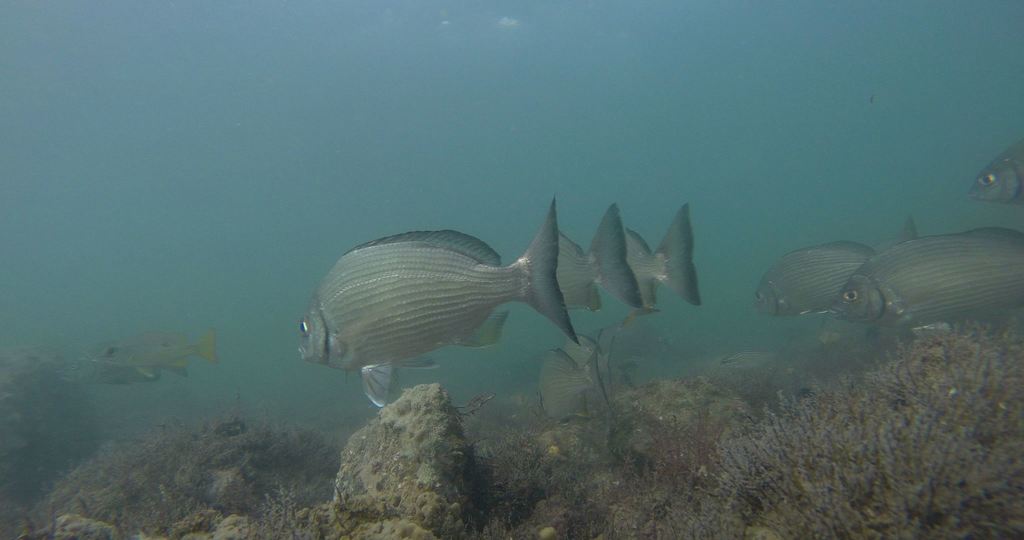
Karanteen Seabream
Crenidens crenidens
Crenidens crenidens, the karanteen seabream or karanteen, is a species of ray-finned fish from the sea bream family Sparidae which was described by the Swedish zoologist Peter Forsskål in 1775. It is native to the western Indian Ocean but has colonised the eastern Mediterranean Sea since 1970. It is one of only three species in genus Crenidens, the others being the little known Crenidens macracanthus and the partially sympatric C. indicus.
From the article Crenidens crenidens on Wikipedia (CC BY-SA), quoted section by section
Description
Crenidens crenidens has an oblong to ovoid shaped body which is slightly compressed. Smaller adults, less than 19.7 cm in length, show a nose like bump in front of the eye. The mouth extends back to the anterior nostril and there are three rows of teeth in each jaw, the upper front jaw has 8-9 brown-tipped incisor like teeth, each bearing five denticulations which give the edge of the teeth a wavy appearance. The inner rows have a few teeth of similar form but the other teeth are granular. The scales finely ctenoid, the scaly cheeks contrasting with the scaleless interorbital region. The dorsal fin has eleven each of spiny and soft rays, while the anal fin has three spiny and ten soft rays. The caudal fin is forked. There are 52-60 scales making up the lateral line. C. crenidens is silvery greenish-blue or olive in colour with darker narrow longitudinal stripes created by dark spots on the scales which are above the level of pectoral fins; the fins are coloured dull yellowish or olive with a dark margin on the dorsal fin and infrequently the axil pectoral fin shows darkish axils. They can grow to 30 cm in length in their native range, although the maximum in the Mediterranean is 20 cm, the more usual measurement is between 10 and 16 cm in length.
Range & habitat
Crenidens crenidens is indigenous to the western Indian Ocean from the Red Sea south along the coast of eastern Africa South Africa and has been also reported from southern Madagascar. In 1970 it was recorded for the first time in the Mediterranean in the Bardawil Lagoon (northern Egypt) and has since spread to Israel and to Libya. The most likely route for this species to have followed to colonise the Mediterranean is through the Suez Canal.
Wikipedia: “Distribution”
At the table
Crenidens crenidens is caught all year round in the northern Indian Ocean using trammel nets and beach seines and is consumed fresh, however, in the southern part of that Ocean it is fished mainly for bait.
== References ==
Wikipedia: “Uses”
Where it lives
Recorded sightings
—
geo-referenced records in GBIF, from museums, herbaria and field observers.
Drag the globe to turn it. Dots are where records exist, not a range map; darker means more records.
In the stacks
Searching the stacks…
Every page naming Crenidens crenidens in the Biodiversity Heritage Library →
This page is assembled live from iNaturalist, GBIF, Wikipedia, the Source Library and the Internet Archive. It is not yet part of the hand-edited codex. iNaturalist taxon 445835.