- Animals
- ›Chordates
- ›Vertebrates
- ›Ray-finned Fishes
- ›Spiny-rayed fishes
- ›Butterflyfishes, Angelfishes, and Allies
- ›Seabreams and Porgies
- ›Diplodus
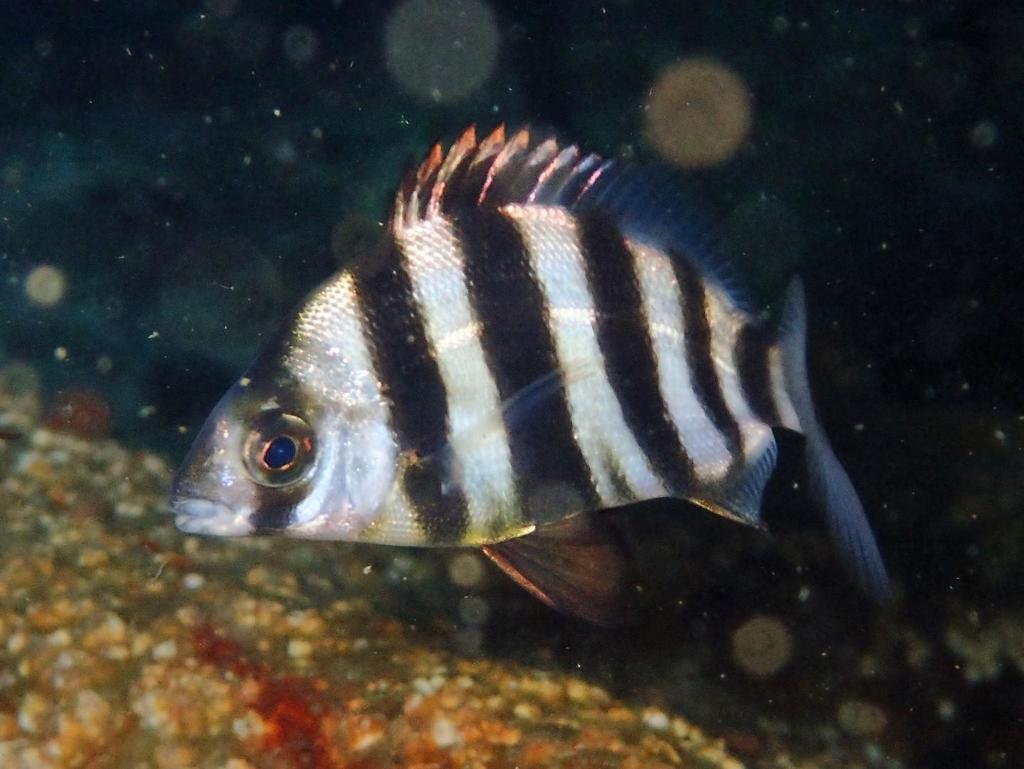
Zebra Seabream
Diplodus hottentotus
Diplodus hottentotus, the zebra, is a species of marine ray-finned fish belonging to the family Sparidae, which includes the seabreams and porgies. This fish is found in the Western Indian Ocean off Southern Africa.
From the article Diplodus hottentotus on Wikipedia (CC BY-SA), quoted section by section
Description
Diplodus hottentotus has a deep, oval and compressed body with a depth that fits into the standard length between 2 and 2.3 times. The dorsal fin is supported by 11 spines and 12 or 13 soft rays while the anal fin is supported by 3 spines and 11 soft rays. There are 15 fin rays on the pectoral fins. The upper jaw has 10 or 12 incisor-like teeth in the front of the upper jaw and 8 in the lower jaw. The background colour of the body is bright yellow with 5 wide vertical dark bars along the back and flanks, the snout is black and the gill cover is grey. The fins are grey too, except in juveniles which have a pink caudal fin with a black bar at its base. The maximum published total length for this species is 60 cm (24 in), although 30 cm (12 in) is more typical.
Range & habitat
Diplodus hottentotus is found in the southwestern Indian Ocean off the south and eastern coasts of South Africa and southern Mozambique. There is a disjunct population in the southeastern Atlantic Ocean off Angola which may be taxonomically distinct. The zebra is a sedentary fish that is found in rocky habitats from the surf-zone as deep as 120 m (390 ft) in submarine canyons. The juveniles are also very sedentary and occur on shallow reefs in below the low tide mark, gullies, tidal pools and in the mouths of estuaries.
Wikipedia: “Distribution and habitat”
In human culture
Diplodus hottentotus has the specific name hottentotus, a latinisation of the pejorative term hottentot, a name given by the original Dutch colonists to the Cape to the indigenous people of that region. In this case it is thought to be geographical, referring to the South African coast.
Wikipedia: “Etymology”
Where it lives
Recorded sightings
—
geo-referenced records in GBIF, from museums, herbaria and field observers.
Drag the globe to turn it. Dots are where records exist, not a range map; darker means more records.
In the stacks
Searching the stacks…
Every page naming Diplodus hottentotus in the Biodiversity Heritage Library →
This page is assembled live from iNaturalist, GBIF, Wikipedia, the Source Library and the Internet Archive. It is not yet part of the hand-edited codex. iNaturalist taxon 445869.