- Animals
- ›Chordates
- ›Vertebrates
- ›Birds
- ›Shorebirds and Allies
- ›Gulls, Terns, and Skimmers
- ›True Terns
- ›Sterna
On eBird ↗
Black-bellied Tern
Live sightings near you, the range map, bar charts of when it is seen, and Macaulay Library photos and recordings.
Black-bellied Tern
Sterna acuticauda
The black-bellied tern (Sterna acuticauda) is a tern found near large rivers in the Indian subcontinent, its range extending from Pakistan, Nepal and India to Myanmar. It has become very scarce in the eastern part of its range and the International Union for Conservation of Nature has assessed its conservation status as being endangered.
They have a black belly in the summer and a deep forked tail. They can sometimes resemble whiskered terns (Chlidonias hybrida), but the deeper fork of the tail and the black on the lower belly distinguish them from the shallow fork and black closer to the breast on the whiskered tern. Considering that sequence analysis supports moving the similar black-fronted tern ("Sterna" albostriata) into Chlidonias, this species might also be better placed in that genus, but no research has yet been conducted.
From the article Black-bellied tern on Wikipedia (CC BY-SA), quoted section by section
Description
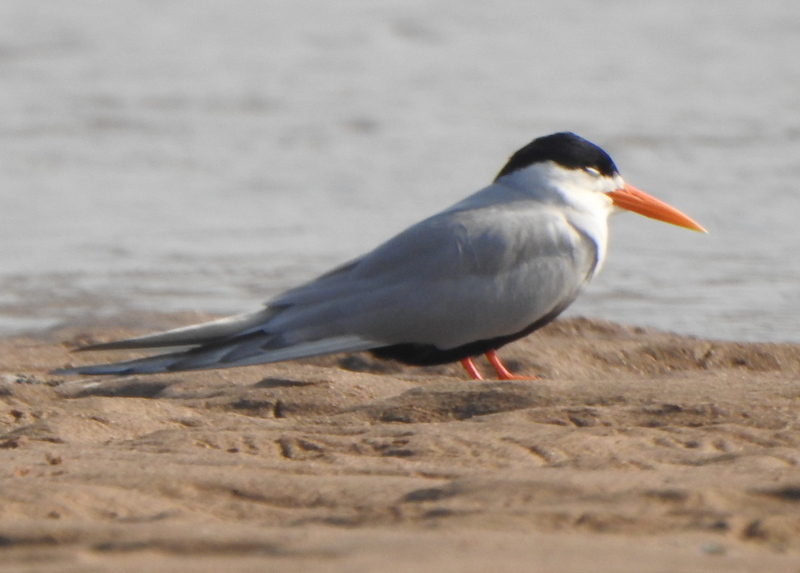
The black-bellied tern grows to a length of 32 to 35 cm (13 to 14 in). In the breeding plumage, the crown and nape are black and the upper parts are pale grey. The throat is white and the breast pale grey, gradually darkening to a black belly. The wings are long, slender and pointed and the tail is deeply forked with sharply pointed tips. The bill and feet are yellow or orange and the iris is reddish brown. Outside the breeding season, the belly is whitish, the tail is reduced in length and the bill has a dark tip.
Range & habitat
The species occurs mostly in Pakistan, Nepal, India and Bangladesh, with a separate range in Myanmar. Its typical habitat is lowland rivers and marshes, and sometimes ditches and pools, at altitudes of up to about 700 m (2,300 ft). It is an entirely inland species and is not found on the coast.
Wikipedia: “Distribution and habitat”
What it does
The black-bellied tern has long wings but its flight is slow, with much flapping. It feeds on insects and small fish, skimming over the surface of the water and ground to pick up insects, and plunging obliquely into the water to feed on crustaceans, tadpoles and fish. Breeding takes place from February to April, the nesting site usually being a flat sandy location near a river or lake, a sand spit or a sandy island. It does not nest colonially but may nest with other birds such as river terns (Sterna aurantia), pratincoles (Glareola spp.) and Indian skimmers (Rynchops albicollis).
Wikipedia: “Ecology”
Listen
Looking for field recordings…
Where it lives
Recorded sightings
—
geo-referenced records in GBIF, from museums, herbaria and field observers.
Drag the globe to turn it. Dots are where records exist, not a range map; darker means more records.
In the stacks
Searching the stacks…
Every page naming Sterna acuticauda in the Biodiversity Heritage Library →
This page is assembled live from iNaturalist, GBIF, Wikipedia, the Source Library and the Internet Archive. It is not yet part of the hand-edited codex. iNaturalist taxon 4461.