- Animals
- ›Chordates
- ›Vertebrates
- ›Ray-finned Fishes
- ›Spiny-rayed fishes
- ›Butterflyfishes, Angelfishes, and Allies
- ›Seabreams and Porgies
- ›Lithognathus
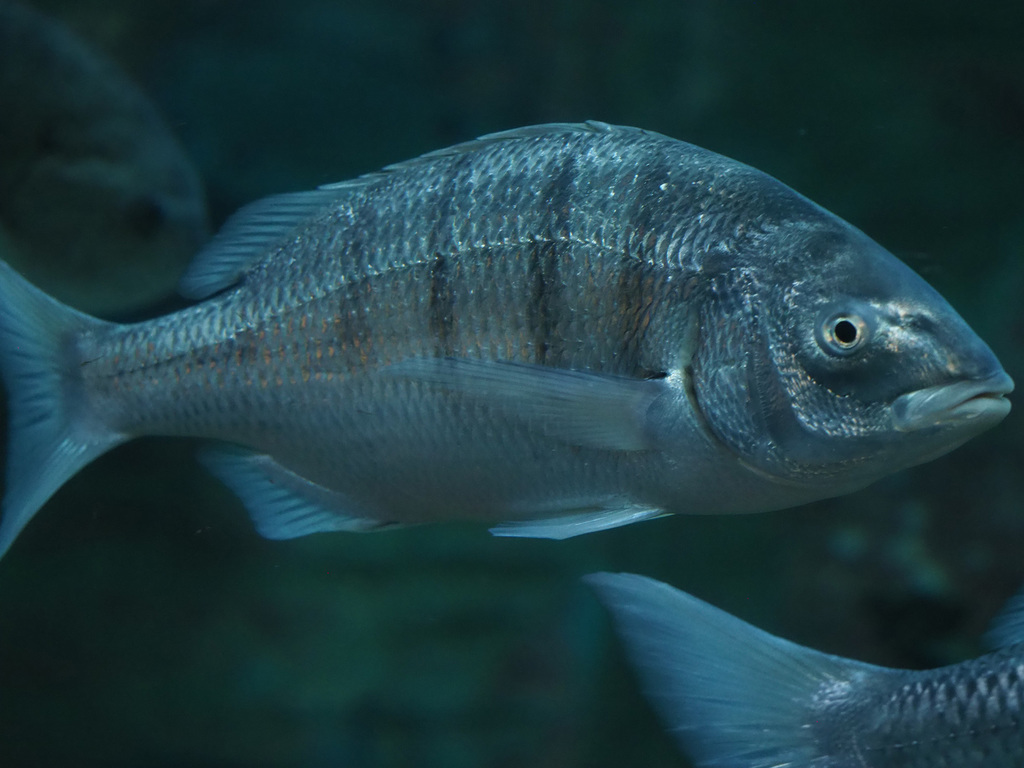
West Coast Seabream
Lithognathus aureti
The west coast seabream or west coast steenbras (Lithognathus aureti) is a species of marine fish in the family Sparidae. It is found in very shallow water off the coasts of to Angola, Namibia and South Africa. The International Union for Conservation of Nature lists its conservation status as being "near threatened".
From the article West coast seabream on Wikipedia (CC BY-SA), quoted section by section
Description
The west coast seabream is a deep-bodied fish that can grow to a length of about 100 cm (39 in). The maximum recorded weight is 19.3 kilograms (43 lb). The head is shorter than its depth, and the profile is slightly convex above the eye. There are no scales on the snout and the upper jaw is protusible. The teeth are small, with a single outer row of pointed teeth and two inner rows of small molars. The dorsal fin has eleven spines and nine to ten soft rays, and the anal fin has three spines and eight to nine soft rays. The pectoral fin is longer than the head and has fifteen to sixteen soft rays. The colour is silvery-grey with about seven faint, vertical bars which are more visible in young fish. This species could be confused with the sand steenbras (Lithognathus mormyrus), but that has a shallower body, more rays in its dorsal and anal fins, and ten to fourteen dark bars. The white steenbras (Lithognathus lithognathus) is also similar, but has a longer head and more slender body.
Range & habitat
Endemic to the coast of southwestern Africa, the west coast seabream's range extends from Rio Longa, in Angola, to Cape Town, South Africa, but it is uncommon outside Namibian waters. It occurs in two separate populations; one in the northern and central part of Namibia and one around Meob Bay in the south. It lives close inshore in the surf zone, usually at depths of less than 10 m (33 ft) over sandy seabeds.
Wikipedia: “Distribution and habitat”
What it does
The west coast seabream feeds on invertebrates on the seabed such as crabs, polychaete worms and bivalve molluscs. This fish is a protandric hermaphrodite. This means it starts its adult life as a male and later changes its sex to female. As a male, the average age to reach maturity is about 4.8 years for northern populations and about 6 years for southern ones. As a female, the average ages are 7.2 and 9.7 respectively. The eggs are spawned in the surf zone and tend to drift northwards with the sea current.
Wikipedia: “Ecology”
Where it lives
Recorded sightings
—
geo-referenced records in GBIF, from museums, herbaria and field observers.
Drag the globe to turn it. Dots are where records exist, not a range map; darker means more records.
In the stacks
Searching the stacks…
Every page naming Lithognathus aureti in the Biodiversity Heritage Library →
This page is assembled live from iNaturalist, GBIF, Wikipedia, the Source Library and the Internet Archive. It is not yet part of the hand-edited codex. iNaturalist taxon 446165.