- Animals
- ›Chordates
- ›Vertebrates
- ›Ray-finned Fishes
- ›Spiny-rayed fishes
- ›Blennies, Damselfishes and Allies
- ›Blennies
- ›Combtooth Blennies
- ›Salariin Blennies
- ›Ophioblennius
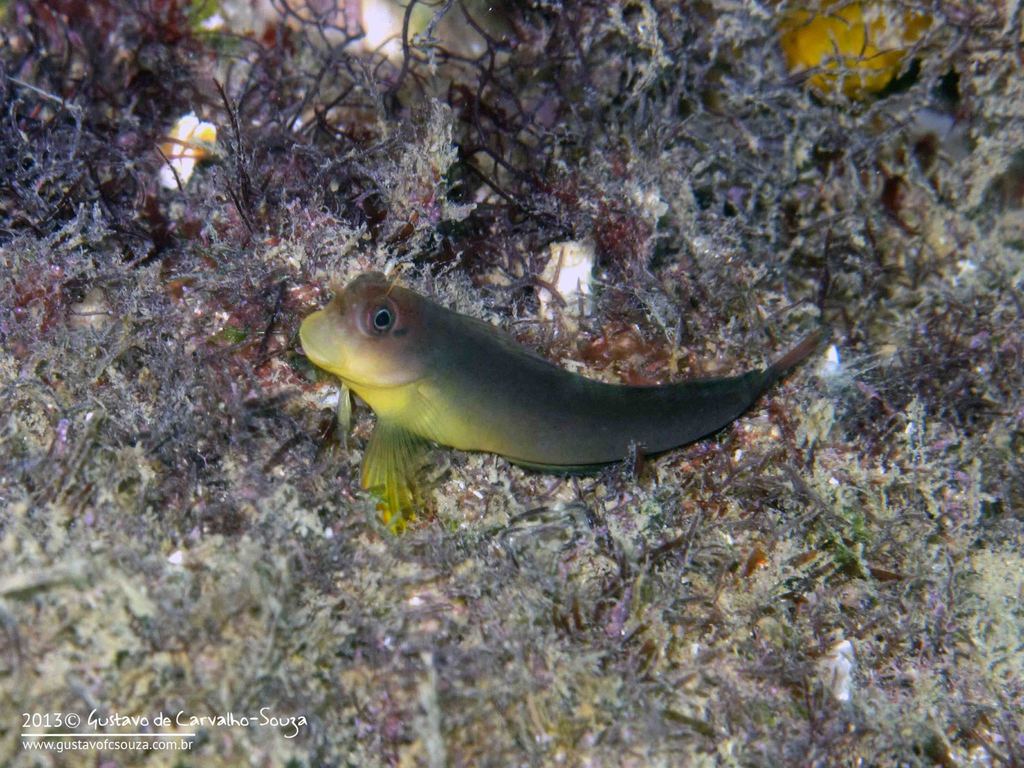
Brazilian fanged blenny
Ophioblennius trinitatis
Ophioblennius trinitatis is a species of combtooth blenny endemic to the southwest Atlantic ocean. It is a subtropical marine fish commonly found in reefs off the coast of Brazil. Combtooth blennies are often referred to as "peixes-macacos" in Brazil, which translates to "monkey-fish".
This species reaches a length of 5.6 centimetres (2.2 in) SL.
From the article Ophioblennius trinitatis on Wikipedia (CC BY-SA), quoted section by section
Description
Combtooth blennies are small, scaleless fish that are characterized by comb-like teeth in the jaw. A single row of comb-like teeth are found on the dentary and premaxilla but are absent on the palatine bone. In addition to comb-like teeth, many combtooth blennies have recurved, fang-like caniniform teeth at the rear end of each dentary. Ophioblennius trinitatis have a blunt head and large eyes positioned high on the head. A blue coloration borders each eye and a dark-brown spot, similar in size to the diameter of the pupil, is located after the eyeball. The anatomy of Ophioblennius trinitatis differs from other species of Ophioblennius in that it has 22 segmented dorsal-fin rays and 23 segmented anal-fin rays. This species reaches a length of 5.6 centimetres (2.2 in) SL. Adult Ophioblennius trinitatis have a homogenous brown color pattern with pale yellow fins. In stressful situations, the color pattern changes to a mix of irregular bands that alternate between dark and light. Juveniles, however, are bicolored: the anterior half is an olive green, while the posterior half is yellow.
Wikipedia: “Anatomy and morphology”
Range & habitat
Ophioblennius trinitatis are commonly found in intertidal habitats and tropical coral reefs of Brazil at depths of up to 53 meters. Although adult Ophioblennius trinitatis are restricted to shallow waters, dwelling among rocks and corals, larvae can be found in deep waters. Ophioblennius trinitatis prefer areas with substrate of high structural complexity and ample hiding places.
Wikipedia: “Habitat”
What it does
Ophioblennius trinitatis are primary consumers; their diet consists of detritus, turf algae, filamentous algae, red calcareous algae, ascidians, and a variety of invertebrates. Ophioblennius trinitatis are able to co-exist with other species by feeding more often in the morning than in the afternoon, an example of a resource partitioning strategy. Juveniles feed more often than adults due to the higher energy demand required of development. Larger Ophioblennius trinitatis have a lower feeding rate because they spend more time patrolling feeding and breeding territories.
Wikipedia: “Feeding behavior”
Where it lives
Recorded sightings
—
geo-referenced records in GBIF, from museums, herbaria and field observers.
Drag the globe to turn it. Dots are where records exist, not a range map; darker means more records.
In the stacks
Searching the stacks…
Every page naming Ophioblennius trinitatis in the Biodiversity Heritage Library →
This page is assembled live from iNaturalist, GBIF, Wikipedia, the Source Library and the Internet Archive. It is not yet part of the hand-edited codex. iNaturalist taxon 446289.