- Animals
- ›Chordates
- ›Vertebrates
- ›Ray-finned Fishes
- ›Spiny-rayed fishes
- ›Butterflyfishes, Angelfishes, and Allies
- ›Seabreams and Porgies
- ›Pachymetopon
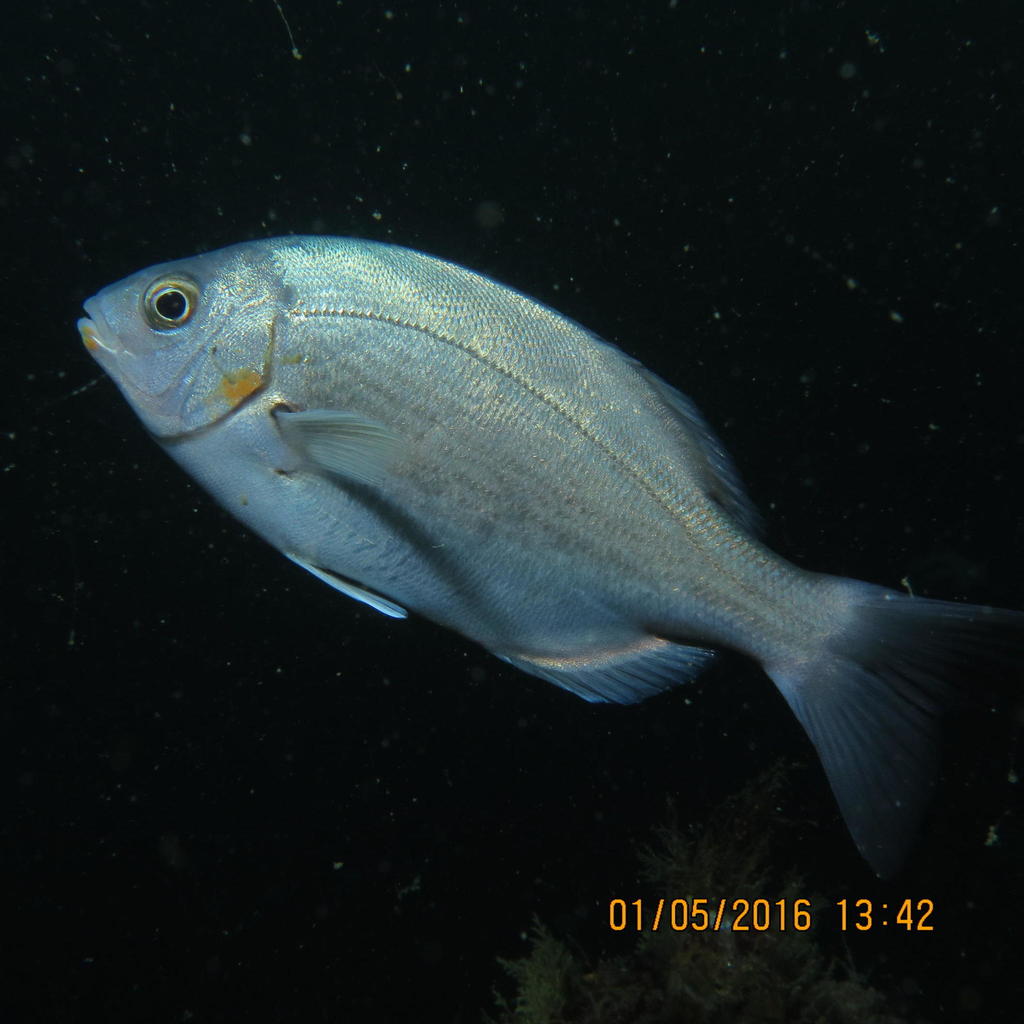
Hottentot Seabream
Pachymetopon blochii
The hottentot (Pachymetopon blochii), also known as the Hottentot seabream, is a species of sea bream in the family Sparidae, native to the southwestern coast of Africa.
From the article Pachymetopon blochii on Wikipedia (CC BY-SA), quoted section by section
Description
Pachymetopon blochii has a bronzy grey color, with darker fins. The small mouth contains five rows of incisors in both upper and lower jaw, but no molars. Adults are commonly around 25 cm in length at the age of maturity, but may reach up to 54 cm, with a maximum recorded weight of 2.67 kg.
Range & habitat
The species occurs in the southeastern Atlantic, from Angola to Cape Agulhas at the southern tip of South Africa. Vagrants have been recorded as far east as the mouth of the Tsitsikamma River. Pachymetopon blochii inhabits kelp beds on shallow rocky reefs, as well as blinders, subtidal reefs and offshore pinnacles in deeper waters (up to 55 m). Juveniles are restricted to the kelp beds.
Wikipedia: “Distribution and habitat”
What it does
The species is a generalist and feeds on seaweeds, algae, crustaceans, worms, molluscs, sea urchins, and occasionally small fish. It may spawn all year round, with peaks in summer and winter. Individuals generally live to an age of about 12 years, but may exceptionally reach an age of up to 21 years. Generation length is about 9 years. Pachymetopon blochii is a frequent host of the parasitic isopod Anilocra capensis.
Wikipedia: “Ecology”
Where it lives
Recorded sightings
—
geo-referenced records in GBIF, from museums, herbaria and field observers.
Drag the globe to turn it. Dots are where records exist, not a range map; darker means more records.
In the stacks
Searching the stacks…
Every page naming Pachymetopon blochii in the Biodiversity Heritage Library →
This page is assembled live from iNaturalist, GBIF, Wikipedia, the Source Library and the Internet Archive. It is not yet part of the hand-edited codex. iNaturalist taxon 446325.