- Animals
- ›Chordates
- ›Vertebrates
- ›Ray-finned Fishes
- ›Spiny-rayed fishes
- ›Blennies, Damselfishes and Allies
- ›Blennies
- ›Combtooth Blennies
- ›Salariin Blennies
- ›Salarias
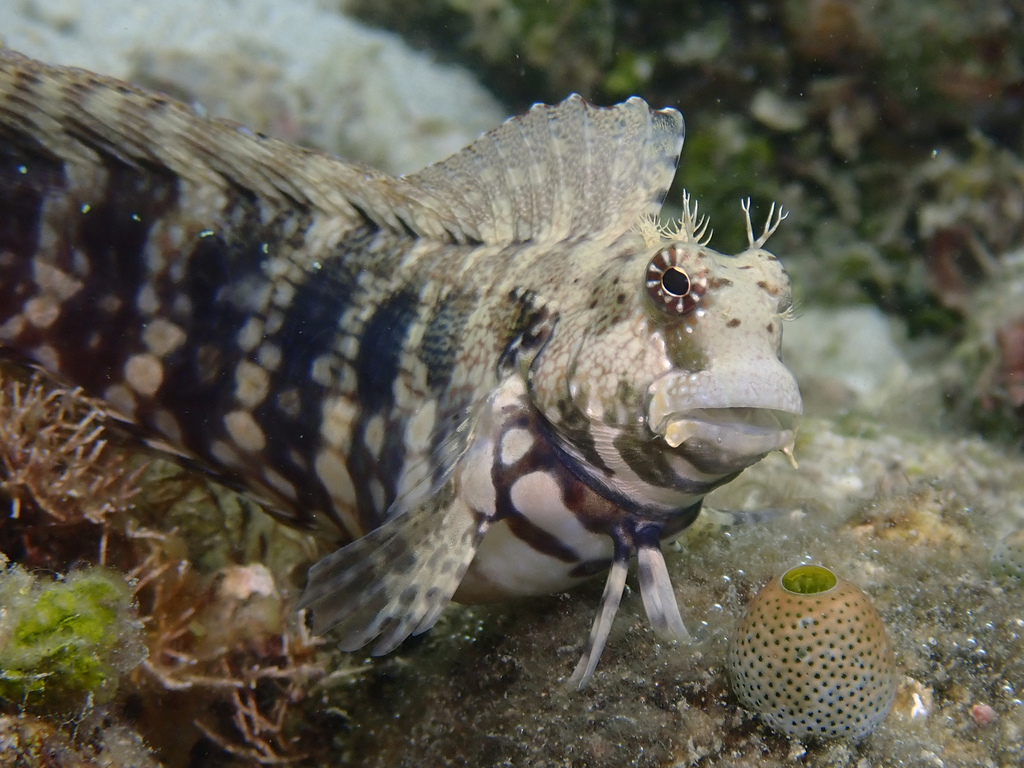
Jewelled Blenny
Salarias fasciatus
Salarias fasciatus (jewelled blenny) is a popular marine aquarium fish species in Australasia. Despite being also known as the lawnmower blenny due to its propensity to consume algae growth from rocks and glass, it is principally a detritivore, with plant material making up only 15% of its diet. This species reaches a length of 14 centimetres (5.5 in) TL. The lawnmower blenny is generally regarded as compatible with most other marine fish species and as a group...
From the article Salarias fasciatus on Wikipedia (CC BY-SA), quoted section by section
Description
Salarias fasciatus is typically olive to brown with dark bars and a large number of round or elongated white spots of different sizes. The blenny has many pale spots, dark streaks that run anteriorly, and several dark bands. It is a small fish, which reaches a maximum length of 14 centimetres (5.5 in) TL. It possesses no notch in its dorsal fin. The dorsal and anal fins are attached to the base of the caudal fin by a skin membrane. Adult males have elongated anterior rays on the anal fin. There are usually dark longitudinal lines on the front part of the body, and small bright blue spots with dark outlines along the rear part of the body.
Range & habitat
The Salarias fasciatus lives in reefs at depths of 0–8 m (0–26 ft) from East Africa and the Red Sea to Samoa and the Islands of Micronesia. It is most often found on shallow reef flats that have heavy algae cover.
Wikipedia: “Distribution and habitat”
Where it lives
Recorded sightings
—
geo-referenced records in GBIF, from museums, herbaria and field observers.
Drag the globe to turn it. Dots are where records exist, not a range map; darker means more records.
In the stacks
Searching the stacks…
Every page naming Salarias fasciatus in the Biodiversity Heritage Library →
This page is assembled live from iNaturalist, GBIF, Wikipedia, the Source Library and the Internet Archive. It is not yet part of the hand-edited codex. iNaturalist taxon 446462.