- Animals
- ›Chordates
- ›Vertebrates
- ›Mammals
- ›Therians
- ›Placental Mammals
- ›Primates, Rodents, and Allies
- ›Rodents
- ›Mice, Rats, and Hamsters
- ›Muroids
- ›Hamsters, Voles, Lemmings, and Allies
- ›South American Mice and Rats
- ›Rice Rats
- ›Nectomys
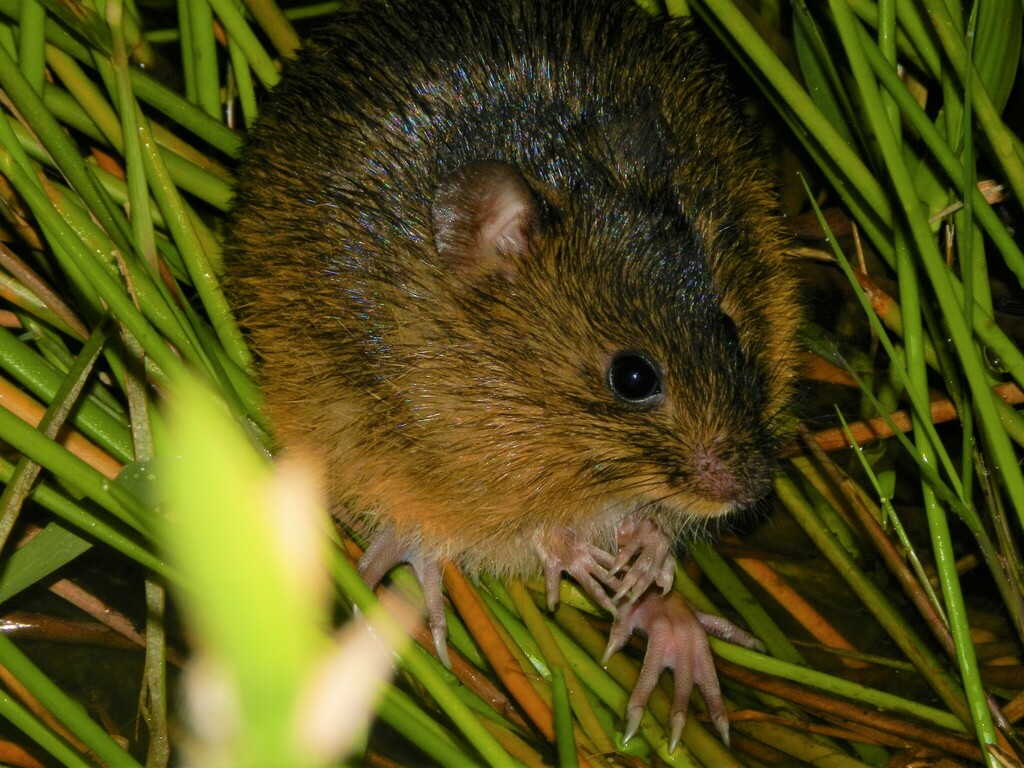
Atlantic Forest Water Rat
Nectomys squamipes
Nectomys squamipes, also known as the Atlantic Forest nectomys, South American water rat, or scaly-footed water rat, is a semiaquatic insectivorous rodent species. It is from Argentina, Brazil, and Paraguay — found primarily near forest rivers and streams in the Atlantic Forest ecoregion.
From the article Nectomys squamipes on Wikipedia (CC BY-SA), quoted section by section
Description
Nectomys squamipes, or the South American water rat can be distinguished from other Sigmodontinae based on their size and morphology of their hindfeet. They are the largest of the family (average of 216g) and have long hind legs with partially webbed feet to aid in swimming and have completely scaled heels. Nectomys is derived from Greek words meaning "mouse" and "swimming". One unique morphological characteristic is the distinct primitive cuspidate pattern of their cheekteeth, which have hypsodont molars, teeth crowned earlier in life and the outer fold of the upper molars tend to be more isolated as enamel islands. The Nectomys squamipe tends to have relatively longer, less hairy ears and a glossy, long pelage. This pelage is made up of wool hairs and guard hairs and is darker dorsally and tends to be lighter grey on its sides and ventrally. The tail is much less covered in hair, and length is around 75% of the body length. N. squamipes have a larger skull that occupies well-developed supraorbital ridges and lambdoidal crests, giving the mammal great attachments for jaw muscles and a strong bite. This strong bite is shown useful with its large, strong incisors that are greatly curved.
Range & habitat
The South American water rat inhabits elevations from sea level to around 2,000 m, in areas from the northern coast of South America to Brazil, Argentina and the western slope of the Andes. Almost all of these mammals are found a small (2 m) distance from tropical forest streams and rivers. They tend to prefer the moist habitats in forested areas such as swamps or marshes, and are sometimes found inhabiting caves
Wikipedia: “Distribution and habitat”
What it does
Nectomys squamipes is an omnivorous mammal with a diet ranging from fruits and leaves to insects and small fish. The South American water rat tends to feed more often after the end of the wet season, when food is in abundance. Many newborn water rats will grow bigger during this time period, because they have access to more food than those born during drier periods.
Wikipedia: “Diet”
In human culture
The South American water rat is a polygynous mammal in which males will increase their home range in attempt to mate with many females to produce the most offspring possible. Although males tend to be sexually active all year long, seasonal breeding patterns are suggested since females have a higher pregnancy rate during the wet season, which is August to November in South America. This will produce offspring that have an abundant food source when born, resulting in greater growth and larger populations. Gestation periods last around 30 days and young have an average body length between 10-11 grams, with litters as small as 1 offspring and as large as 7. Males are generally absent when raising the altricial young, so the female is responsible for feeding and caring for their young.
Wikipedia: “Life history and reproduction”
Listen
Looking for field recordings…
Where it lives
Recorded sightings
—
geo-referenced records in GBIF, from museums, herbaria and field observers.
Drag the globe to turn it. Dots are where records exist, not a range map; darker means more records.
In the stacks
Searching the stacks…
Every page naming Nectomys squamipes in the Biodiversity Heritage Library →
This page is assembled live from iNaturalist, GBIF, Wikipedia, the Source Library and the Internet Archive. It is not yet part of the hand-edited codex. iNaturalist taxon 44771.