- Animals
- ›Chordates
- ›Vertebrates
- ›Mammals
- ›Therians
- ›Placental Mammals
- ›Primates, Rodents, and Allies
- ›Rodents
- ›Mice, Rats, and Hamsters
- ›Muroids
- ›Hamsters, Voles, Lemmings, and Allies
- ›North American Mice and Rats
- ›Pygmy and Singing Mice
- ›Scotinomys
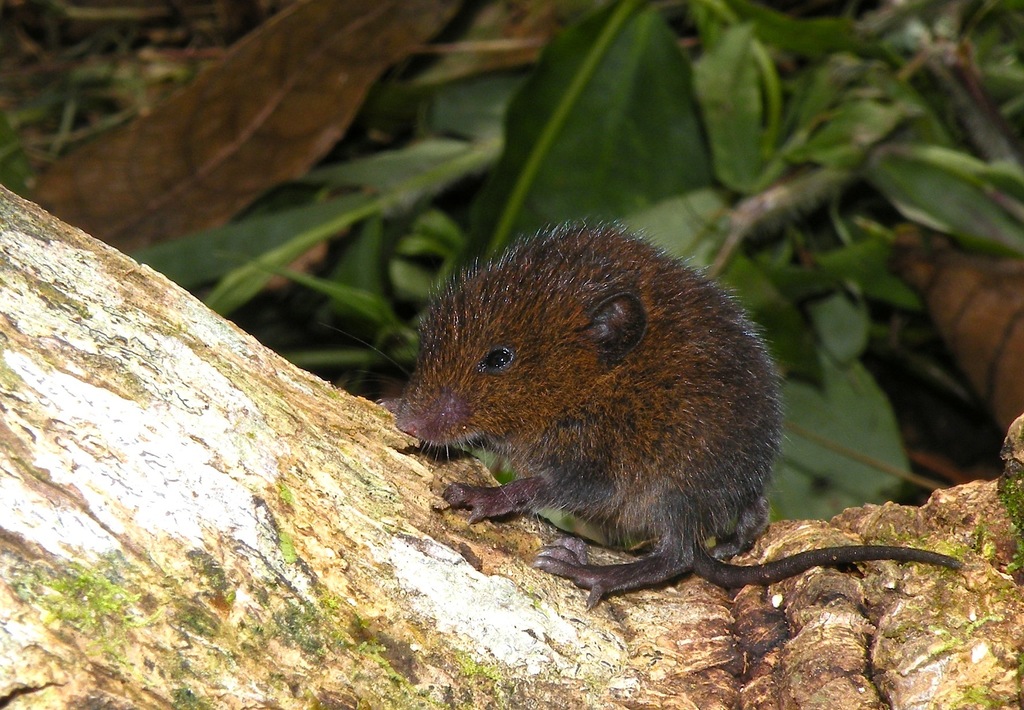
Short-tailed Singing Mouse
Scotinomys teguina
Alston's brown mouse, also called Alston's singing mouse, short-tailed singing mouse, or singing mouse (Scotinomys teguina), is a species of rodent in the family Cricetidae. It is found in Central America, from Chiapas, Mexico, to western Panama.
This species produces vocalizations in both the sonic and ultrasonic range that are thought to be an important component of its communication behavior.
From the article Alston's brown mouse on Wikipedia (CC BY-SA), quoted section by section
Description
S. teguina is small (10–13 grams), with a dark coat, and a short tail. Its underparts are dark gray-brown to orange-brown. The tail is blackish and lightly haired and its feet are black. It also emits a noticeably strong, musky odor.
Range & habitat
S. teguina is exclusively found in the highland forests of southern North America and throughout Central America, from Chiapas, Mexico to western Panama, at elevations between 1100 and 2950 meters. Costa Rica, El Salvador, Guatemala, Honduras, Mexico, Nicaragua, and Panama. This rodent prefers wet habitats with subtropical climates, and is commonly observed in grassy clearings and rocky areas at the forest edge. S. teguina is diurnal in the wild. In laboratory settings, it is predominantly active in the morning, with decreasing activity in the afternoon to evening hours.
Wikipedia: “Distribution and habitat”
What it does
S. teguina is predominantly insectivorous, feeding on beetles and other small insects. Additionally, seeds and fruits make up a small portion of its diet.
S. teguina is often recognized for its unique vocalization behavior. Both males and females produce vocalizations which are characterized by singing bouts containing both sonic and ultrasonic elements. Male songs tend to be longer than females, but seem to share similar spectral characteristics. The singing is created by whistling created with an inflated air sac called the ventral pouch. This enlarged air sac is not found in other Neotominae species. Although ultrasonic vocalizations have been demonstrated in numerous rodent species, few display vocalizing bouts as continuous and stereotyped as S. teguina. Because of their length and complexity, these vocalizations have been described as "song". When singing, the mouse rears on its hind legs and extends its neck, facing upward while producing a stereotypical call of up to 10 seconds. The song is loud, with components audible to humans typically occurring towards the end of the call. Research links their singing to an expansion of projections from their orofacial motor cortex to areas involved in vocalization in their auditory cortex and their periaqueductal grey. …
Wikipedia: “Behavior”
Listen
Looking for field recordings…
Where it lives
Recorded sightings
—
geo-referenced records in GBIF, from museums, herbaria and field observers.
Drag the globe to turn it. Dots are where records exist, not a range map; darker means more records.
In the stacks
Searching the stacks…
Every page naming Scotinomys teguina in the Biodiversity Heritage Library →
This page is assembled live from iNaturalist, GBIF, Wikipedia, the Source Library and the Internet Archive. It is not yet part of the hand-edited codex. iNaturalist taxon 44891.