- Animals
- ›Chordates
- ›Vertebrates
- ›Mammals
- ›Therians
- ›Placental Mammals
- ›Primates, Rodents, and Allies
- ›Rodents
- ›Mice, Rats, and Hamsters
- ›Muroids
- ›Hamsters, Voles, Lemmings, and Allies
- ›Hamsters
- ›Mesocricetus
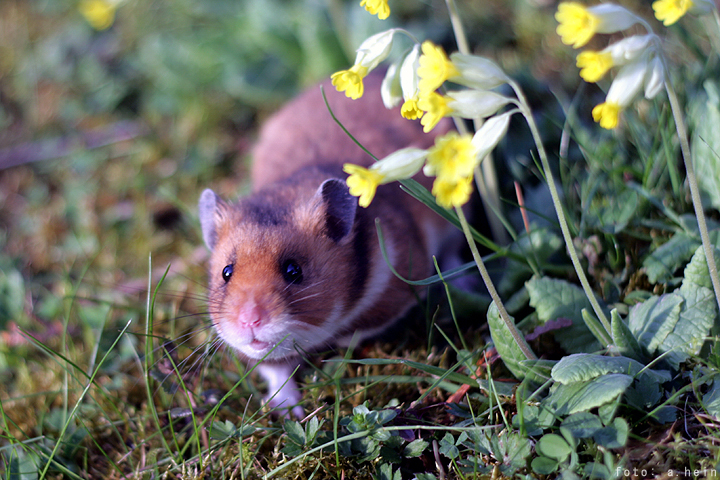
Golden Hamster
Mesocricetus auratus
The golden hamster or Syrian hamster (Mesocricetus auratus) is a rodent belonging to the hamster subfamily, Cricetinae. Their natural geographical range is in an arid region of northern Syria and southern Turkey. Their numbers have been declining in the wild due to a loss of habitat from agriculture and deliberate elimination by humans. Thus, wild golden hamsters are now considered endangered by the International Union for Conservation of Nature. However, captive breeding programs are well established, and captive-bred golden hamsters are often kept as small house pets. They are also used as scientific research animals.
Syrian hamsters kept as pets are sensitive to their housing conditions, and many welfare concerns have been identified in association with inadequate care. Major concerns include undersized cages, the presence of predatory species (dogs and cats) in the hamster's environment, insufficient substrate depth, excessive handling, noise, and wet tail (proliferative ileitis), the risk of which is increased by poor hygiene and cage cleanliness and high levels of stress.
From the article Golden hamster on Wikipedia (CC BY-SA), quoted section by section
Description
Adult golden hamsters can reach around 7.1 in (18 cm) long. Females are usually larger than males, with a body mass of around 100–150 grams (3.5–5.3 oz) and lifespan of 1.5–2 years. Syrian hamsters from private breeders can be in the range of 175–225 grams (6.2–7.9 oz).
Like most members of the subfamily, the golden hamster has expandable cheek pouches, which extend from its cheeks to its shoulders. In the wild, hamsters are larder hoarders; they use their cheek pouches to transport food to their burrows. Their name in the local Arabic dialect where they were found roughly translates to "mister saddlebags" (Arabic: أبو جراب) due to the amount of storage space in their cheek pouches. Sexually mature female hamsters come into heat (estrus) every four days. Golden hamsters and other species in the genus Mesocricetus have the shortest gestation period in any known placental mammal at around 16 days. Gestation has been known to last up to 21 days, but this is rare and almost always results in complications. They can produce large litters of 20 or more young, although the average litter size is between eight and 10 pups. If a mother hamster is inexperienced or feels threatened, she may abandon or eat her pups. A female hamster enters estrus almost immediately after giving birth, and can become pregnant despite already having a litter. …
Wikipedia: “Characteristics”
What it does
A solitary species, Syrian hamsters are very territorial and intolerant of each other; attacks against each other are commonplace. Exceptions do occur, usually when a female and male meet when the female is in heat, but even so, the female may attack the male after mating. In captivity, babies are separated from their mother and by sex after four weeks, as they sexually mature at four to five weeks old. Same-sex groups of siblings can stay with each other until they are about eight weeks old, at which point they will become territorial and fight with one another, sometimes to the death. Infanticide is not uncommon among female golden hamsters. In captivity, they may kill and eat healthy young as a result of the pups interacting with humans, as any foreign scent is treated as a threat. Females also eat their dead young in the wild. Golden hamsters mark their burrows with secretions from special scent glands on their hips called flank glands. Male hamsters in particular lick their bodies near the glands, creating damp spots on the fur, then drag their sides along objects to mark their territory. Females also use bodily secretions and feces.
Socialization. Syrian hamsters acquire learned helplessness when they are bullied a few times by a larger animal. …
Wikipedia: “Behavior”
Listen
Looking for field recordings…
Where it lives
Recorded sightings
—
geo-referenced records in GBIF, from museums, herbaria and field observers.
Drag the globe to turn it. Dots are where records exist, not a range map; darker means more records.
In the stacks
Searching the stacks…
Every page naming Mesocricetus auratus in the Biodiversity Heritage Library →
This page is assembled live from iNaturalist, GBIF, Wikipedia, the Source Library and the Internet Archive. It is not yet part of the hand-edited codex. iNaturalist taxon 44919.