- Animals
- ›Chordates
- ›Vertebrates
- ›Mammals
- ›Therians
- ›Placental Mammals
- ›Primates, Rodents, and Allies
- ›Rodents
- ›Mice, Rats, and Hamsters
- ›Muroids
- ›Hamsters, Voles, Lemmings, and Allies
- ›Voles, Lemmings, and Muskrats
- ›Molevoles
- ›Ellobius
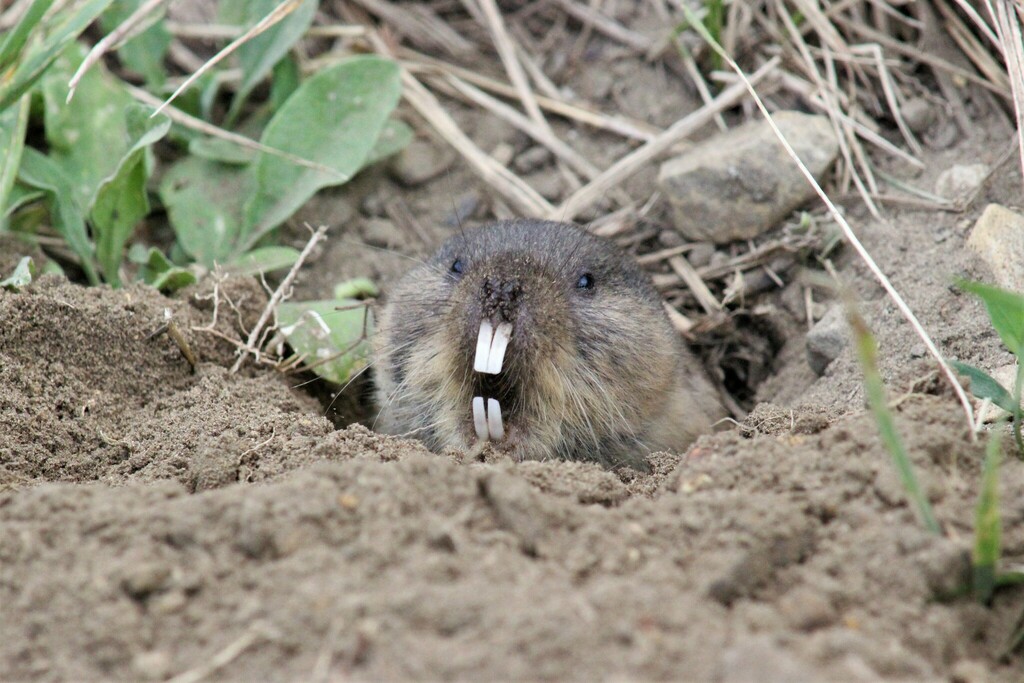
Northern Molevole
Ellobius talpinus
The northern mole vole (Ellobius talpinus) is a species of rodent in the family Cricetidae.
It is distributed over large parts of Eastern Europe and Asia.
From the article Northern mole vole on Wikipedia (CC BY-SA), quoted section by section
Description
The northern mole vole is a small mammal about 130 mm (5.1 in) long with a short tail, weighing up to 70 g. The females are slightly larger than the males. The body is wedge-shaped, the head flat, the neck short and the musculature of the forelimbs strongly developed. It has short, dense, brownish fur somewhat paler on the underparts. The feet are naked and pink. It is adapted to life underground, digging its burrows with the help of its large incisors.
Wikipedia: “Morphology”
Range & habitat
This vole is found in Kazakhstan, Turkmenistan, Kyrgyzstan, Uzbekistan and Ukraine, the southern parts of Russia, western Siberia, northern Afghanistan, Mongolia and northern China.
Wikipedia: “Distribution”
What it does
This vole is a colonial species, living in groups of about 10 individuals, typically a family group of one pair of adults and young animals from one or two litters. The burrows are complex, the entrances are usually sealed by soil and the nesting chambers and fodder chambers are usually about 4 m (13 ft) beneath the surface. The animals feed on roots, bulbs, tubers and the juicy rhizomes of plants, and in the summer and autumn they store small stocks of food. They seldom emerge onto the surface except to distribute soil excavated from the burrow or to move to new territories, at which times they can cover distances of up to 800 m (2,600 ft). The population size varies, being limited by infectious diseases, parasites, severe winters with deep-frozen ground, spring flooding of burrows by melt water and predatory birds and mammals.
== References ==
Wikipedia: “Ecology”
Listen
Looking for field recordings…
Where it lives
Recorded sightings
—
geo-referenced records in GBIF, from museums, herbaria and field observers.
Drag the globe to turn it. Dots are where records exist, not a range map; darker means more records.
In the stacks
Searching the stacks…
Every page naming Ellobius talpinus in the Biodiversity Heritage Library →
This page is assembled live from iNaturalist, GBIF, Wikipedia, the Source Library and the Internet Archive. It is not yet part of the hand-edited codex. iNaturalist taxon 45080.