- Animals
- ›Chordates
- ›Vertebrates
- ›Mammals
- ›Therians
- ›Placental Mammals
- ›Primates, Rodents, and Allies
- ›Rodents
- ›Mice, Rats, and Hamsters
- ›Muroids
- ›Hamsters, Voles, Lemmings, and Allies
- ›Voles, Lemmings, and Muskrats
- ›Steppe Lemmings
- ›Lagurus
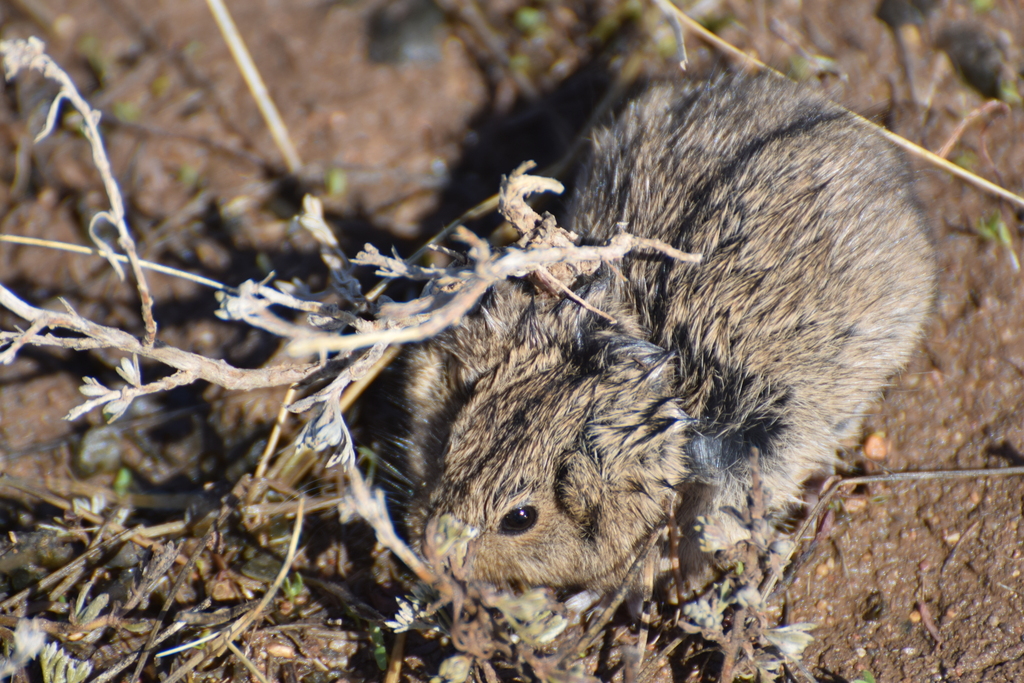
Steppe Lemming
Lagurus lagurus
The steppe lemming or steppe vole (Lagurus lagurus) is a small rodent. It is described as somewhat similar in appearance to the Norway lemming (Lemmus lemmus). It is more active at night, however, it is not entirely nocturnal. The steppe lemming's diet consists of shoots and leaves. In the wild, it is found in steppes and semiarid environments in Russia, Ukraine, Kazakhstan, northwestern China, and western Mongolia. Fossil remains of this species have been found in areas as far west as Great Britain.
From the article Steppe lemming on Wikipedia (CC BY-SA), quoted section by section
Description
The steppe lemming's body length is up to 12 cm with a tail of 2 cm. It is light-grey and plump. It has small ears and eyes and the fur is brownish-grey with a black dorsal stripe. It weighs around 30 g.
Range & habitat
This lemming is found in steppe, forest-steppe and semidesert parts of western Mongolia, northwest China, many parts of the former USSR, Kazakhstan, Ukraine, the southern and middle Ural, and western and eastern Siberia.
Wikipedia: “Distribution”
What it does
The steppe lemming is a colonial species. It digs burrows. During the day, it is active, though only emerges from its burrow for short periods. It eats different parts of plants. This includes seeds. It reaches sexual maturity at the age of six weeks. It can produce up to six broods in a year, with five or six young in each. Under the correct conditions, reproduction continues throughout the year. The amount of steppe lemmings differs based on the climate and resources available. Migrations are observed during years of mass outbreaks.
Wikipedia: “Ecology”
Listen
Looking for field recordings…
Where it lives
Recorded sightings
—
geo-referenced records in GBIF, from museums, herbaria and field observers.
Drag the globe to turn it. Dots are where records exist, not a range map; darker means more records.
In the stacks
Searching the stacks…
Every page naming Lagurus lagurus in the Biodiversity Heritage Library →
This page is assembled live from iNaturalist, GBIF, Wikipedia, the Source Library and the Internet Archive. It is not yet part of the hand-edited codex. iNaturalist taxon 45092.