- Animals
- ›Chordates
- ›Vertebrates
- ›Ray-finned Fishes
- ›Spiny-rayed fishes
- ›Lanterneyes, fangtooths and allies
- ›Lanterneye Fishes
- ›Anomalops
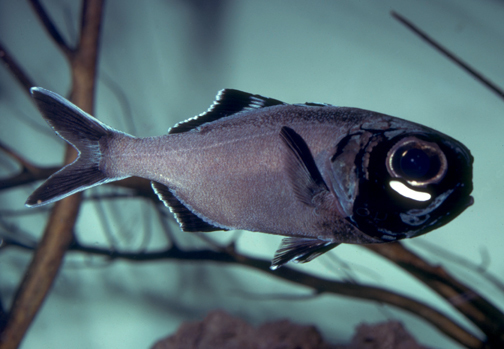
Twofin Flashlightfish
Anomalops katoptron
The splitfin flashlightfish or two-fin flashlightfish (Anomalops katoptron) is a species of schooling reef fish in the family Anomalopidae. It is found in warm waters in the central and western Pacific Ocean near reefs 200–400 m (660–1,300 ft) in depth. It can grow to a length of 35 cm (14 in) TL. It is the only known member of the genus Anomalops. It is listed under the IUCN as a species of least concern.
From the article Splitfin flashlightfish on Wikipedia (CC BY-SA), quoted section by section
Description
The splitfin flashlightfish is characterized by a black body with a blue tinge along the dorsal and caudal fins. Adults can reach up to 35 cm (14 in) TL in length but on average measure anywhere between 10 cm to 30 cm (4–12 in). It has a slightly laterally compressed deep body with an upwards terminal mouth and narrow caudal peduncle. It has two separate dorsal fins: the anterior portion consisting of 6-7 dorsal spines and the posterior portion consisting of 14-15 soft dorsal rays. Its anal fin contains 2 spines and 9-11 soft rays. Its most prominent features are the two bean shaped torch-like organs under its eyes containing symbiotic bioluminescent bacteria Candidatus photodesmus katoptron, which the fish can turn on and off by blinking. The light organs are embedded in suborbital cavities and are connected at the anterior edge via a cartilaginous rod-like attachment. The suborbital light organs are densely settled with luminous symbiotic bacteria that grow in tubular structures and produce a constant bluish light of around 500 nm in wavelength. One face of these organs is black, whereas the other is luminous. To turn ‘on’ its light, A. katoptron rotates the organ length-wise so that the luminous face is exposed to the outside. To turn ‘off’ its light, it then rotates the luminous face down towards the body, presenting the black pigmented face outwards. …
Range & habitat
Splitfin flashlightfish are found in the western and central Pacific Ocean from the Philippines and Indonesia east to the Tuamotus, north to Japan, and south to the Great Barrier Reef. It is generally found near drop-offs and caves 200–400 m (660–1,310 ft) in depth, but will move into shallower waters during the winter months.
Wikipedia: “Distribution and habitat”
What it does
A nocturnal species, the splitfin flashlightfish avoids sunlight and seeks prey in dark areas. It feeds primarily on zooplankton. Individuals can be found in large schools during moonless nights in the shallow water of coral reefs and in the open surrounding water. Its bioluminescent organs serve a functional purpose in searching for and detecting planktonic prey. Researchers have found that in darkness (periods of activity), A. katoptron has high blink frequencies and increases the amount of time light organs are on. Paired with their schooling behavior, this high blinking frequency can confuse and deter predators. During the day (periods of inactivity), A. katoptron reduces blink frequency and decreases the amount of time light organs are on. When in the presence of prey, A. katoptron emits a constant glow from their light organs, effectively illuminating their meal. This, however, presents a trade off by making themselves more vulnerable to predators. Changes in eyeshine and occlusion of the eye organ also elucidates the possibility of a communication system among fish. Further research has revealed that the blinking mechanism of the splitfin flashlightfish also assists in keeping a cohesive school of fish together. Intraspecific communication between A. katoptron is crucial for the movement of a school of fish. …
Wikipedia: “Biology and ecology”
Where it lives
Recorded sightings
—
geo-referenced records in GBIF, from museums, herbaria and field observers.
Drag the globe to turn it. Dots are where records exist, not a range map; darker means more records.
In the stacks
Searching the stacks…
Every page naming Anomalops katoptron in the Biodiversity Heritage Library →
This page is assembled live from iNaturalist, GBIF, Wikipedia, the Source Library and the Internet Archive. It is not yet part of the hand-edited codex. iNaturalist taxon 451023.