- Animals
- ›Chordates
- ›Vertebrates
- ›Mammals
- ›Therians
- ›Placental Mammals
- ›Primates, Rodents, and Allies
- ›Rodents
- ›Mice, Rats, and Hamsters
- ›Muroids
- ›Old World Mice and Rats
- ›Murines
- ›Cloud Rats
- ›Phloeomys
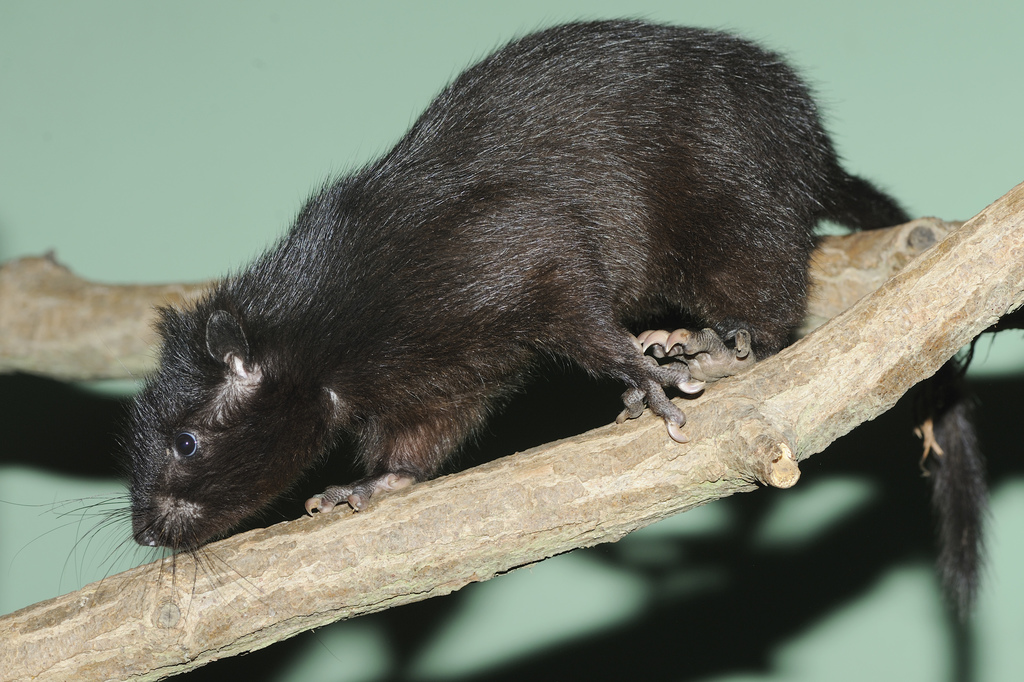
Southern Luzon Giant Cloud Rat
Phloeomys cumingi
The southern giant slender-tailed cloud rat or southern Luzon giant cloud rat (Phloeomys cumingi), also known as bugkon in Filipino, is a vulnerable species of rodent in the family Muridae, found only in southern Luzon in the Philippines. It is dark brown, occasionally with some reddish, but lacking the light-coloured sections usually seen in its close relative, the northern Luzon giant cloud rat (P. pallidus). The southern giant slender-tailed cloud rat is a large rodent that has a total length of about 67–75 cm (26–30 in) and weighs 1.45–2.1 kg (3.2–4.6 lb).
Equally at home high amongst the branches of a tree as on the forest floor, the southern giant slender-tailed cloud rat is a slow-moving animal only active at night, spending the day in hollow trees or logs. It usually lives singly, or in pairs consisting of an adult male and female, or a female and her young, but larger groups have also been seen. Their diet consists primarily of tender, young leaves, but fruit is also reportedly eaten. The southern giant slender-tailed cloud rat typically gives birth to a single pup each year, with data indicating that most births take place during the late rainy season. The young are born in the hollow of a standing or fallen tree, or in a hole in the ground. The mother carries her young firmly attached to a nipple. In captivity, one cloud rat lived for over 13 years.
Listen
Looking for field recordings…
Where it lives
Recorded sightings
—
geo-referenced records in GBIF, from museums, herbaria and field observers.
Drag the globe to turn it. Dots are where records exist, not a range map; darker means more records.
In the stacks
Searching the stacks…
Every page naming Phloeomys cumingi in the Biodiversity Heritage Library →
This page is assembled live from iNaturalist, GBIF, Wikipedia, the Source Library and the Internet Archive. It is not yet part of the hand-edited codex. iNaturalist taxon 45164.