- Animals
- ›Chordates
- ›Vertebrates
- ›Mammals
- ›Therians
- ›Placental Mammals
- ›Ungulates, Carnivorans, and Allies
- ›Carnivorans
- ›Mustelids
- ›Wolverines, Martens, and Tayras
- ›Martes
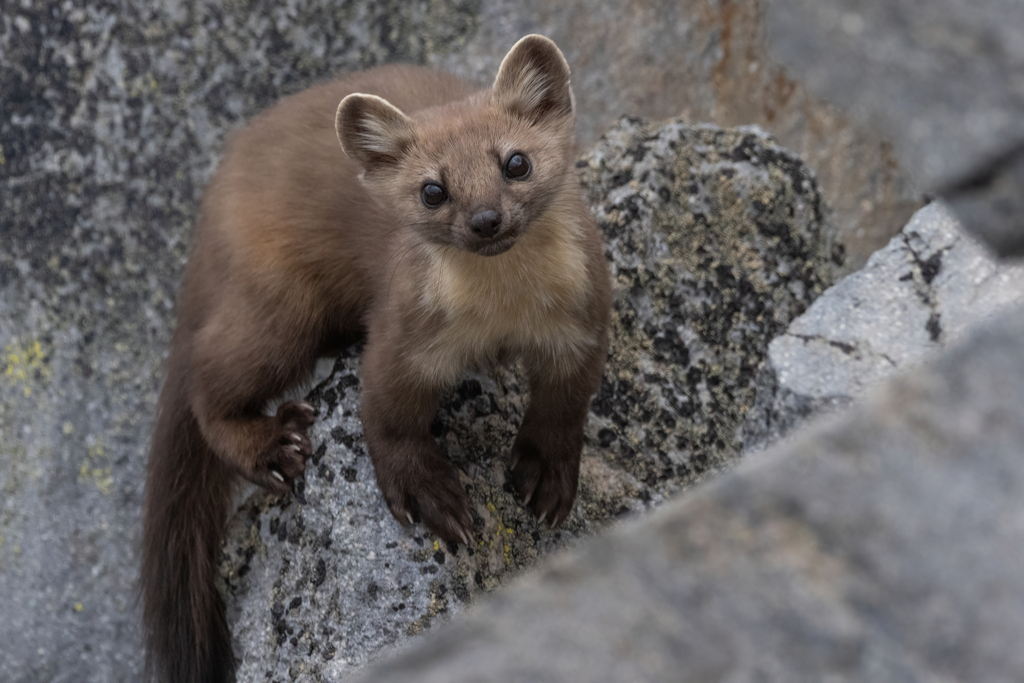
Pacific Marten
Martes caurina
The Pacific marten (Martes caurina) is a species of North American mammal, a member of the family Mustelidae. It is found throughout western North America.
From the article Pacific marten on Wikipedia (CC BY-SA), quoted section by section
Range & habitat
The Pacific marten has a wide but fragmented distribution throughout western North America; this distribution is thought to be a consequence of the pattern in which it colonized new areas as the ice sheets retreated. Its range extends from the Alexander and Haida Gwaii archipelagos south along the Pacific Northwest coast to Humboldt County, California, and east to the southern Rocky Mountains, reaching as far south as New Mexico. A broad hybrid zone between the Pacific and American martens is known to exist in the Columbia Mountains, as well as Kupreanof and Kuiu Islands in Alaska. The species is known to inhabit deciduous and coniferous forests in areas such as the Pacific Northwest of the United States, and through the Rocky Mountains and Sierra Nevada. In Oregon, Pacific martens occur in higher terrain due to their ability to survive larger snow levels. They are separated in two habitats, the coastal mountains, where they occur in lower elevations as well, and the Cascade Range, mostly in mountainous areas with pine forests, separated by more unsuitable habitat in the lowlands and valleys.
Wikipedia: “Distribution”
What it does
In northeastern California, more time was spent traveling and hunting in summer than in winter, suggesting that reduced winter activity may be related to thermal and food stress or may be the result of larger prey consumption and consequent decrease in time spent foraging. Also in northeastern California, activity in the snow-free season (May–December) was diurnal, while winter activity was largely nocturnal. Year-round daily movements in Grand Teton National Park ranged from 0 to 2.83 miles (0.00 to 4.55 km), averaging 0.6-mile (0.97 km), observations of 88 individuals).
Weather factors. In southeastern Wyoming, temperature influenced resting site location. Above-snow sites were used during the warmest weather, while subnivean sites were used during the coldest weather, particularly when temperatures were low and winds were high following storms. High mortality may occur if Pacific marten become wet in cold weather, as when unusual winter rains occur during live trapping. In Yosemite National Park, drought conditions increased the diversity of prey items; Pacific marten consumed fish and small mammal species made more accessible by low snow conditions in a drought year. Pacific marten may travel extensively under the snowpack. …
Wikipedia: “Behavior”
At the table
Marten are omnivorous, with rodents and rabbits being common prey. Birds were the most important prey item in terms of frequency and volume on Haida Gwaii, British Columbia. Fish may be important in coastal areas. Diet is less diverse within the Pacific marten's range than with the American marten, although there is diversity in Pacific states.
Wikipedia: “Food habits”
Listen
Looking for field recordings…
Where it lives
Recorded sightings
—
geo-referenced records in GBIF, from museums, herbaria and field observers.
Drag the globe to turn it. Dots are where records exist, not a range map; darker means more records.
In the stacks
Searching the stacks…
Every page naming Martes caurina in the Biodiversity Heritage Library →
This page is assembled live from iNaturalist, GBIF, Wikipedia, the Source Library and the Internet Archive. It is not yet part of the hand-edited codex. iNaturalist taxon 453111.