- Animals
- ›Chordates
- ›Vertebrates
- ›Mammals
- ›Therians
- ›Placental Mammals
- ›Primates, Rodents, and Allies
- ›Rodents
- ›Mice, Rats, and Hamsters
- ›Muroids
- ›Old World Mice and Rats
- ›Murines
- ›Australasian Mice and Rats
- ›Zyzomys
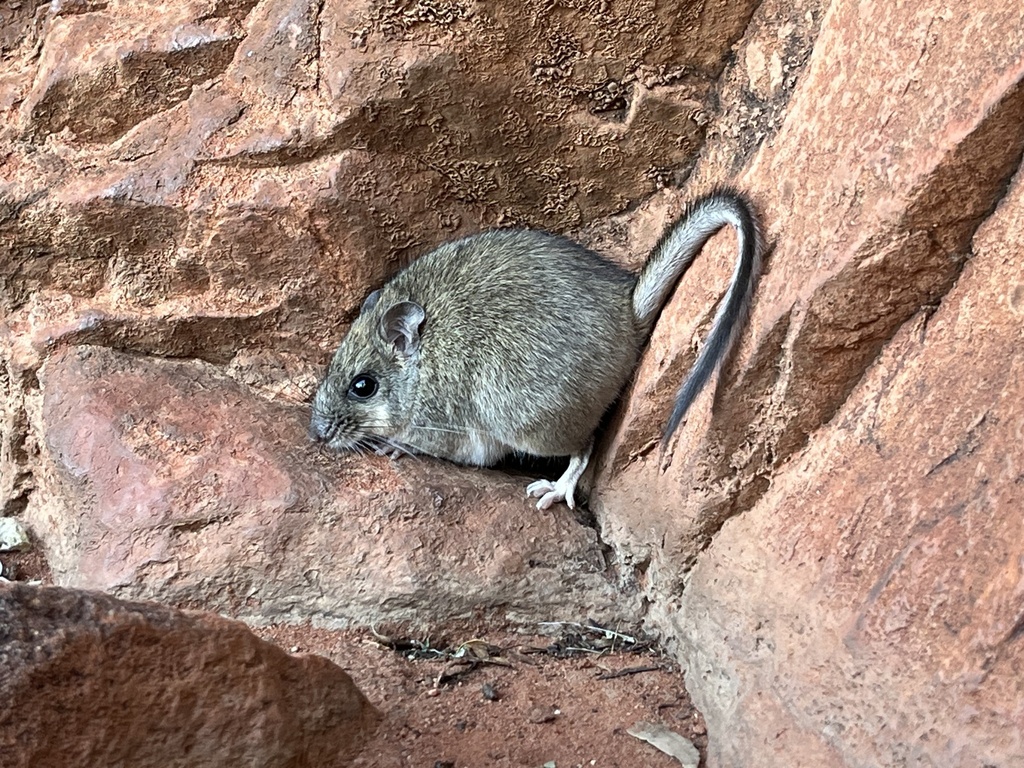
Central Rock Rat
Zyzomys pedunculatus
The central rock rat (Zyzomys pedunculatus), also known as the central thick-tailed rock-rat, Macdonnell Range rock-rat, Australian native mouse, rat à grosse queue (French), or rata coligorda (Spanish), is a species of rodent in the family Muridae that is found only in Australia. The rats have been found in rocky outcrops and on mountainsides with loose stones, as well as hilly grasslands and low open shrubland or woodland. Historically, Z. pedunculatus is only known to be...
From the article Central rock rat on Wikipedia (CC BY-SA), quoted section by section
Description
The central rock rat is one of five rock rat species native to Australia. It is a nocturnal species that forages for food at nighttime. They can range from 10.6 to 14.9 cm (4.2 to 5.9 in) long for the head and body, and around 30 cm (12 in) from head to tail. They weigh between 50 and 120 g (1.8 and 4.2 oz). Their fur is a light mustard above with a pale underbelly. The lightly furred tail is the most noticeable feature of the central rock rat. The tail base is thick and bulky. The thickness of the tail has been reported to be a fat storage adaptation, an effect of scarce food distribution. Rock rats are known to lose their tails, fur and skin very easily and are, therefore, known to be difficult to handle. As for their birthrate, captive animals have bred and have had litters of various sizes, ranging from one to four young.
Range & habitat
The rats have been found in rocky outcrops and on mountainsides with loose stones, as well as hilly grasslands and low open shrubland or woodland. Historically, the central rock rat is only known to be found in a 77 km (48 mi) stretch of the West MacDonnell Ranges, Northern Territory. The species has previously been recorded from living animals or cave deposits in Northern Territory at Uluru-Kata Tjuta National Park, Illamurta (James Range), Haasts Bluff (West MacDonnell Ranges), Mount Liebig, Napperby Station, Devils Marbles, The Granites (Tanami Desert), and the Davenport Range National Park. It is known from cave deposits in the Cape Range National Park.
Wikipedia: “Distribution and habitat”
What it does
The central rock rat is a largely granivorous, having a preference for seeds from grasses of the genus Triodia. These grasses become abundant after long periods of no fires, explaining why populations of this species are steady even in areas that have no recently experienced fires. The diet of the central rock rat consists of four major food groups that can be found across all seasons. Seed makes up 72% of the species' food intake. The rest of its diet consists of plant leaves (21%), plant stems (3%), and insects (4%). They can be found near rocky habitats for burrow sites and local seed availability. This helps to explain why the central rock rat is found in such low numbers, since they rely on constant food supply and a steady and supportive habitat. This makes the central rock rat difficult to find in the Central Australian range. They play an essential role in seed dispersal as well as food resource for other animals in the wild. The species likely has a pattern of recovery and expansion during wet periods, probably due to increased food supply.
Wikipedia: “Ecology”
Listen
Looking for field recordings…
Where it lives
Recorded sightings
—
geo-referenced records in GBIF, from museums, herbaria and field observers.
Drag the globe to turn it. Dots are where records exist, not a range map; darker means more records.
In the stacks
Searching the stacks…
Every page naming Zyzomys pedunculatus in the Biodiversity Heritage Library →
This page is assembled live from iNaturalist, GBIF, Wikipedia, the Source Library and the Internet Archive. It is not yet part of the hand-edited codex. iNaturalist taxon 45374.