On eBird ↗
Great Auk
Live sightings near you, the range map, bar charts of when it is seen, and Macaulay Library photos and recordings.
Great Auk
Pinguinus impennis
The great auk (Pinguinus impennis), also known as the penguin or garefowl, is an extinct species of flightless alcid that first appeared around 400,000 years ago and was driven to extinction by human exploitation in the mid-19th century. It was the only modern species in the genus Pinguinus. It was not closely related to the penguins of the Southern Hemisphere, which were named for their resemblance to this species.
It bred on rocky, remote islands with easy access to the ocean and a plentiful food supply, a rarity in nature that provided only a few breeding sites for the great auks. During the non-breeding season, the auk foraged in the waters of the North Atlantic, ranging as far south as northern Spain and along the coastlines of Canada, Greenland, Iceland, the Faroe Islands, Norway, Ireland, and Great Britain.
From the article Great auk on Wikipedia (CC BY-SA), quoted section by section
Description
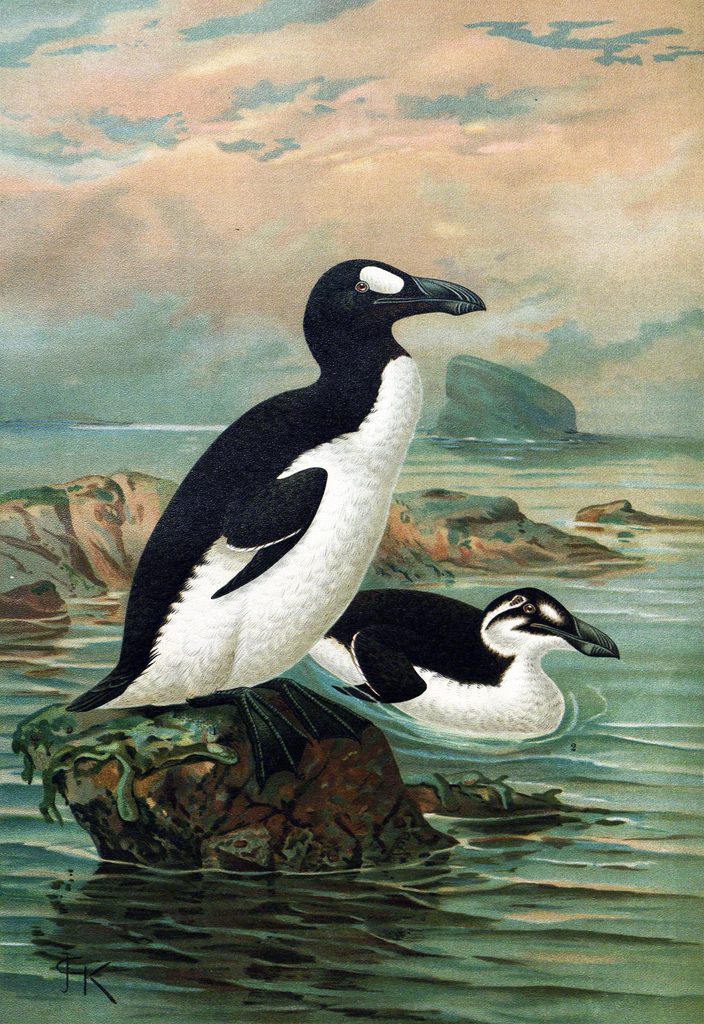
Standing about 75 centimetres (29.5 in) tall and weighing approximately 5 kilograms (11 lb) as adult birds, the flightless great auk was the second-largest member of both its family and the order Charadriiformes overall, surpassed only by the mancalline Miomancalla. It is, however, the largest species to survive into modern times. The great auks that lived farther north averaged larger in size than the more southerly members of the species. Males and females were similar in plumage, although there is evidence for differences in size, particularly in the bill and femur length. The back was primarily a glossy black, and the belly was white. The neck and legs were short, and the head and wings small. During summer, it developed a wide white eye patch over each eye, which had a hazel or chestnut iris. Auks are known for their close resemblance to penguins, their webbed feet and countershading are a result of convergent evolution in the water. During winter the great auk moulted and lost this eye patch, which was replaced with a wide white band and a grey line of feathers that stretched from the eye to the ear. During the summer, its chin and throat were blackish-brown and the inside of the mouth was yellow. In winter, the throat became white. Some individuals reportedly had grey plumage on their flanks, but the purpose, seasonal duration, and frequency of this variation is unknown. …
Range & habitat
The great auk was found in the cold North Atlantic coastal waters along the coasts of Canada, the Northeastern United States, Norway, Greenland, Iceland, the Faroe Islands, Great Britain, Ireland, France, and the Iberian Peninsula. Pleistocene fossils indicate the great auk also inhabited Southern France, Italy, and other coasts of the Mediterranean Basin. The southernmost records in the eastern Atlantic are two isolated bones from North Africa: one from Madeira and another from the Neolithic site of El Harhoura 2 in Morocco. In the western Atlantic, Great auk bones have been found as far south as Florida, where it may have been present during some periods: approximately 1000 BC, AD 1000, and the 17th century. However, it has also been suggested that some of the bones discovered in Florida may be the result of aboriginal trading. In recorded history, the great auk typically did not go farther south than Massachusetts Bay in the winter. It was particularly common on the Grand Banks of Newfoundland, the place where the last individual was recorded in 1852.
The great auk left the waters for land only to breed, even roosting at sea when not breeding. Rookeries of the great auk were found from Baffin Bay to the Gulf of St. Lawrence, across the far northern Atlantic, including Iceland, and in Norway and the British Isles in Europe. …
Wikipedia: “Distribution and habitat”
What it does
The great auk was never observed and described by modern scientists during its existence and is only known from the accounts of laymen, such as sailors, so its behaviour is not well known and difficult to reconstruct. Much may be inferred from its close, living relative, the razorbill, as well as from remaining soft tissue. Great auks walked slowly and sometimes used their wings to help them traverse rough terrain. When they did run, it was awkwardly and with short steps in a straight line. They had few natural predators, mainly large marine mammals, such as the orca, and white-tailed eagles. Polar bears preyed on nesting colonies of the great auk. Based on observations by the Naturalist Otto Fabricius (the only scientist to make primary observations on the great auk), some auks were "stupid and tame" whilst others were difficult to approach which he suggested was related to the bird's age. Humans preyed upon them as food, for feathers, and as specimens for museums and private collections. Great auks reacted to noises, but were rarely frightened by the sight of something. They used their bills aggressively both in the dense nesting sites and when threatened or captured by humans. These birds are believed to have had a life span of approximately 20 to 25 years. …
Wikipedia: “Ecology and behaviour”
In human culture
The great auk was one of the 4,400 animal species formally described by Carl Linnaeus in his eighteenth-century work Systema Naturae, in which it was given the binomial Alca impennis. The name Alca is a Latin derivative of the Scandinavian word for razorbills and their relatives. The bird was known in literature even before this and was described by Charles d'Ecluse in 1605 as Mergus Americanus. This also included a woodcut which represents the oldest unambiguous visual depictions of the bird. The species was not placed in its own scientific genus, Pinguinus, until 1791. The generic name is derived from the Spanish, Portuguese and French name for the species, in turn from Latin pinguis meaning "plump", and the specific name, impennis, is from Latin and refers to the lack of flight feathers, or pennae. The Irish name for the great auk is falcóg mhór, meaning "big seabird/auk". The Basque name is arponaz, meaning "spearbill". Its early French name was apponatz, while modern French uses grand pingouin. The Norse called the great auk geirfugl, which means "spearbird". This has led to an alternative English common name for the bird, garefowl or gairfowl. The Inuit name for the great auk was isarukitsok, which meant "little wing". The word "penguin" first appears in the 16th century as a synonym for "great auk". …
Wikipedia: “Etymology”
Listen
Looking for field recordings…
Where it lives
Recorded sightings
—
geo-referenced records in GBIF, from museums, herbaria and field observers.
Drag the globe to turn it. Dots are where records exist, not a range map; darker means more records.
In the old herbals & bestiaries

In the stacks
Searching the stacks…
Every page naming Pinguinus impennis in the Biodiversity Heritage Library →
This page is assembled live from iNaturalist, GBIF, Wikipedia, the Source Library and the Internet Archive. It is not yet part of the hand-edited codex. iNaturalist taxon 4540.