- Animals
- ›Chordates
- ›Vertebrates
- ›Mammals
- ›Therians
- ›Placental Mammals
- ›Primates, Rodents, and Allies
- ›Rodents
- ›Mice, Rats, and Hamsters
- ›Muroids
- ›Old World Mice and Rats
- ›Murines
- ›African and Indian Bush Rats
- ›Thallomys
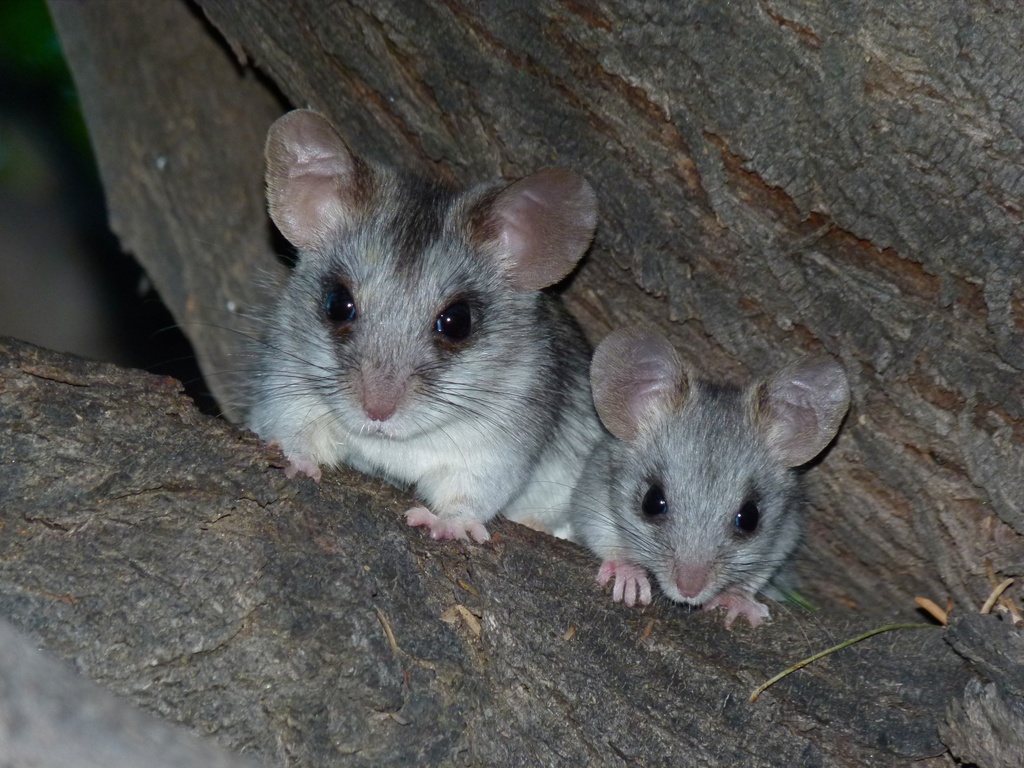
Black-tailed Acacia Rat
Thallomys nigricauda
The black-tailed tree rat, also called black-tailed acacia rat or black-tailed thallomys, (Thallomys nigricauda), is a species of rodent in the family Muridae. It is found in Angola, Botswana, Namibia and South Africa, where its natural habitat is subtropical or tropical dry shrubland. It is both nocturnal and arboreal and makes bulky nests in the trees, often acacias, where it feeds on leaves and buds.
From the article Black-tailed tree rat on Wikipedia (CC BY-SA), quoted section by section
Description
The black-tailed tree rat is a medium-sized rodent with a head-and body length of about 135 mm (5 in) and a tail of about 145 mm (6 in). The sides of the face are grey, and a dark band extends from the muzzle to around the eyes and below the ears. The eyes are large and the whiskers are long. The ears are large, oval, and set at an oblique angle. The dorsal fur is long and woolly, slate grey tinged with yellow. The underparts are white, the limbs are grey and the upper sides of the broad feet are white. The long tail is clad in black scales and black bristles, and tipped with black hairs.
Range & habitat
The black-tailed tree rat is endemic to southwestern Africa. Its range includes southwestern Angola, Namibia, Botswana and northwestern South Africa. It inhabits dry savanna, and thorny scrubland with dense patches of woodland or scattered trees such as Vachellia erioloba, Vachellia luederitzii, Vachellia karroo, Euclea pseudebenus, Terminalia sericea, and Boscia albitrunca.
Wikipedia: “Distribution and habitat”
What it does
This rat lives in trees and is nocturnal. The broad feet and robust claws make it an agile climber, and it uses its tail for balance as well as prehensilely. It particularly favours Vachellia erioloba trees where there are the crevices and holes it needs for its nest, but it also builds nests in the forks of branches or under slabs of bark; there may be several nests in one tree, not all of them occupied. The nest is a bulky affair of grass, leaves and twigs and may be as much as 30 cm (12 in) deep, with the nesting material overflowing from the cavity. The nest resembles that of the red-billed buffalo weaver but is made of finer material. Sometimes these rats are solitary while at other times, there may be an individual and several offspring living together. Both males and females have home ranges, the males' ranges being much larger than those of the females. A pair of rats and their offspring may share a nest, moving off at dusk to climb into the canopy where they nibble on young Acacia shoots, or cross into other large trees such as leadwood and mopane to feed. The diet mainly consists of leaves and buds, but also includes the outer layers of Acacia seed pods, occasional insects, and gum that oozes from the branches where the rats create grooves in the bark. …
Wikipedia: “Ecology”
Listen
Looking for field recordings…
Where it lives
Recorded sightings
—
geo-referenced records in GBIF, from museums, herbaria and field observers.
Drag the globe to turn it. Dots are where records exist, not a range map; darker means more records.
In the stacks
Searching the stacks…
Every page naming Thallomys nigricauda in the Biodiversity Heritage Library →
This page is assembled live from iNaturalist, GBIF, Wikipedia, the Source Library and the Internet Archive. It is not yet part of the hand-edited codex. iNaturalist taxon 45413.