- Animals
- ›Chordates
- ›Vertebrates
- ›Mammals
- ›Therians
- ›Placental Mammals
- ›Primates, Rodents, and Allies
- ›Rodents
- ›Mice, Rats, and Hamsters
- ›Muroids
- ›Old World Mice and Rats
- ›Murines
- ›Australasian Mice and Rats
- ›Leporillus
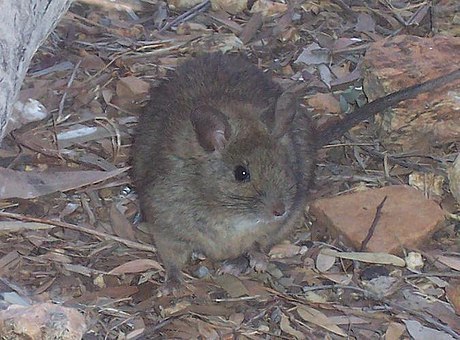
Greater Stick-nest Rat
Leporillus conditor
The greater stick-nest rat (Leporillus conditor), also known as the housebuilding rat and wopilkara, is a species of rodent in the family Muridae. They are about the size of a small rabbit and construct large nests of interwoven sticks. Once widespread across southern Australia, the population was reduced after European colonisation to a remnant outpost on South Australia's Franklin Islands. The species has since been reintroduced to a series of protected and monitored areas, with varying levels of success. Its close relative, the lesser stick-nest rat, is believed to be extinct.
From the article Greater stick-nest rat on Wikipedia (CC BY-SA), quoted section by section
Description
The species has a broad and short head, with wide and rounded ears. The length of the head and body combined in 190 to 260 millimetres, and a tail noticeably shorter than that, measuring from 148 to 180 mm. The weight ranges from 190 to 450 grams. The pelage is a uniform grey-brown colour at the upper-side, the buff to grey beneath is paler and the two colours blend where they meet. The visible parts of the foot are whitish at the inside and greyish brown at the outside, this is from 42 to 48 mm in length. The female possesses four teats, two pairs at the inguinal region.
Range & habitat
The species' natural habitat is dry savanna, with perennial shrubland, especially of succulent and semi-succulent plant species including the chenopod and pig-face genera. It was formerly widespread in semi-arid habitat on the mainland, where the soils were shallow with calcareous underlying strata. Before the sharp decline in population in the late nineteenth century, the species was found south of a line from Shark Bay to the meeting of the rivers at the Murray–Darling basin and above the 28° southern latitude. The drastic reduction in the range of this mammal is associated with the collapse of mammalian fauna in Australia between about 1875 and 1925, which is often linked to the decline of aboriginal land management and burning practices, widespread land clearance and agriculture, the introduction of foreign grazing animals including sheep, cattle and rabbits, and invasions by exotic predators like the European red fox and feral cats. …
Wikipedia: “Distribution and habitat”
What it does
The behavioural description is of a passive and gentle species, largely active at night, with a herbivorous diet largely composed of succulent leaves. The 'nest' of L. conditor is sited at a cave, rocky outcrop or over a shrub, the construction reaching a metre in height and around two metres in width. The larger part of the nest is tightly woven from sticks, the inner part is built from softer grassy material. Ownership of nests appears typically to be passed down through relatively sedentary, genetically related female lines, with males typically distributing throughout the landscape at sexual maturity. Mainland populations were reported in historical accounts to prefer building nests over slight depressions in the ground or above the burrows of other animals, which were used as escape routes. Some animals were known to weight their nests with small rocks. …
Wikipedia: “Behaviour”
Listen
Looking for field recordings…
Where it lives
Recorded sightings
—
geo-referenced records in GBIF, from museums, herbaria and field observers.
Drag the globe to turn it. Dots are where records exist, not a range map; darker means more records.
In the stacks
Searching the stacks…
Every page naming Leporillus conditor in the Biodiversity Heritage Library →
This page is assembled live from iNaturalist, GBIF, Wikipedia, the Source Library and the Internet Archive. It is not yet part of the hand-edited codex. iNaturalist taxon 45507.