- Animals
- ›Chordates
- ›Vertebrates
- ›Birds
- ›Shorebirds and Allies
- ›Auks, Murres, and Puffins
- ›Synthliboramphus
On eBird ↗
Japanese Murrelet
Live sightings near you, the range map, bar charts of when it is seen, and Macaulay Library photos and recordings.
Japanese Murrelet
Synthliboramphus wumizusume
The Japanese murrelet or crested murrelet (Synthliboramphus wumizusume) is a small seabird in the auk family that occurs along the remote rocky coasts and in the offshore waters of Japan, and may also be found after the breeding season as far as Sakhalin to the north and in particular off South Korea. With a small and declining population, estimated as of 2017 to total 2,500–10,000 individuals, it is the rarest alcid, and the most at risk of extinction.
From the article Japanese murrelet on Wikipedia (CC BY-SA), quoted section by section
Description
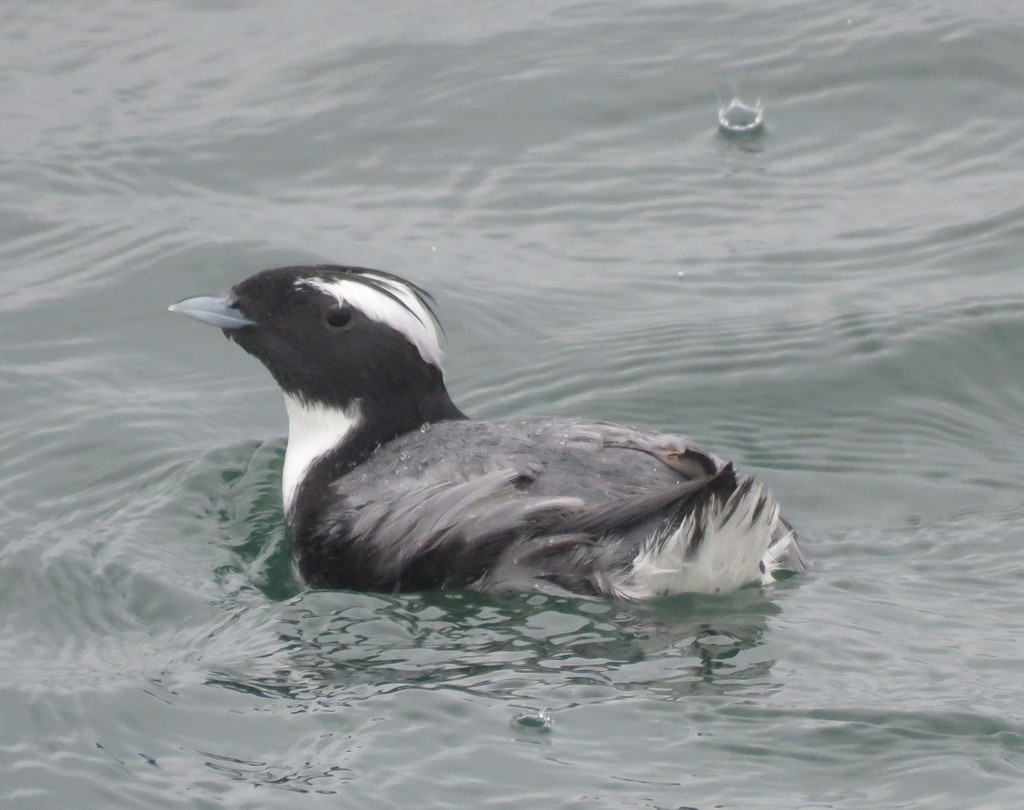
The Japanese murrelet is a smallish seabird 24–26 cm (9.4–10.2 in) in length, with a wingspan of 43 cm (17 in), and weighing some 164–183 g (5.8–6.5 oz). Its upperparts are blackish and bluish grey, its throat and underparts white, legs and feet a yellowish grey, and short, thick bill a bluish grey, the culmen being darker; the iris is a dark brown. The black head features a white stripe from the top of each eye that meets on the nape, although this is less visible in winter. It may be distinguished from the Ancient murrelet (Synthliboramphus antiquus), which also occurs in much of its range, in particular by its summer crest of black feathers 3–5 cm (1.2–2.0 in) in length, although this again is absent in winter. Juveniles resemble winter adults, though the head and upperparts are somewhat browner. The Japanese murrelet's calls include a quiet "ch-ch-chi-chi" (「チッ、チッ、チ、チ」), while in flight, "peee-p-p-p" (「ピィー、ピッ、ピッ、ピッ」) and "jee-jujjujju" (「ジージュッジュッジュッ」), and while at the nest "jijiji-pipewpipewkukukuku" (「ジジジ、ピピュウピピュウクククク」), "gugguwa-gugugu" (「グッグワ、グググ」), and "jukkukuwa-kuwakuwakuwa" (「ジュッククワ、クワクワクワ」).
Range & habitat
The Japanese murrelet occurs in the boreo-cool and temperate-subtropical waters of the northwest Pacific. It breeds on the small rocky islets and coasts of Japan from Nanatsujima in Ishikawa Prefecture in the north to Tori-shima in the Izu Islands of Tokyo Metropolis to the south, the chief areas being Birōjima in Miyazaki Prefecture, followed by the Izu Islands, and other small islands such as Mimiana Island (耳穴島) in Mie Prefecture, and Kōshima (幸島) in Kōchi Prefecture; family groups have been reported from the waters off Yashima [ja] in Kaminoseki at the western end of the Seto Inland Sea, and a pair with two chicks has been collected off the south coast of Korea, across the Tsushima Strait. After breeding, it disperses along Honshū and Kyūshū, in the warm waters of the Kuroshio Current and Tsushima Current, with records from Iturup and Shikotan in the Southern Kuriles, Sakhalin, Peter the Great Bay and Olga Bay in Primorsky Krai, Fujian (1894), South Korea, and Taiwan (1973). It flies back around December and winters mostly offshore from its breeding locations.
Wikipedia: “Distribution and habitat”
What it does
The Japanese murrelet's diet mostly comprises krill, other planktonic crustaceans, crangonid shimps, larval and small pelagic fish, including Pacific herring (Clupea pallasii), sculpin (Triglops), and smelt (Osmerus), sand eels (Ammodytes), and sandlances (Hypoptychus dybowskii). It nests in rocky crevices and hollows, in the gaps between piles of stones, and among the grasses on uninhabited islands. Typically two eggs are laid, a week apart, from late March to early April, though this takes place a little earlier on Tori-shima, at the southern end of its breeding range. Month-long incubation duty is shared almost equally by both parents. The precocial chicks are not fed in the nest, but leave it together with their parents on the second night after hatching.
Wikipedia: “Ecology”
Listen
Looking for field recordings…
Where it lives
Recorded sightings
—
geo-referenced records in GBIF, from museums, herbaria and field observers.
Drag the globe to turn it. Dots are where records exist, not a range map; darker means more records.
In the stacks
Searching the stacks…
Every page naming Synthliboramphus wumizusume in the Biodiversity Heritage Library →
This page is assembled live from iNaturalist, GBIF, Wikipedia, the Source Library and the Internet Archive. It is not yet part of the hand-edited codex. iNaturalist taxon 4560.