- Animals
- ›Chordates
- ›Vertebrates
- ›Mammals
- ›Therians
- ›Placental Mammals
- ›Primates, Rodents, and Allies
- ›Rodents
- ›Mice, Rats, and Hamsters
- ›Muroids
- ›Old World Mice and Rats
- ›Murines
- ›African and Indian Bush Rats
- ›Stochomys
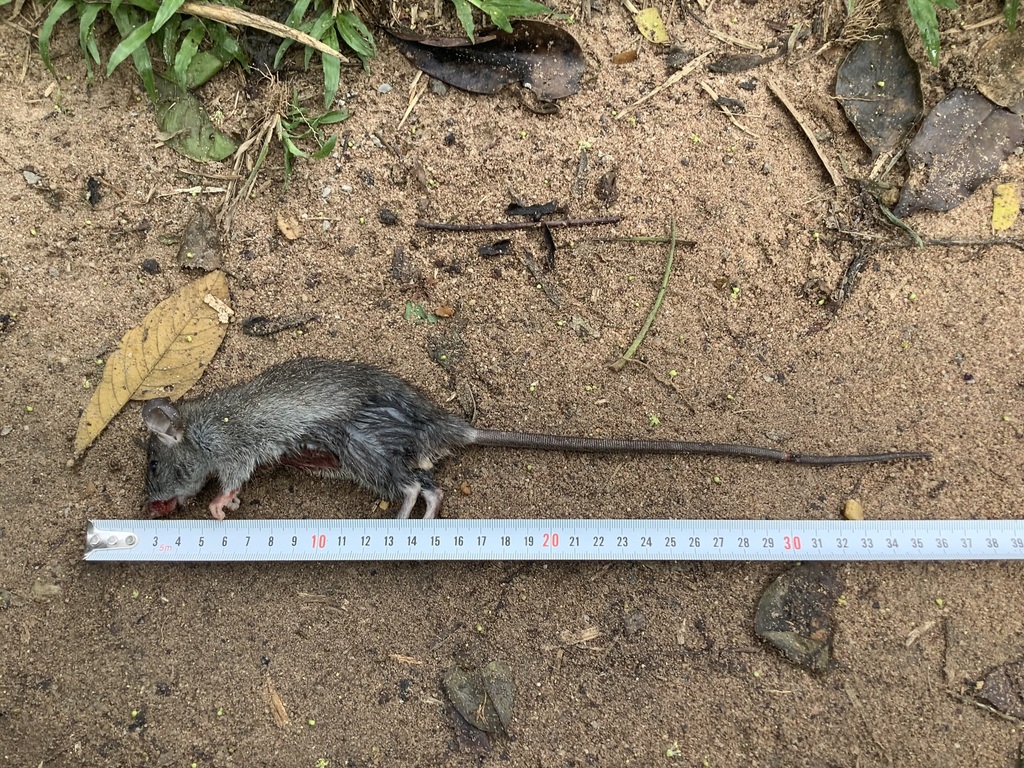
Target Rat
Stochomys longicaudatus
The target rat (Stochomys longicaudatus) is a species of rodent in the family Muridae. It is the only species in the genus Stochomys. It is found in Benin, Cameroon, Central African Republic, Republic of the Congo, Democratic Republic of the Congo, Equatorial Guinea, Gabon, Nigeria, Togo, and Uganda. Its natural habitat is subtropical or tropical moist lowland forests.
From the article Target rat on Wikipedia (CC BY-SA), quoted section by section
Description
The target rat is a moderately sized rat-like rodent, with a head-body length of 13 to 17 centimetres (5.1 to 6.7 in) and weighing around 90 grams (3.2 oz). The fur is dark reddish-brown over the back, becoming greyish on the flanks, and fading to pale grey on the underparts. The sparsely bristled tail is much longer than the body, being typically 18 to 22 centimetres (7.1 to 8.7 in) in length. Females have six teats. It is so named because it has a number of long dark bristles projecting from its rump which resemble the shafts of arrows in a target. The synonym Mus sebastianus also refers to this, Saint Sebastian being an early Christian martyr said to have been tied to a tree and shot with arrows.
Range & habitat
The target rat is native to humid rainforests in tropical western Central Africa at elevations from sea level to 1,000 metres (3,300 ft). Its range extends from Togo through Benin and Nigeria to the Congo Basin and eastwards to western Uganda. It occurs in swampy areas of forests and in gallery forests and beside streams. It has also been observed in secondary forests around villages and in banana plantations. Two subspecies are currently recognised:
S. l. longicaudatus (Tullberg 1893) - Togo to the Republic of the Congo S. l. ituricus (Thomas, 1915) - the Democratic Republic of the Congo, Rwanda, Burundi, western Uganda
Wikipedia: “Distribution and habitat”
What it does
The target rat is largely nocturnal and feeds on the ground on green vegetable material and fallen fruit, supplementing these with some insects. In addition to moving along the ground, it often climbs into the rainforest understory, although not high into trees. It has been reported to construct spherical nests of shredded grass. Little is known of the social organisation of this species but in Cameroon a group of thirteen was caught at one location in an oil palm plantation. Breeding takes place throughout the year, but may be more common between February and May and between September and December. Litters range from one to four young.
Wikipedia: “Biology and behaviour”
Listen
Looking for field recordings…
Where it lives
Recorded sightings
—
geo-referenced records in GBIF, from museums, herbaria and field observers.
Drag the globe to turn it. Dots are where records exist, not a range map; darker means more records.
In the stacks
Searching the stacks…
Every page naming Stochomys longicaudatus in the Biodiversity Heritage Library →
This page is assembled live from iNaturalist, GBIF, Wikipedia, the Source Library and the Internet Archive. It is not yet part of the hand-edited codex. iNaturalist taxon 45704.