- Animals
- ›Chordates
- ›Vertebrates
- ›Mammals
- ›Therians
- ›Placental Mammals
- ›Primates, Rodents, and Allies
- ›Rodents
- ›Mice, Rats, and Hamsters
- ›Muroids
- ›Hamsters, Voles, Lemmings, and Allies
- ›North American Mice and Rats
- ›North American Deer Mice
- ›Neotomodon
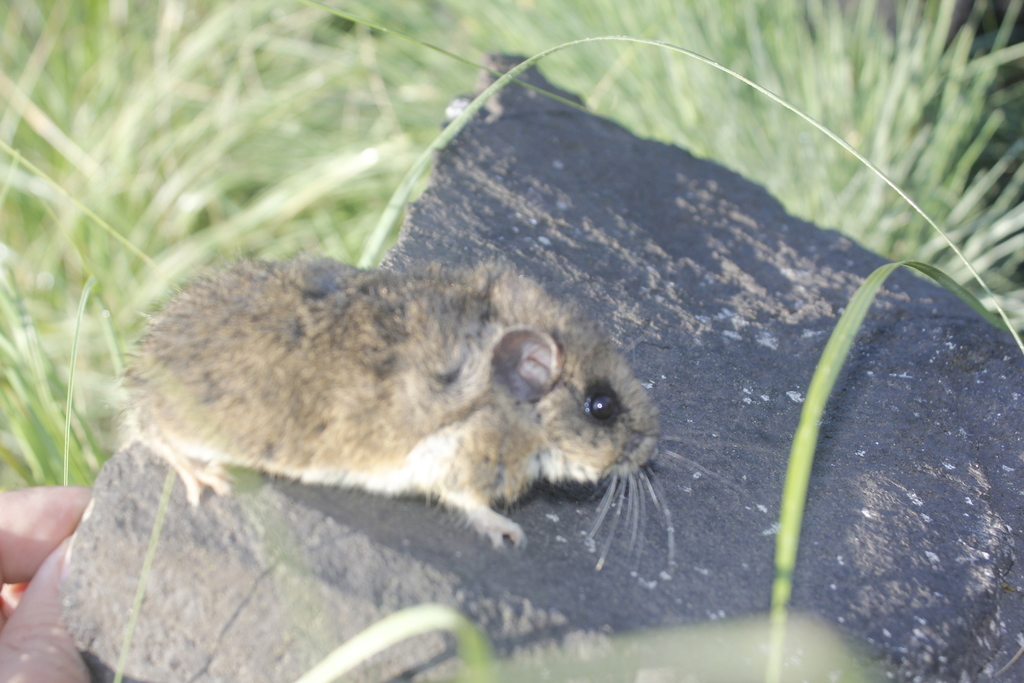
Mexican volcano mouse
Neotomodon alstoni
The Mexican volcano mouse (Neotomodon alstoni) is a species of rodent in the family Cricetidae endemic to high elevation areas of the Trans-Mexican Volcanic Belt.
From the article Mexican volcano mouse on Wikipedia (CC BY-SA), quoted section by section
Description
The Volcano mouse has a relatively medium-sized compared to other members of its genus. It has a pair of broad, naked ears while its fur is rather soft with grayish to fulvous brown color dorsally and whitish ventrally. Its tail is quite short but sharply bicolored. Compared to its short brain case entrapped in a broad skull, its zygomatic expanded. Its molars are pretty large and densely enameled. No sexual dimorphism in this species. With relatively large eyes and ears, bi-colored body and tail (dark dorsally and white ventrally), and a tail slightly shorter than the body length, the Mexican volcano mouse appears very similar to a deer mouse, but it is diagnosed by several skull characters including the number and extent of palatal ridges and molar characteristics.
Wikipedia: “Characteristics”
Range & habitat
The Volcano mouse is seen to reside restrictively to higher elevation or boreal habitats of the trans-volcanic belt of Central Mexico. There has been no discovery of the fossil record for this species but it seems to have a similarity in appearance to Pliotomodon' fossil. The mouse can perform simple burrowing in well-drained areas and sometimes pass under boulders.
Wikipedia: “Distribution”
Listen
Looking for field recordings…
Where it lives
Recorded sightings
—
geo-referenced records in GBIF, from museums, herbaria and field observers.
Drag the globe to turn it. Dots are where records exist, not a range map; darker means more records.
In the stacks
Searching the stacks…
Every page naming Neotomodon alstoni in the Biodiversity Heritage Library →
This page is assembled live from iNaturalist, GBIF, Wikipedia, the Source Library and the Internet Archive. It is not yet part of the hand-edited codex. iNaturalist taxon 45770.