On eBird ↗
Lesser Jacana
Live sightings near you, the range map, bar charts of when it is seen, and Macaulay Library photos and recordings.
Lesser Jacana
Microparra capensis
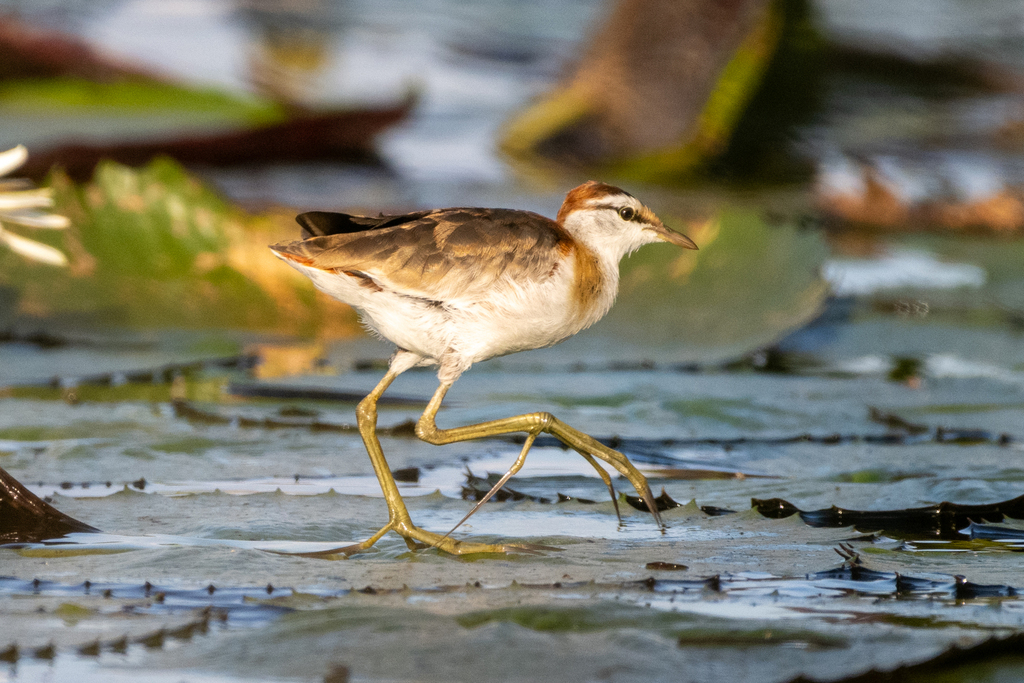
The lesser jacana (Microparra capensis) is a wader in the family Jacanidae and can be found in Africa. It can be recognized by its long legs and claws that allow it to walk on aquatic vegetation – although it is not to be confused with the larger African Jacana. The lesser jacana is insectivorous. Its conservation status is of least concern.
The name jacana is derived from a Tupi name of the bird, ñaha'nã.
From the article Lesser jacana on Wikipedia (CC BY-SA), quoted section by section
Description
The smallest species in the Jacanidae family, the lesser jacana is 15–16 cm (5.9–6.3 in) tall and weighs 41 g (1.4 oz). It has a white breast, golden forehead, cinnamon crown, and dark eyestripe. Its mantle and wings are also darker. As other jacanas, they have long legs and claws which are adapted for walking on lily-pads and aquatic grasses – which is why jacanas are sometimes referred to as lily trotters or Jesus birds because they appear as though they are walking on the surface of the water. Lesser jacana eggs resemble African jacana eggs but are smaller. African jacana juveniles closely resemble adult lesser jacanas, and the two may be confused as their range overlaps in Southern Africa. In the field, lesser jacanas are reportedly more easily identifiable when flying as they may hide in aquatic vegetation. In flight, its legs appear long and trail behind its body. Its wings have a white trailing edge. The lesser jacana has minimal sexual dimorphism, with males and females being nearly identical, although the female is on average 4% larger than the male. Males are reported to have darker backs than females.
Range & habitat
The lesser jacana can be found in wetland habitats in Angola, Botswana, Burkina Faso, Burundi, Cameroon, Central African Republic, Chad, Democratic Republic of the Congo, Eswatini, Ivory Coast, Ethiopia, Kenya, Malawi, Mali, Mauritania, Mozambique, Namibia, Niger, Nigeria, Rwanda, Sierra Leone, South Africa, Sudan, Tanzania, Uganda, Zambia, and Zimbabwe. They occupy the shorelines of permanent and seasonally flooded wetlands in Africa. They hang out in areas that are partially grown with sedge and grass. As new pools are filled with rainfall, lesser jacanas may move into these newly flooded habitats. They favor areas where sedge and grass cover is sparse, but more abundant as compared to water lilies. They use aquatic vegetation for cover and may be inconspicuous as a result. Lesser jacanas range overlaps with that of the African Jacana, and these species often coexist.
Wikipedia: “Habitat and Distribution”
What it does
As the lesser jacana trots across lily pads or climbs grass stems, it is able to forage insects from emergent vegetation. It has been observed to peck insects off surrounding vegetation, to search for insects by lifting submerged stems out of the water with its bill, and to swim for food at the water's surface.
Wikipedia: “Diet”
Listen
Looking for field recordings…
Where it lives
Recorded sightings
—
geo-referenced records in GBIF, from museums, herbaria and field observers.
Drag the globe to turn it. Dots are where records exist, not a range map; darker means more records.
In the stacks
Searching the stacks…
Every page naming Microparra capensis in the Biodiversity Heritage Library →
This page is assembled live from iNaturalist, GBIF, Wikipedia, the Source Library and the Internet Archive. It is not yet part of the hand-edited codex. iNaturalist taxon 4587.