- Animals
- ›Chordates
- ›Vertebrates
- ›Mammals
- ›Therians
- ›Placental Mammals
- ›Primates, Rodents, and Allies
- ›Rodents
- ›Ctenohystricans
- ›Hystricognaths
- ›Degus, Hutias, Tuco-tucos, and Allies
- ›Tuco-Tucos
- ›Ctenomys
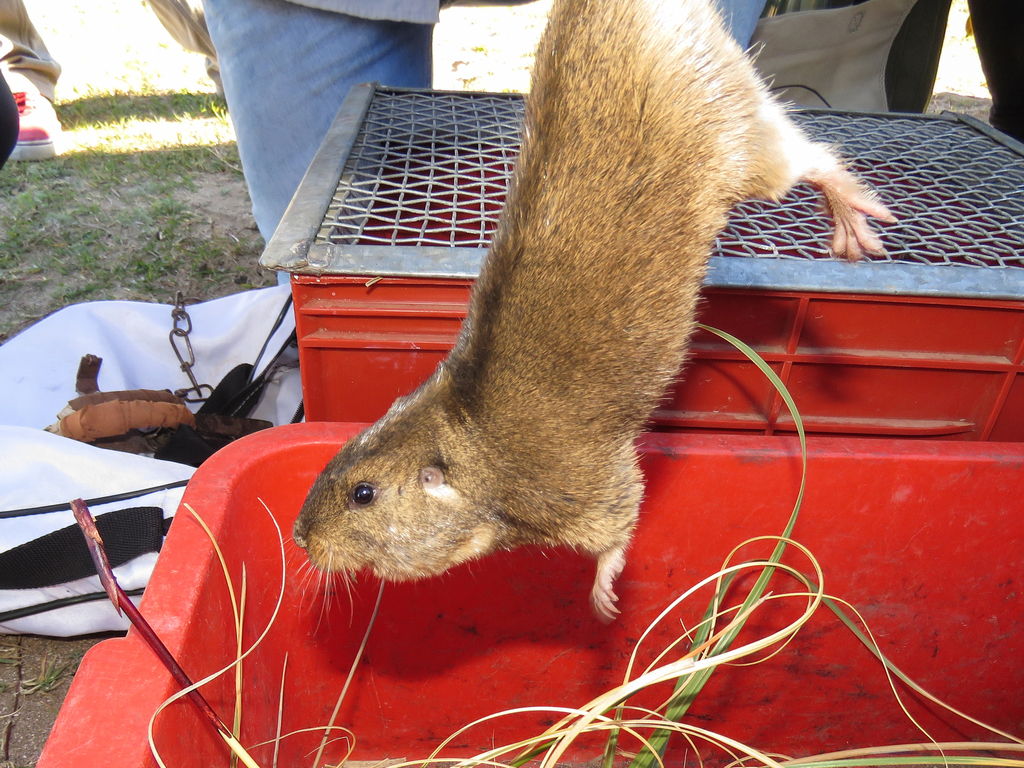
Talas Tuco-tuco
Ctenomys talarum
The Talas tuco-tuco (Ctenomys talarum) is a species of tuco-tuco endemic to eastern Argentina.
From the article Talas tuco-tuco on Wikipedia (CC BY-SA), quoted section by section
Description
The Talas tuco-tuco is a large rodent ranging in size from 212 to 254 mm (8.35 to 10.00 in), more than twice the size of a house mouse. Its tail length varies from 56 to 75 mm (2.20 to 2.95 in) and it weighs approximately 118 g (4.2 oz). The species shows significant sexual dimorphism. The Talas tuco-tuco basically has a cylindrically-shaped body, but is larger around the head and shoulders. It has short fine hair, which is normally a mix of hazel, gray and red on the back, and white on the underparts. It also has a distinct white patch on either side of the head, along the lower edge of its ears. Its eyes and ears are small compared to its headband it has very long, curved claws on all four feet.
Range & habitat
The Talas tuco-tuco is subterranean, living in burrows. Only one inhabits a particular burrow at a time; however, some build extensive burrowing systems connecting individual burrows with tunnels. They prefer areas with loamy soil, grass, perennials plants and woody shrubs. In some cases, they can be found in sandy soils as well. They are usually found along the coasts of the Buenos Aires, La Pampa and Santa Fe provinces.
Wikipedia: “Distribution and habitat”
What it does
The Talas tuco-tuco is solitary, aggressive and territorial. They use scent recognition to distinguish between individuals. Males engage in one on one confrontations with other males for prospective mates, using their sharp incisors as weapons. These can also be used as digging tools, but they prefer to use their claws when building their burrows. Although they are subterranean, they spend much of their time above the ground, foraging for food.
== References ==
Wikipedia: “Behavior”
Listen
Looking for field recordings…
Where it lives
Recorded sightings
—
geo-referenced records in GBIF, from museums, herbaria and field observers.
Drag the globe to turn it. Dots are where records exist, not a range map; darker means more records.
In the stacks
Searching the stacks…
Every page naming Ctenomys talarum in the Biodiversity Heritage Library →
This page is assembled live from iNaturalist, GBIF, Wikipedia, the Source Library and the Internet Archive. It is not yet part of the hand-edited codex. iNaturalist taxon 45903.