- Animals
- ›Chordates
- ›Vertebrates
- ›Mammals
- ›Therians
- ›Placental Mammals
- ›Primates, Rodents, and Allies
- ›Rodents
- ›Ctenohystricans
- ›Hystricognaths
- ›Degus, Hutias, Tuco-tucos, and Allies
- ›Tuco-Tucos
- ›Ctenomys
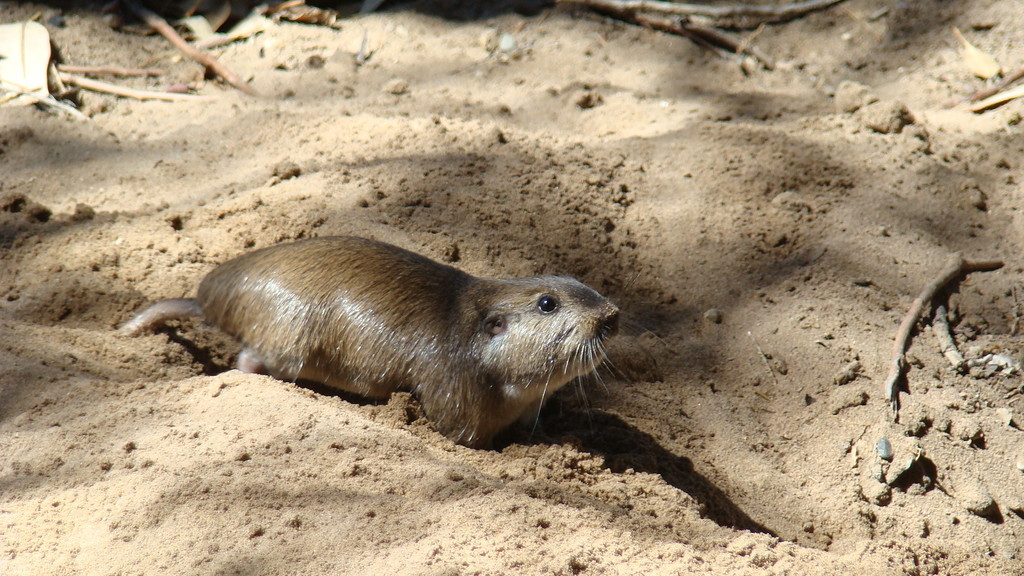
Mendoza Tuco-tuco
Ctenomys mendocinus
The Mendoza tuco-tuco (Ctenomys mendocinus) is a species of rodent in the family Ctenomyidae.
From the article Mendoza tuco-tuco on Wikipedia (CC BY-SA), quoted section by section
Description
Ctenomys mendocinus ranges from 230 to 280 mm (9.1 to 11.0 in) in body length, and tail length of 70–91 mm (2.8–3.6 in). Body mass ranges anywhere between 100 and 250 g (3.5 and 8.8 oz), with males typically larger than females. They have a stocky, robust body shape with short limbs and ears. Pelage is predominantly light-brown with subtle black and white coloration on its dorsal side, and a lightly colored tail. Forelimbs have long claws, necessary for burrowing.
Range & habitat
The species is endemic to the northern and central regions of the Mendoza province in Argentina, at a range of elevation from 460 to 3,600 m (1,510 to 11,810 ft).
Wikipedia: “Distribution”
What it does
Members of this species engage in solitary burrowing behavior. Their foreleg claws are their primary method of digging tunnels through the ground, although the incisors may be used occasionally. They generally do not arise above the surface during the day time; however, they have a preference for above ground plant material and will surface to forage for food. Newborns are highly altricial: after a 3-month gestation period, pups are born half-naked and blind, weaning 56 days after birth and becoming independent after 80 days.
Wikipedia: “Behavior”
Listen
Looking for field recordings…
Where it lives
Recorded sightings
—
geo-referenced records in GBIF, from museums, herbaria and field observers.
Drag the globe to turn it. Dots are where records exist, not a range map; darker means more records.
In the stacks
Searching the stacks…
Every page naming Ctenomys mendocinus in the Biodiversity Heritage Library →
This page is assembled live from iNaturalist, GBIF, Wikipedia, the Source Library and the Internet Archive. It is not yet part of the hand-edited codex. iNaturalist taxon 45910.