- Animals
- ›Chordates
- ›Vertebrates
- ›Ray-finned Fishes
- ›Dragonfishes and Allies
- ›Dragonfishes
- ›Scaly Dragonfishes
- ›Borostomias
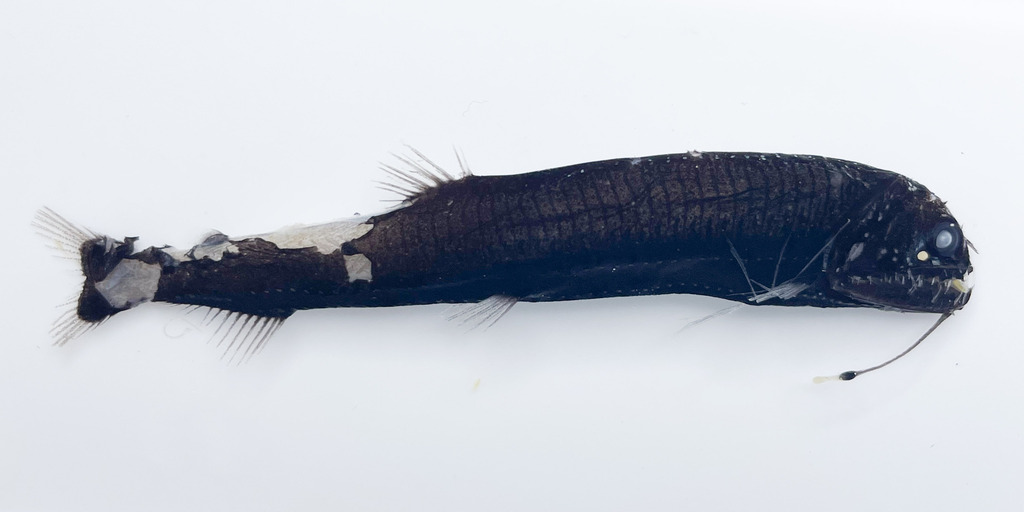
Antarctic Snaggletooth
Borostomias antarcticus
The large-eye snaggletooth (Borostomias antarcticus), also called the straightline dragonfish or Antarctic snaggletooth, is a species of fish in the family Stomiidae (barbeled dragonfishes).
From the article Large-eye snaggletooth on Wikipedia (CC BY-SA), quoted section by section
Description
The large-eye snaggletooth is black in colour, up to 35 cm (14 in) in length. It has 9–13 dorsal soft rays and 12–17 anal soft rays. It is identified by the lack of high arch in the photophores behind the anal base, presence of double postorbital organ and the clear separation of the dagger-like teeth in its upper jaw. It has 40–60 lateral photophores extending along its belly and positioned in two straight lines. The genome of Borostomias antarcticus contains at least fifteen filovirus-like elements (nucleoprotein-like) of which nine have extended open reading frames.
Range & habitat
The large-eye snaggletooth is bathydemersal and mesopelagic, staying below 500 m (1,600 ft) during the day, sometimes as deep as 2,500 m (8,200 ft). It is found in oceans worldwide.
Wikipedia: “Habitat”
What it does
The large-eye snaggletooth feeds on mysids, bony fish and crustaceans.
== References ==
Wikipedia: “Behaviour”
Where it lives
Recorded sightings
—
geo-referenced records in GBIF, from museums, herbaria and field observers.
Drag the globe to turn it. Dots are where records exist, not a range map; darker means more records.
In the stacks
Searching the stacks…
Every page naming Borostomias antarcticus in the Biodiversity Heritage Library →
This page is assembled live from iNaturalist, GBIF, Wikipedia, the Source Library and the Internet Archive. It is not yet part of the hand-edited codex. iNaturalist taxon 459178.