- Animals
- ›Chordates
- ›Vertebrates
- ›Mammals
- ›Therians
- ›Placental Mammals
- ›Primates, Rodents, and Allies
- ›Rodents
- ›Ctenohystricans
- ›Hystricognaths
- ›Degus, Hutias, Tuco-tucos, and Allies
- ›Octodonts and Degus
- ›Tympanoctomys
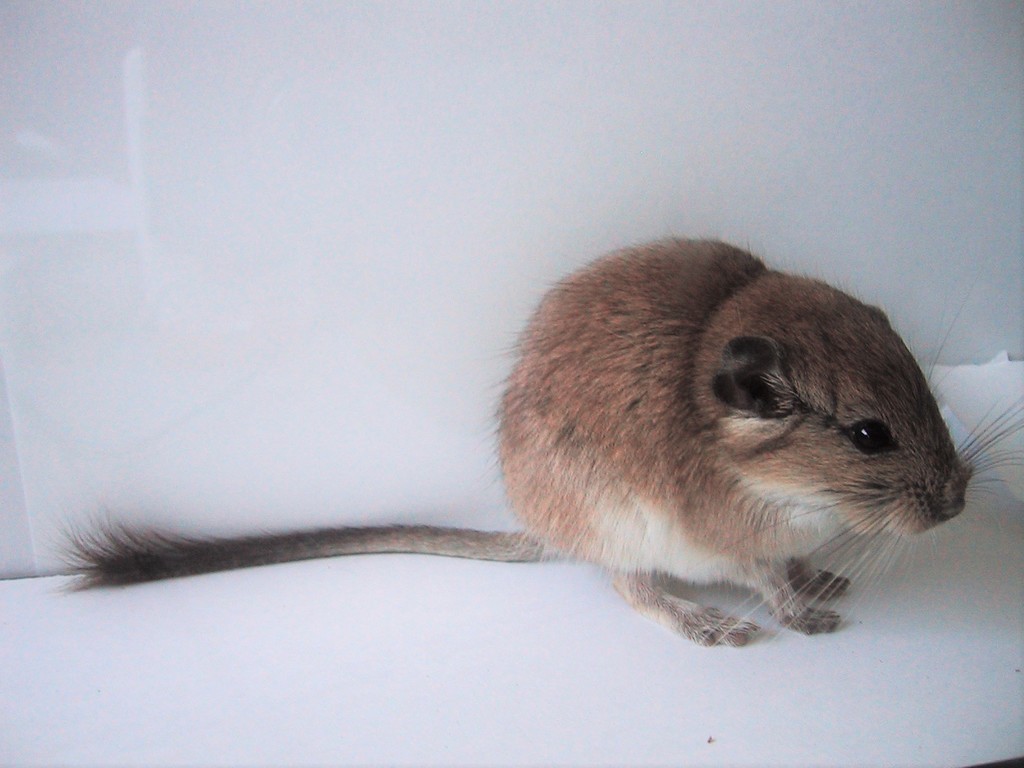
Plains Viscacha Rat
Tympanoctomys barrerae
The plains viscacha rat, plains vizcacha rat, red viscacha rat, or red vizcacha rat (Tympanoctomys barrerae) is a species of rodent in the family Octodontidae native to Argentina. It is one of three species in the genus Tympanoctomys.
From the article Plains viscacha rat on Wikipedia (CC BY-SA), quoted section by section
Description
The plains viscacha rat is a moderately-sized rat, with a large head, long tail, and short ears. Adults measure about 13 cm (5.1 in) in total length, with a 15 cm (5.9 in) tail, and weigh an average of 90 g (3.2 oz), with males being slightly larger than females. The rat has buff-yellow fur with white underparts, fading to dark brown at the tip of the tail.
Range & habitat
The plains viscacha rat is endemic to central western Argentina, where it has a fragmented range in Mendoza Province and western La Pampa. Its natural habitat is desert scrubland, dunes and salt flats, between 300 and 1,400 m (980 and 4,590 ft). There are no recognised subspecies. The species is threatened by destruction of its fragmented and restricted habitat.
Wikipedia: “Distribution and habitat”
What it does
Plains viscacha rats are solitary, and nocturnal. They construct complex burrow systems within large artificial mounds. Typical mounds are 13.6 by 8.7 m (45 by 29 ft) across, and 1.25 m (4 ft 1 in) in height, and have an average of 23 burrow entrances. Within the mound, the burrow system has up to three levels and contains numerous chambers and dead-end tunnels. The large burrow system, along with the food and fecal material deposited by the rodents, creates refugia with a stabilized and humid microclimate that are vital for other plants, invertebrates, and vertebrates. The rats are herbivorous, feeding primarily on halophytic vegetation, such as Atriplex and Suaeda, although they will occasionally eat other plants such as grass. The rats scrape off and discard salt from the leaves of Atriplex saltbushes with their teeth and bristles around their mouths before eating them. Although this reduces their salt intake, they still produce highly concentrated urine to help maintain their water balance. The young are born blind, and weighing about 4 g (0.14 oz). Their eyes open at about six days, and they begin to take solid food at ten days.
Wikipedia: “Biology and behaviour”
Listen
Looking for field recordings…
Where it lives
Recorded sightings
—
geo-referenced records in GBIF, from museums, herbaria and field observers.
Drag the globe to turn it. Dots are where records exist, not a range map; darker means more records.
In the stacks
Searching the stacks…
Every page naming Tympanoctomys barrerae in the Biodiversity Heritage Library →
This page is assembled live from iNaturalist, GBIF, Wikipedia, the Source Library and the Internet Archive. It is not yet part of the hand-edited codex. iNaturalist taxon 45926.