- Animals
- ›Chordates
- ›Vertebrates
- ›Mammals
- ›Therians
- ›Placental Mammals
- ›Primates, Rodents, and Allies
- ›Rodents
- ›Squirrels, Dormice, and Mountain Beavers
- ›Squirrels
- ›Typical and Flying Squirrels
- ›Typical Squirrels
- ›Sciurus
- ›Sciurus
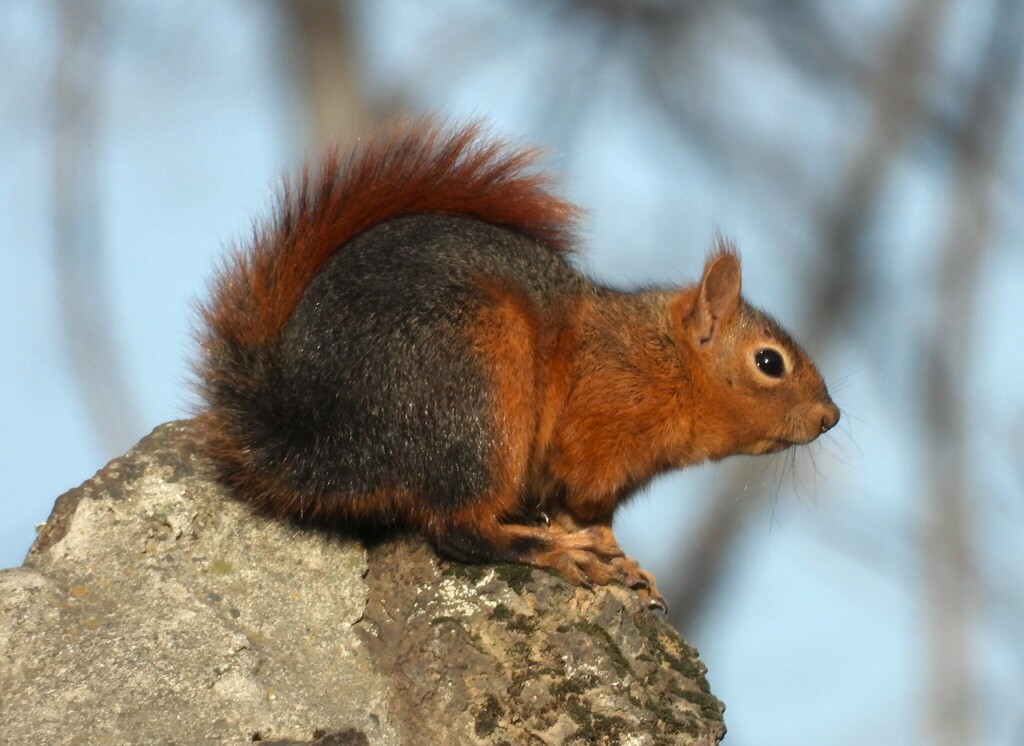
Caucasian Squirrel
Sciurus anomalus
The Caucasian squirrel (Sciurus anomalus) or Persian squirrel is a tree squirrel in the genus Sciurus found in temperate broadleaf and mixed forests in south-western Asia.
The species is traditionally said to have first been described in 1778 by Johann Friedrich Gmelin in the 13th edition of Systema Naturae, and named Sciurus anomalus. However, this work was actually published in 1788, so the true first description was made by Johann Anton Güldenstädt in 1785. Gmelin made reference to this in the 1788 work, citing Güldenstädt as the author.
From the article Caucasian squirrel on Wikipedia (CC BY-SA), quoted section by section
Description
Caucasian squirrels are small tree squirrels, with a total length of 32 to 36 cm (13 to 14 in), including the 13 to 18 cm (5.1 to 7.1 in) tail, and weighing 250 to 410 g (8.8 to 14.5 oz). The color of the upper body fur ranges from greyish brown to pale grey, depending on the subspecies, while that of the underparts is rusty brown to yellowish, and that of the tail is yellow brown to deep red. The claws are relatively short, compared with those of other tree squirrels, and females have either eight or ten teats. Samuel Griswold Goodrich described the Caucasian squirrel in 1885 as "Its color is grayish-brown above, and yellowish-brown below".
Range & habitat
Caucasian squirrels are native to south-western Asia, where they are found from Turkey, and the islands of Gökçeada and Lesbos in the west, Iran in the southeast, and as far as Israel and Jordan in the south. It is one of only two species of the genus Sciurus to be found on Mediterranean islands, and, although Eurasian red squirrels have been recently introduced to some areas, is the only species of Sciurus native to the wider region. The species mainly lives in mixed and deciduous forests, including ones dominated by oak, pine, and pistachio. They can also be encountered in coniferous forests, rocky areas, and chestnut, walnut, almond, and olive orchards. They are found up to altitudes of 2,000 metres (6,600 ft). Three subspecies are recognised:
S. a. anomalus - Lesbos, Turkey and Transcaucasia. Belly is chestnut gray-buff. S. a. pallescens - Iraq and the Zagros Mountains and Fars District in Iran. Belly is pale gray. S. a. syriacus - Lebanon, Syria, Israel, and Jordan. Belly is yellow to gold.
Wikipedia: “Distribution and habitat”
What it does
The squirrels are diurnal and solitary, although temporary groups may forage where food is plentiful. Their diet includes nuts, seeds, tree shoots, and buds, with the seeds of oak and pine being particularly favored. Like many other squirrels, they cache their food within tree cavities or loose soil, with some larders containing up to 6 kg (13 lb) of seeds.
They live in trees, where they make their dens, but frequently forage on the ground, and are considered less arboreal than Eurasian red squirrels. They commonly nest in tree hollows lined with moss and leaves, and located 5 to 14 m (16 to 46 ft) above the ground, but nests are also sometimes found under rocks or tree roots. Their alarm call is high-pitched, and said to resemble the call of the European green woodpecker, and they mark their territories with urine and dung. Breeding occurs throughout the year, but is more common in spring or autumn. Litters range from two to seven, with three or four being typical, and the young are fully mature by five or six months of age.
Wikipedia: “Biology and behavior”
Listen
Looking for field recordings…
Where it lives
Recorded sightings
—
geo-referenced records in GBIF, from museums, herbaria and field observers.
Drag the globe to turn it. Dots are where records exist, not a range map; darker means more records.
In the stacks
Searching the stacks…
Every page naming Sciurus anomalus in the Biodiversity Heritage Library →
This page is assembled live from iNaturalist, GBIF, Wikipedia, the Source Library and the Internet Archive. It is not yet part of the hand-edited codex. iNaturalist taxon 46015.