- Animals
- ›Chordates
- ›Vertebrates
- ›Mammals
- ›Therians
- ›Placental Mammals
- ›Primates, Rodents, and Allies
- ›Rodents
- ›Squirrels, Dormice, and Mountain Beavers
- ›Squirrels
- ›Asian Giant Squirrels
- ›Ratufa
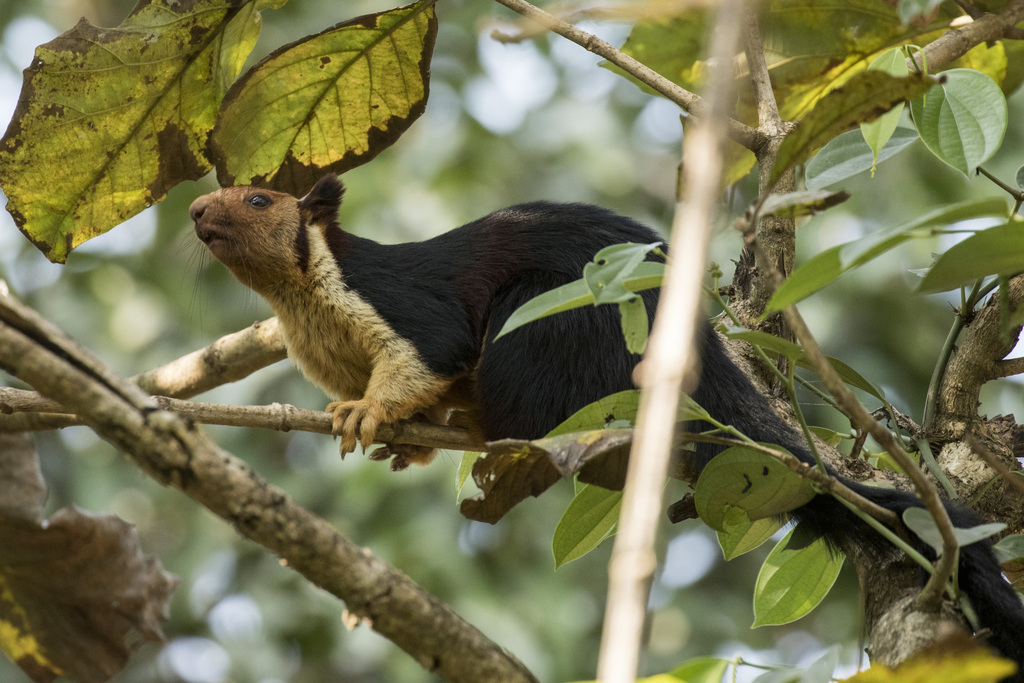
Indian Giant Squirrel
Ratufa indica
The Indian giant squirrel, or Malabar giant squirrel, (Ratufa indica) is a large tree squirrel species genus Ratufa native to India. It is a large-bodied diurnal, arboreal, and mainly herbivorous squirrel found in South Asia.
From the article Indian giant squirrel on Wikipedia (CC BY-SA), quoted section by section
Description
The Indian giant squirrel is one of the largest squirrels, with a head–and–body length of 25–50 cm (10–20 in), a tail that is about the same or somewhat longer, and a weight of 1.5–2 kg (3–4 lb), although rarely up to 3 kg (7 lb). Average for both sexes is about 36 cm (1 ft 2 in) in head–and–body length, 45 cm (1 ft 6 in) in tail length and 1.7–1.8 kg (3.7–4.0 lb) in weight. It has a conspicuous one-, two-, or three-toned colour scheme. The colours involved can be whitish, creamy-beige, buff, tan, rust, reddish-maroon, brown, dark seal brown, or black. The underparts and the front legs are usually cream coloured, and the head can be brown or beige, and there is a distinctive white spot between the ears. Otherwise the colours depend on the subspecies.
Subspecies. Ten subspecies have been described, but recent authorities generally recognise four:
R. i. indica: Found in the northern and central Western Ghats from around Mumbai to Karnataka. Its upper parts and basal half of the tail are rich reddish-maroon or reddish-brown; the distal part of the tail is whitish or buff. On occasion there can be some black at the shoulder or at the very base of the tail (features typically associated with other subspecies). …
Range & habitat
This species is endemic to India, with sections of its distribution in the Western Ghats, Eastern Ghats and Satpura Range as far north as Madhya Pradesh (approximately 22° N). It is found at altitudes of 180–2,300 m (590–7,550 ft) in tropical deciduous, semi-deciduous (where often utilizing denser riparian growth), and moist evergreen forests and woodlands. In general, its distribution is fragmented because it is intolerant of habitat degradation. The Indian giant squirrel generally nests in taller trees with a mean height of 11 m (36 ft) (±3 m (10 ft) SD) in order to avoid predators.
Wikipedia: “Distribution and habitat”
What it does
The Indian giant squirrel is an upper-canopy dwelling species, which rarely leaves the trees, and requires "tall profusely branched trees for the construction of nests." It travels from tree to tree with jumps of up to 6 m (20 ft). This giant squirrel is mostly active in the early hours of the morning and in the evening, resting in the midday. When in danger, the Indian giant squirrel often freezes or flattens itself against the tree trunk, instead of fleeing. Its main predators are the birds of prey like owls and the leopard. The species is believed to play a substantial role in shaping the ecosystem of its habitat by engaging in seed dispersal. The diet includes fruit, flowers, nuts and tree bark. They may also consume insects and bird eggs.
Social behaviour. The Indian giant squirrel lives alone or in pairs. They are typically solitary animals that only come together for breeding. They build large globular nests of twigs and leaves, placing them on thinner branches where large predators can't get to them. These nests become conspicuous in deciduous forests during the dry season. An individual may build several nests in a small area of forest which are used as sleeping quarters, with one being used as a nursery.
Reproduction. Captive breeding of the Malayan giant squirrel, a close relative has indicated births in March, April, September and December. …
Wikipedia: “Behaviour”
In human culture
The Indian giant squirrel (shekaru in Marathi) is the state animal of the state of Maharashtra in western India.
Wikipedia: “Cultural impact”
Listen
Looking for field recordings…
Where it lives
Recorded sightings
—
geo-referenced records in GBIF, from museums, herbaria and field observers.
Drag the globe to turn it. Dots are where records exist, not a range map; darker means more records.
In the stacks
Searching the stacks…
Every page naming Ratufa indica in the Biodiversity Heritage Library →
This page is assembled live from iNaturalist, GBIF, Wikipedia, the Source Library and the Internet Archive. It is not yet part of the hand-edited codex. iNaturalist taxon 46030.