- Animals
- ›Chordates
- ›Vertebrates
- ›Mammals
- ›Therians
- ›Placental Mammals
- ›Primates, Rodents, and Allies
- ›Rodents
- ›Squirrels, Dormice, and Mountain Beavers
- ›Squirrels
- ›Ground and African Tree Squirrels
- ›African Ground Squirrels
- ›Xerus
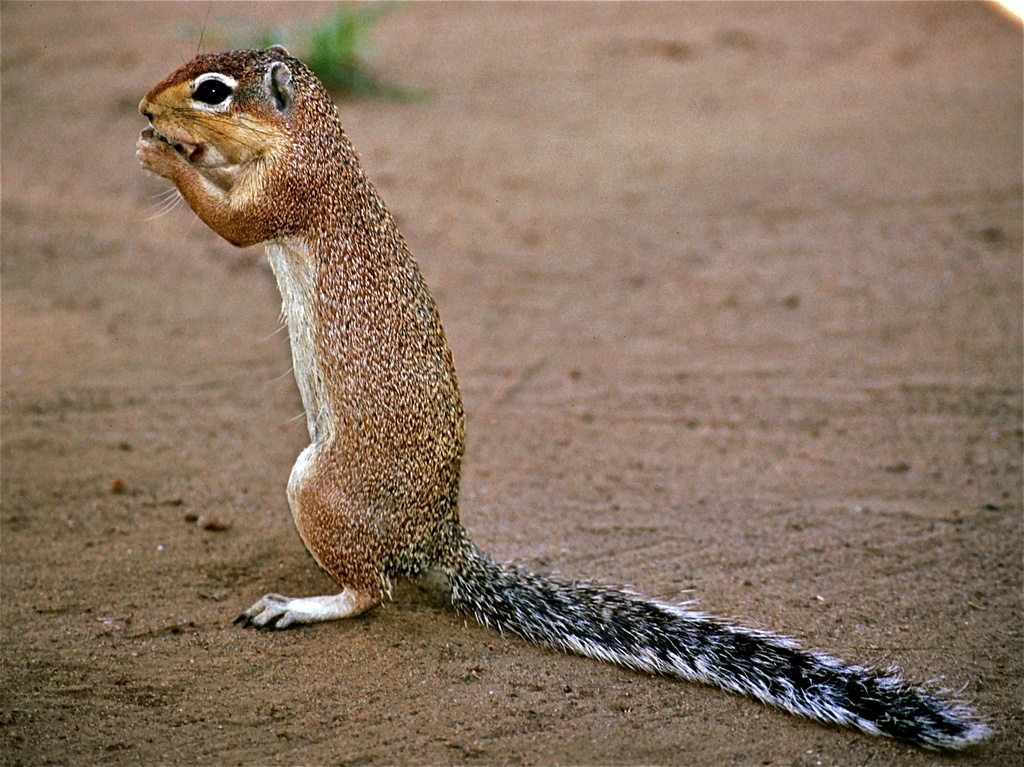
Unstriped Ground Squirrel
Xerus rutilus
The unstriped ground squirrel (Xerus rutilus) is a species of rodent (order Rodentia) in the family Sciuridae. It is the only member of the genus Xerus. It is found in Djibouti, Eritrea, Ethiopia, Kenya, Somalia, Sudan, Tanzania, and Uganda. Its natural habitats are dry savanna and subtropical or tropical dry shrubland.
From the article Unstriped ground squirrel on Wikipedia (CC BY-SA), quoted section by section
Description
The unstriped ground squirrel is brownish or tawny in color with a lighter colored front. As the name suggests the X. rutilus differs from other species of African ground squirrel by not having dorsal-running longitudinal white stripes. The eye is ringed with white hair (all hair being coarse in observed specimens). Their small head and body measure on average 225.8 millimetres (8.89 in) long with an average tail length of 172 mm (6.8 in). This tail is flat in appearance. Body weight varies across studies and habitats and ranges from 257.7 to 420 grams (9.09 to 14.82 oz). The length of the hind foot is 35–49 mm with a braincase measuring only 24–25 mm. The length of the mandible is variable in the range of 31.0 to 33.9 mm. Xerus rutilus is a member of the Xerini tribe, but differs from its sister group Xerus daamsi. Both are separate and distinct from the North African equivalent Atlantoxerus. Vibrissae (whiskers) length and brain size are both smaller than arboreal squirrels of the region, but are similar to other terrestrial squirrels. No significant sexual dimorphism is noted in X. rutilus.
Range & habitat
The unstriped ground squirrel is endemic to Ethiopia, Kenya, Sudan, Tanzania, Djibouti, Eritrea and Uganda and probably extant in Somalia. Its natural habitats include dry (arid) savanna and subtropical or tropical dry shrubland. Populations occupy many overlapping regions with its sister group, the African striped ground squirrel (Euxerus erythropus), in northeastern Africa. X. rutilus dig and occupy burrows in generally arid conditions.
Wikipedia: “Range and habitat”
What it does
The unstriped ground squirrels demonstrate diurnality with an omnivorous diet consisting of leaves, tree fruits (Adansonia digital), seeds (Commiphora and Acacia trees), other plant materials, and insects. Studies show that X. rutilus is unaffected by poisonous tannins and to some degree eats oxalic-containing foods. X. rutilus has been shown to be uniquely efficient in its capacity to forage for food. This ability is not diminished across a variety of different environments, including those with a poor to moderate food supply.
Wikipedia: “Diet and foraging”
Listen
Looking for field recordings…
Where it lives
Recorded sightings
—
geo-referenced records in GBIF, from museums, herbaria and field observers.
Drag the globe to turn it. Dots are where records exist, not a range map; darker means more records.
In the stacks
Searching the stacks…
Every page naming Xerus rutilus in the Biodiversity Heritage Library →
This page is assembled live from iNaturalist, GBIF, Wikipedia, the Source Library and the Internet Archive. It is not yet part of the hand-edited codex. iNaturalist taxon 46206.