On eBird ↗
Arctic Loon
Live sightings near you, the range map, bar charts of when it is seen, and Macaulay Library photos and recordings.
Arctic Loon
Gavia arctica
The black-throated loon (Gavia arctica), also known as the Arctic loon and the black-throated diver, is a migratory aquatic bird found in the Northern Hemisphere, primarily breeding in freshwater lakes in northern Europe and Asia. It winters along sheltered, ice-free coasts of the north-east Atlantic Ocean and the eastern and western Pacific Ocean. This loon was first described by Carl Linnaeus in 1758 and has two subspecies. It was previously considered to be the same species as the Pacific loon, of which it is traditionally considered to be a sister species, although this is debated. In a study that used mitochondrial and nuclear intron DNA, the black-throated loon was found to be sister to a clade consisting of the Pacific loon and two sister species, the common loon and the yellow-billed loon.
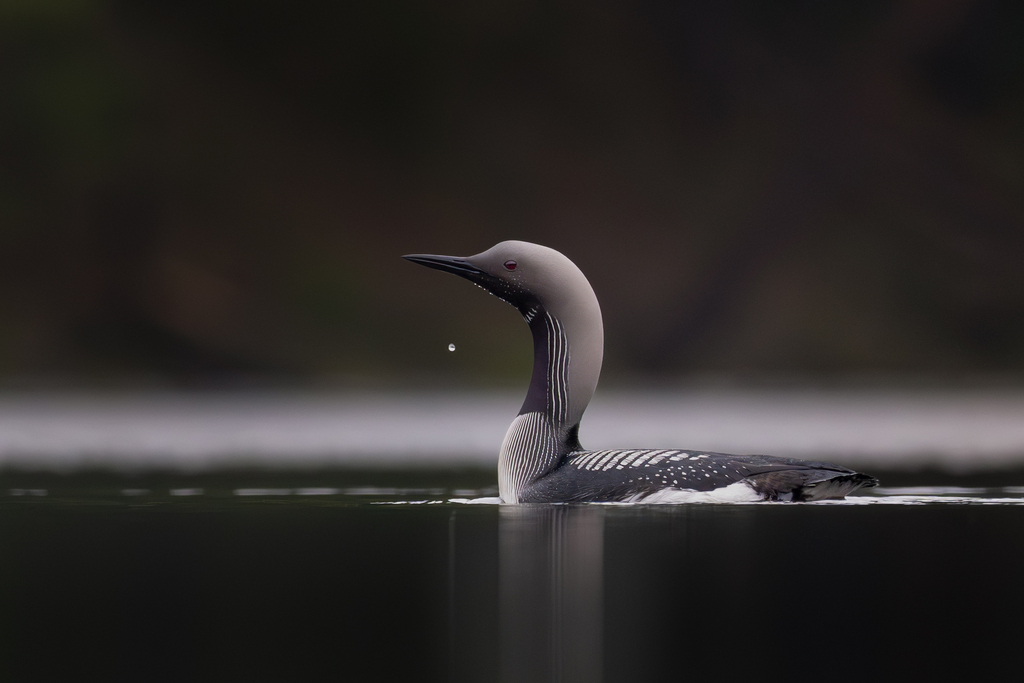
The black-throated loon measures about 70 cm (28 in) in length and can weigh anywhere from 1.3 to 3.4 kilograms (2.9 to 7.5 lb). In breeding plumage, the adult of the nominate subspecies has mostly black upperparts, with the exception of some of the mantle and scapulars, which have white squares. The head and hindneck are grey, and the sides white and striped black. Most of the throat is also black, giving this bird the name "black-throated loon". The colour of the throat patch can be used to distinguish the two subspecies; the throat patch of the other subspecies, G. a. viridigularis, is green. The underparts are mostly white, including the bottom of the throat. The flanks are also white, a feature that can be used to separate this bird from the Pacific loon.
From the article Black-throated loon on Wikipedia (CC BY-SA), quoted section by section
Description
The adult black-throated loon is 58 to 73 cm (23 to 29 in) in length with a 100 to 130 cm (39 to 51 in) wingspan and a weight of 1.3 to 3.4 kilograms (2.9 to 7.5 lb). The nominate subspecies in its breeding plumage has a grey head and hindneck, with a black throat and a large black patch on the foreneck, both of which have a soft purple gloss. The lower throat has a necklace-shaped patch of short parallel white lines. The sides of the throat have about five long parallel white lines that start at the side of the patch on the lower throat and run down to the chest, which also has a pattern of parallel white and black lines. The rest of the underparts, including the centre of the chest, is pure white. The upperparts are blackish down to the base of the wing, where there are a few rows of high contrast white squares that cover the mantle and scapulars. There are small white spots on both the lesser and median coverts. The rest of the upperwing is a blackish colour. The underwing is paler than the upperwing, and the underwing coverts are white. The tail is blackish. The bill and legs are black, with a pale grey colour on the inner half of the legs. The toes and the webs are grey, the latter also being flesh coloured. The irides are a deep brown-red. …
Range & habitat
The black-throated loon has a large range, breeding taking place across northern Europe, Asia, and the Seward Peninsula in Alaska. When breeding, it is found in the area around isolated, deep freshwater lakes larger than 0.1 square kilometres (0.039 mi2), especially those with inlets, as it prefers to face only small stretches of open water. When it is not breeding, this loon moves in a general southward direction and towards ice-free sea, usually wintering on the coasts of the north-east Atlantic Ocean and those on the eastern and western Pacific Ocean, such as the coasts of Japan. During this time, its habitat is usually inshore waters along sheltered coasts, although it will sometimes be found inland, in places such as the Mediterranean and Black seas.
Wikipedia: “Distribution and habitat”
What it does
Like other loons, this bird does not take flight well; it takes off by pattering on a "runway" of water. While flying, it makes a barking "kwow" flight call.
Breeding. This species usually nests on the ground within about 1 metre (3.3 ft) of the lake it breeds at. This loon also sometimes nests on vegetation, like Arctophila fulva, that has emerged from lakes. The nest site is often reused the next year. The nest itself is oval-shaped and built mostly by the female out of heaped plant material like leaves and sticks. The nest is about 23 centimetres (9.1 in) across. Families of black-throated loons often move their nest site from the original nest ponds they inhabited to wetlands nearby after the chicks reach two weeks of age. The journey is generally less than 150 metres (490 ft). In the southern portion of its range, this loon starts to breed in April, whereas in the northern parts of its range, it waits until the spring thaw, when there is adequate water for it to take off. It usually arrives before the lake thaws, in the latter case. Before copulation, the female hunches its neck and swims close to the shore until it finds a suitable place and then lies down on the shore. The male sometimes adopts the same posture as the female. During this time, the only vocalization made is a one note "hum". …
Wikipedia: “Behaviour”
In human culture
The black-throated loon was formally described in 1758 by the Swedish naturalist Carl Linnaeus in the tenth edition of his Systema Naturae under the binomial name Colymbus arcticus. Linnaeus specified the type locality as Europe and America but in 1761 he restricted it to Sweden. In 1897 the American ornithologist Joel Asaph Allen suggested that the black-throated loon should be moved to the genus Gavia that had been introduced by Johann Forster in 1788. This proposal was adopted by the American Ornithologists' Union (AOU) in 1899. The genus name Gavia comes from the Latin for 'sea mew', as used by the ancient Roman naturalist Pliny the Elder. The specific arctica is Latin for 'northern' or 'Arctic'. The name of the subspecies viridigularis stems from the Latin viridis, meaning 'green', and the Latin gularis, meaning 'throated', in reference to the green throat of this subspecies. The common name, black-throated loon, stems from its black throat patch. This loon is also called the Arctic loon and the black-throated diver. There are two subspecies:
Gavia arctica arctica (Linnaeus, 1758) – This subspecies is found in northern Europe, east to the center of northern Asia, and from that to the Lena River and Transbaikal. It migrates to the coasts of northwestern Europe and the coasts of the Mediterranean, Black, and Caspian Seas. G. a. …
Wikipedia: “Taxonomy and etymology”
Listen
Looking for field recordings…
Where it lives
Recorded sightings
—
geo-referenced records in GBIF, from museums, herbaria and field observers.
Drag the globe to turn it. Dots are where records exist, not a range map; darker means more records.
In the stacks
Searching the stacks…
Every page naming Gavia arctica in the Biodiversity Heritage Library →
This page is assembled live from iNaturalist, GBIF, Wikipedia, the Source Library and the Internet Archive. It is not yet part of the hand-edited codex. iNaturalist taxon 4623.