- Animals
- ›Chordates
- ›Vertebrates
- ›Mammals
- ›Therians
- ›Placental Mammals
- ›Primates, Rodents, and Allies
- ›Rodents
- ›Squirrels, Dormice, and Mountain Beavers
- ›Squirrels
- ›Typical and Flying Squirrels
- ›Flying Squirrels
- ›Glaucomys
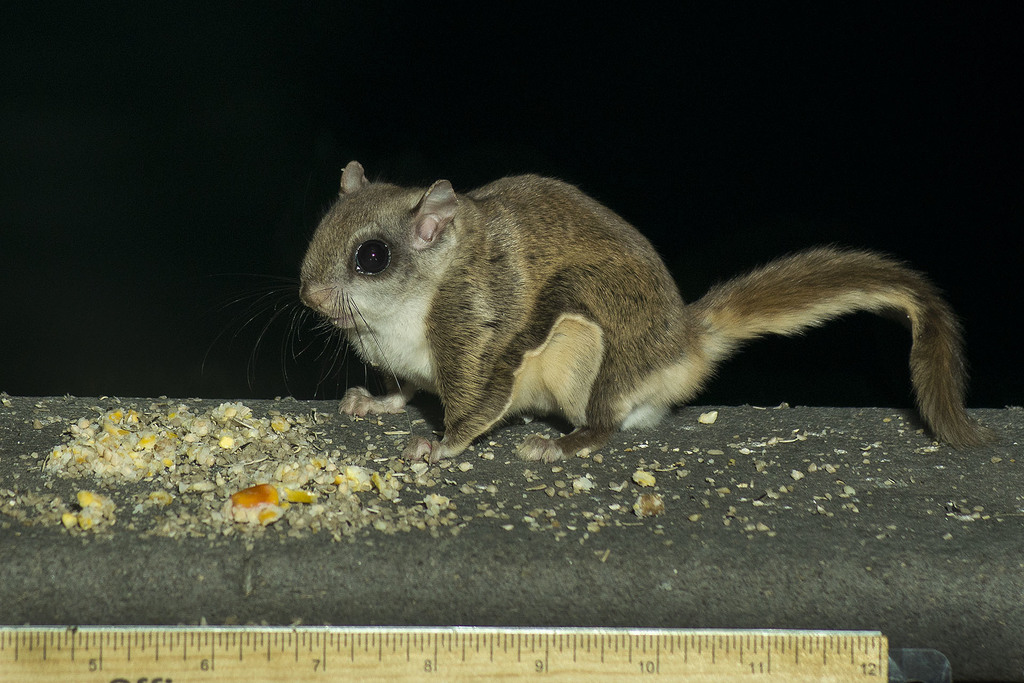
Northern Flying Squirrel
Glaucomys sabrinus
The northern flying squirrel (Glaucomys sabrinus) is one of three species of the genus Glaucomys, the only flying squirrels found in North America. They are found in coniferous and mixed coniferous forests across much of Canada, from Alaska to Nova Scotia, south to the mountains of North Carolina and west to Utah in the United States. They are light brown with pale underparts and grow to a length of 25 to 37 cm (10 to 15 in). They are proficient gliders but uncoordinated walkers on the ground. The species feeds on a variety of plant material as well as tree sap, fungi, insects, carrion, bird eggs and nestlings. They mostly breed once a year in a cavity lined with lichen or other soft material. Except when they have young, they change nests frequently, and in winter a number of individuals may huddle together in a shared nest. Unlike most members of their family, flying squirrels are strictly nocturnal.
From the article Northern flying squirrel on Wikipedia (CC BY-SA), quoted section by section
Description
These nocturnal, arboreal rodents have thick light brown or cinnamon fur on their upper body and greyish fur on the flanks and whitish fur underneath. They have large eyes and a flat tail. They can also be identified by their long whiskers, common to nocturnal mammals. The adult northern flying squirrel measures from 25 to 37 cm long, and their weight can range from 110 to 230 grams.
Range & habitat
The northern flying squirrel is found in coniferous and mixed coniferous forests across the top of North America, from Alaska to Nova Scotia, south to the mountains of North Carolina and Tennessee and west to Utah. The Humboldt's flying squirrel was formerly considered conspecific, but was found to be a cryptic species, and now considered distinct. It is generally smaller and darker than northern flying squirrel and occurs in British Columbia, northern California, Washington and Oregon. Two subspecies are found in the southern Appalachians, the Carolina northern flying squirrel, G. s. coloratus, and the West Virginia northern flying squirrel G. s. fuscus, both of which are endangered, although the West Virginia subspecies has recovered enough that it was delisted in August 2008. The U.S. Fish and Wildlife Service temporarily put the West Virginia northern flying squirrel back under protection on June 6, 2011, in response to a court order. On appeal, the delisting was reinstated in March 2013. G. s. californicus, the San Bernardino flying squirrel, is found in the San Bernardino National Forest in California. In 2010, the Center for Biological Diversity petitioned the U.S. Fish and Wildlife Service to give the San Bernardino flying squirrel protections as an endangered species, but ultimately their request was denied. The U.S. …
Wikipedia: “Habitat and range”
What it does
A major food source for the squirrels are fungi of various species, although they also eat lichens, all mast-crop nuts, tree sap, insects, carrion, bird eggs and nestlings, buds and flowers. The squirrels are able to locate truffles by olfaction, though they also seem to use cues such as the presence of coarse woody debris, indicating a decaying log, and spatial memory of locations where truffles were found in the past. The northern flying squirrel is also known to cache food for when food supplies are lower. These caches can be in cavities in trees, as well as in the squirrels' nest. Lichens and seeds are commonly cached.
Wikipedia: “Diet”
Listen
Looking for field recordings…
Where it lives
Recorded sightings
—
geo-referenced records in GBIF, from museums, herbaria and field observers.
Drag the globe to turn it. Dots are where records exist, not a range map; darker means more records.
In the stacks
Searching the stacks…
Every page naming Glaucomys sabrinus in the Biodiversity Heritage Library →
This page is assembled live from iNaturalist, GBIF, Wikipedia, the Source Library and the Internet Archive. It is not yet part of the hand-edited codex. iNaturalist taxon 46266.