- Animals
- ›Chordates
- ›Vertebrates
- ›Mammals
- ›Therians
- ›Placental Mammals
- ›Afromammals
- ›Sirenians
- ›Manatees
- ›Trichechus
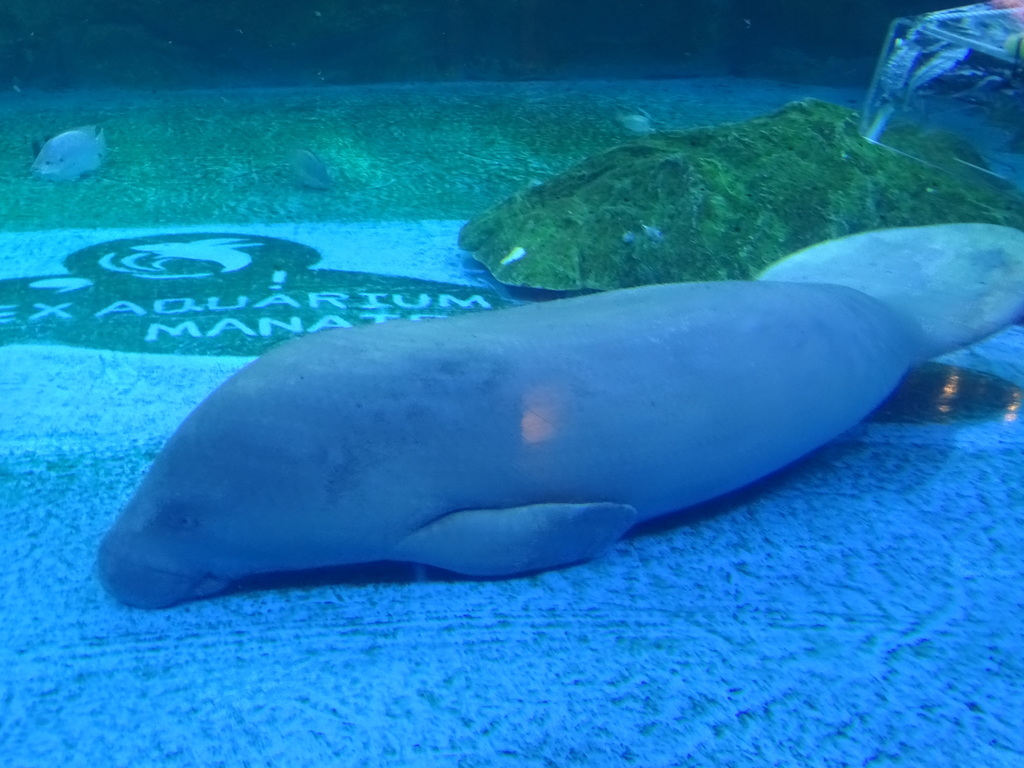
African Manatee
Trichechus senegalensis
The African manatee (Trichechus senegalensis), also known as the West African manatee or sea cow, is a species of manatee that is mostly herbivorous. African manatees inhabit much of the western region of Africa – from Senegal to Angola. Although scientists do not know a great deal about this species, they hypothesize that the African manatee is very similar to the West Indian manatee (Trichechus manatus).
From the article African manatee on Wikipedia (CC BY-SA), quoted section by section
Description
The African manatee's body is widest at the middle, and its tail resembles a paddle. The manatee is gray in color with small, colorless hairs that cover its body. However, algae and other tiny organisms often grow on an African manatee's body, so its body sometimes appears brown or greenish in color. Calves are darker in color when they are very young. African manatees measure up to 4.5 m (15 ft) in length, and weigh about 360 kilograms (790 pounds). African manatees are typically extremely slow, moving between 4.8 km and 8.0 km (3 and 5 mi) per hour, although when scared by predators they can travel at speeds of about 32 km (20 mi) per hour. The African manatee's large forelimbs, or flippers, are used to paddle and to bring food to its mouth. Vegetation is then chewed by the manatee's strong molars, which are its only teeth. When the manatee is born, each jaw has two vestigial incisors, which the manatee loses as it matures. If the African manatee's molars happen to fall out, new molars grow in their place. The manatee's flippers, which have nails, are also used to graze other manatees. The African manatee does not have any hind limbs. From the exterior, the African manatee looks very similar to the American manatee; however, the African manatee is different from the Amazonian manatee, which has characteristic white markings on its abdomen.
Range & habitat
African manatees inhabit the widest ranges of habitats of any sirenian species, ranging from offshore islands in the Atlantic to rivers in the western Sahel, equatorial rainforest rivers, and so on. It has been reported that coastal populations ascend rivers during the rainy season and descend again during the dry season. The movement and habitat of the African manatee has been threatened by the building of agricultural and hydroelectric dams along rivers that isolate populations, such as the Akosombo Dam in Ghana. The Diama Dam has permanently isolated the Senegal River manatee population from the coast, as has the Felou Dam in Mali. African Manatees can be found in West African regions: Angola, Benin, Cameroon, Chad, the Republic of the Congo, the Democratic Republic of the Congo, Côte d'Ivoire, Equatorial Guinea, Gabon, The Gambia, Ghana, Guinea, Guinea-Bissau, Liberia, Mali, Mauritania, Niger, Nigeria, Senegal, Sierra Leone, and Togo. Manatees are found in brackish waters to freshwater: in oceans, rivers, lakes, coastal estuaries, reservoirs, lagoons, and bays on the coast. African manatees rarely inhabit waters with a temperature below 18°C (64°F). Manatees have been found as far as 75 kilometres (47 mi) offshore, where there are shallow coastal flats and calm mangrove creeks filled with seagrass. …
Wikipedia: “Range and habitat”
What it does
Manatees are omnivores; and are known to occasionally eat clams, mollusks, and fish found in nets. The percentage of the diet that is composed of non-plant material varies based on location, with manatees living off the coast having a lifetime average of 50% non-plant material. The West African manatee is the only sirenian that seems to intentionally consume non-plant material. A majority of the African manatee's diet is made up of a variety of flora found above or hanging over the water. African manatees that inhabit rivers mostly eat the overhanging plants growing on the river banks. The diet of African manatees living in estuaries consists solely of mangrove trees. Each day, the African manatee eats about four to nine percent of its body weight in wet vegetation. Microorganisms within the African manatee's large intestine, which measures up to 20 metres or 66 feet in length, aid it in digesting the large quantity and variety of vegetation that it consumes daily.
Wikipedia: “Diet”
Listen
Looking for field recordings…
Where it lives
Recorded sightings
—
geo-referenced records in GBIF, from museums, herbaria and field observers.
Drag the globe to turn it. Dots are where records exist, not a range map; darker means more records.
In the stacks
Searching the stacks…
Every page naming Trichechus senegalensis in the Biodiversity Heritage Library →
This page is assembled live from iNaturalist, GBIF, Wikipedia, the Source Library and the Internet Archive. It is not yet part of the hand-edited codex. iNaturalist taxon 46320.