On eBird ↗
Great Frigatebird
Live sightings near you, the range map, bar charts of when it is seen, and Macaulay Library photos and recordings.
Great Frigatebird
Fregata minor
The great frigatebird (Fregata minor) is a large seabird in the frigatebird family. There are major nesting populations in the tropical Pacific Ocean, such as Hawaii and the Galápagos Islands; in the Indian Ocean, colonies can be found in the Seychelles (on Aldabra and Aride Islands) and Mauritius, and there is a tiny population in the South Atlantic, mostly on and around St. Helena and Boatswain Bird Island (Ascension Island).
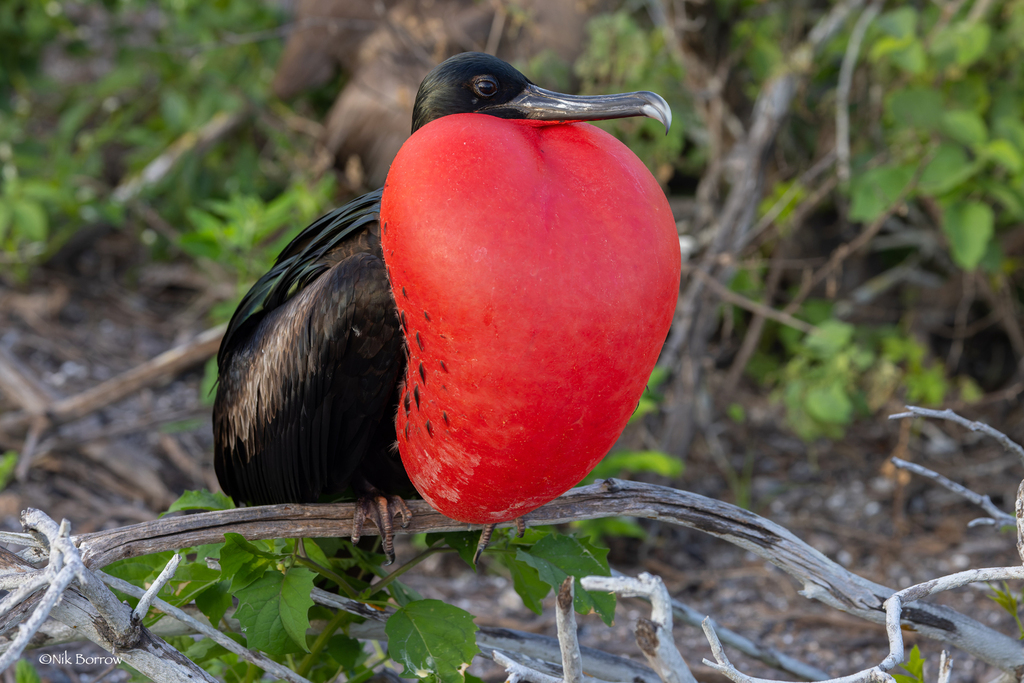
The great frigatebird is a large and lightly built seabird up to 105 cm long with predominantly black plumage. The species exhibits sexual dimorphism; the female is larger than the adult male and has a white throat and breast, and the male's scapular feathers have a purple-green sheen. In the breeding season, the male is able to distend his striking red gular sac. The species feeds on fish taken in flight from the ocean's surface (mostly flying fish), and indulges in kleptoparasitism less frequently than other frigatebirds. They feed in pelagic waters within 80 km (50 mi) of their breeding colony or roosting areas.
From the article Great frigatebird on Wikipedia (CC BY-SA), quoted section by section
Description
The great frigatebird measures 85 to 105 cm (33 to 41 in) in length and has a wingspan of 205–230 cm (81–91 in). Male great frigatebirds are smaller than females, but the extent of the variation varies geographically. The male birds weigh 1,000–1,450 g (2.20–3.20 lb) while the heavier female birds weigh 1,215–1,590 g (2.679–3.505 lb).
Frigatebirds have long narrow pointed wings and a long narrow deeply forked tail. They have the highest ratio of wing area to body mass and the lowest wing loading of any bird. This has been hypothesized to enable the birds to use marine thermals created by small differences between tropical air and water temperatures. The plumage of males is black with scapular feathers that have a green iridescence when they refract sunlight. Females are black with a white throat and breast and have a red eye ring. Juveniles are black with a rust-tinged white face, head, and throat.
Range & habitat
The great frigatebird has a wide distribution throughout the world's tropical seas. Hawaii is the northernmost extent of their range in the Pacific Ocean, with around 10,000 pairs nesting mostly in the Northwestern Hawaiian Islands. In the Central and South Pacific, colonies are found on most island groups from Wake Island to the Galápagos to New Caledonia with a few pairs nesting on Australian possessions in the Coral Sea. Colonies are also found on numerous Indian Ocean islands, the most well-known include the Seychelles islands of Aldabra and Aride, Christmas Island, the Maldives and Mauritius. The Atlantic population is very small, restricted to Ascension Island, St. Helena, and the Brazilian islands of Trindade and Martin Vaz. Great frigatebirds undertake regular migrations across their range, both regular trips and more infrequent widespread dispersals. Birds marked with wing tags on Tern Island in the French Frigate Shoals were found to regularly travel to Johnston Atoll (873 km), one was reported in Quezon City in the Philippines. One male great frigatebird relocated from Europa Island in the Mozambique Channel to the Maldives 4400 km away for four months, where it fed on rich fishing grounds. Despite their extended range, birds also exhibit philopatry, breeding in their natal colony even if they travel to other colonies.
Wikipedia: “Distribution and habitat”
What it does
The great frigatebird forages in pelagic waters within 80 km (50 mi) of the breeding colony or roosting areas. Flying fish from the family Exocoetidae are the most common item in the diet of the great frigatebird; other fish species and squid may be eaten as well. Prey is snatched while in flight, either from just below the surface or from the air in the case of flying fish flushed from the water. Great frigatebirds will make use of schools of predatory tuna or pods of dolphins that push schooling fish to the surface. Like all frigatebirds they will not alight on the water surface and are usually incapable of taking off should they accidentally do so. They are often seen foraging in large, mixed-species flocks, especially flocking with sooty terns and wedge-tailed shearwaters. Great frigatebirds will also hunt seabird chicks at their breeding colonies, taking mostly the chicks of sooty terns, spectacled terns, brown noddies, black noddies and even from other great frigatebirds. Studies show that only females (adults and juveniles) hunt in this fashion, and only a few individuals account for most of the kills. …
Wikipedia: “Feeding”
Listen
Looking for field recordings…
Where it lives
Recorded sightings
—
geo-referenced records in GBIF, from museums, herbaria and field observers.
Drag the globe to turn it. Dots are where records exist, not a range map; darker means more records.
In the stacks
Searching the stacks…
Every page naming Fregata minor in the Biodiversity Heritage Library →
This page is assembled live from iNaturalist, GBIF, Wikipedia, the Source Library and the Internet Archive. It is not yet part of the hand-edited codex. iNaturalist taxon 4636.