On eBird ↗
Spotted Kestrel
Live sightings near you, the range map, bar charts of when it is seen, and Macaulay Library photos and recordings.
Spotted Kestrel
Falco moluccensis
The spotted kestrel (Falco moluccensis), also known as the Moluccan kestrel, is a falcon found throughout Indonesia and Timor-Leste.
From the article Spotted kestrel on Wikipedia (CC BY-SA), quoted section by section
Description
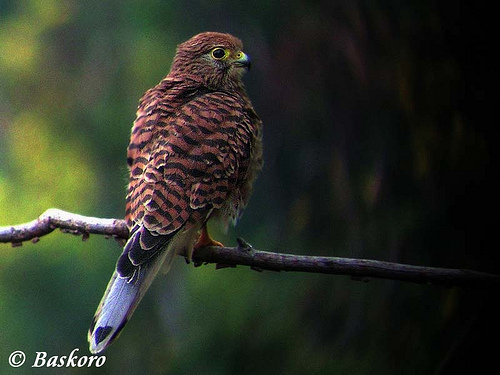
Spotted kestrels measure 26–32 cm (10–12.5 in) from head to tail, with a wingspan of 59–71 cm (23–28 in). On average, spotted kestrels weigh 162 g (5.7 oz). The sexual dimorphism in size and plumage is less pronounced than that of the common kestrel. Males have grey tails with one broad subterminal band with white tips. Females also have grey tails with white tips, although they have 9 dark bands. Juveniles are very similar to females, but they appear more darker and heavily marked. The eggs resemble that of the common kestrel. The colour and shape of the egg is similar to Oriental hobby (Falco severus).
Range & habitat
Spread through Wallacea and Java, the spotted kestrel inhabits grasslands with scattered trees, lightly wooded cultivation, and the edges of primary and tall secondary forest. Along logging roads, it occasionally penetrates forests, and sometimes inhabits clearings within forested areas. It has also been known to live in areas of human habitation. It is likely they have small habitat ranges. They move around during the wet and dry seasons. This is information is inferred by comparing the movements of the nankeen kestrel (F. cenchroides), their closest relative. Both species are known to be more sedentary when compared to the common kestrel (F. tinnunculus).
Wikipedia: “Distribution and habitat”
What it does
The spotted kestrel displays similar habits to that of the common kestrel, although spotted kestrels live more sedentary lives when compared to their sister group F. tinnunculus.
Reproduction. Little is known about their breeding habits. Spotted kestrels have been observed to be in a pre-breeding behaviour in June–July during the dry season, and in one instance breeding was observed in August. However, they also displayed breeding behaviour in December–January, during the wet season. It may be possible that they breed during both seasons, although more information is needed.
Diet. The feeding behaviour of the spotted kestrel is not well known, but much of the diet can be assumed by looking at their closest relative, the nankeen kestrel (F. cenchroides). From this, it is assumed spotted kestrel feeds primarily on small mammals, birds (mostly waterfowl and doves), lizards, and insects. On Christmas Island, an island south of Java, nankeen kestrels have colonized the island. The giant grasshopper (V. irregularis) consisted 97% of their caught prey. Insects are preyed on the most, but vertebrates make up the weight of their diet. They have also been seen preying on spotted dove, western bearded dragons, mice, and other birds such as the common starlings.
Nesting. …
Wikipedia: “Behaviour”
Listen
Looking for field recordings…
Where it lives
Recorded sightings
—
geo-referenced records in GBIF, from museums, herbaria and field observers.
Drag the globe to turn it. Dots are where records exist, not a range map; darker means more records.
In the stacks
Searching the stacks…
Every page naming Falco moluccensis in the Biodiversity Heritage Library →
This page is assembled live from iNaturalist, GBIF, Wikipedia, the Source Library and the Internet Archive. It is not yet part of the hand-edited codex. iNaturalist taxon 4640.