- Animals
- ›Chordates
- ›Vertebrates
- ›Mammals
- ›Therians
- ›Placental Mammals
- ›Ungulates, Carnivorans, and Allies
- ›Shrews, Moles, Hedgehogs, and Allies
- ›Shrews, Moles, and Hedgehogs
- ›Shrews
- ›Red-toothed Shrews
- ›Long-tailed Shrews
- ›Sorex
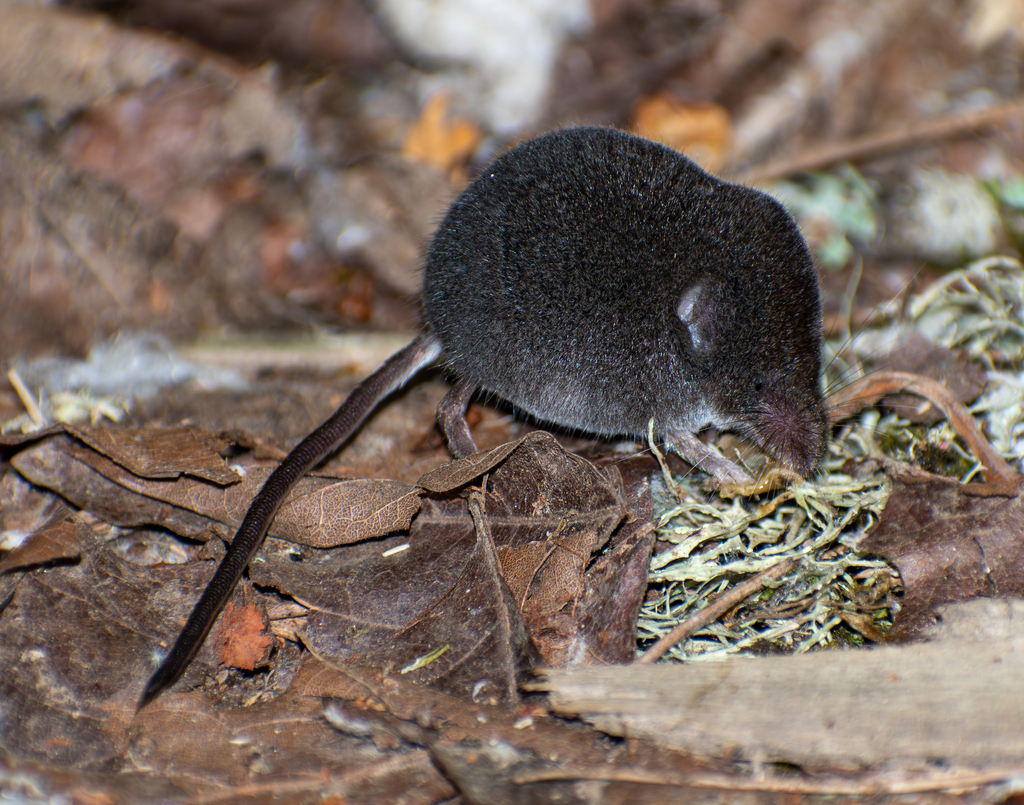
Trowbridge's Shrew
Sorex trowbridgii
Trowbridge's shrew (Sorex trowbridgii) is a species of mammal in the family Soricidae. It is found in southern British Columbia in Canada and in Washington, Oregon, and California in the United States.
From the article Trowbridge's shrew on Wikipedia (CC BY-SA), quoted section by section
Description
Trowbridge's shrew is a medium-sized shrew with a long tail. Non-breeding shrews weigh around 3.8 g (0.13 oz) while breeding shrews average around 5 g (0.18 oz). The fur colorings change over the year, with a darker more brownish coat in the summer and a lighter gray in winter. They have many long whiskers and their ears are mostly covered with fur. Trowbridge's shrews are also known to go through two molts, one in the summer and one in the winter. The winter coat is thick and grey while the summer coat is light and dark brown. Young Trowbridge's shrew have a hairy tail, which becomes less hairy with age. The tail is bi-colored: darker on the top than the bottom, with a sharp line separating the colors. This feature can be used to distinguish Trowbridge's shrew from similar shrews. They are pentadactyl, with whitish to lightly tan colored feet. The caps of the teeth have a dark reddish-brown pigmentation. The dental formula of Sorex trowbridgii is 1.5.1.31.1.1.3=32. The skull is similar in size to that of other long-tailed shrews. Trowbridge's shrew can be distinguished from closely related shrews by the third unicuspid being smaller than the fourth. Other distinguishing features include a post-mandibular foramen, more posterior positioning of the orbit, and orientation of lacrimal and infraorbital foramina relative to the molars. …
Range & habitat
Trowbridge's shrew is found along the western coast of North America. They occur in the extreme southwest of British Columbia, south of Burrard Inlet. They are found in the western part of the states of Washington and Oregon. In northern California, the distribution forks. In the west, the population continues south through the coast range to Santa Barbara County. Through eastern California, the population extends south through the Warner Mountains and the Sierra Nevada Mountains to Kern County. Different subspecies are found in different regions of the geographic range. They are found from sea level up to an elevation of 1,820 m (5,970 ft). Trowbridge's shrew resides in forested areas where the ground may be littered with debris for cover. After logging in an area, they may remain, if sufficient ground cover is present. They are found in both dry and moist forests, as well as in swampy woodlands. Populations on Destruction Island off the Washington coast live in deep rank grass near salmonberry patches. They are less likely to be found near streams. In the southern reaches of their range, they may be found in chaparral.
Wikipedia: “Distribution and habitat”
What it does
Trowbridge's shrews occupy an important ecological niche. They are preyed upon by raptors including the barred owl (Stirix varia). The Pacific giant salamander (Dicamptodon sp.) is another known predator. While domestic cats are known to kill them, they usually do not eat them. Known parasites include a number of ticks, mites, chiggers, fleas, worms, and single-celled organisms. Since they are the most frequently captured shrews within their range, it is presumed that they are the most abundant. The life-span of Trowbridge's shrews is around 1.5 years. They do not hibernate, but remain active year-round. They are roughly twice as abundant in the fall as in the spring. Insects are a primary food source for the shrews, but they also will eat spiders, worms, and centipedes. After identifying food items in the Trowbridges Shrew's stomach, the most consumed items were centipedes (Chilopoda), spiders (Araneae), internal organs of invertebrates, slugs and snails (gastropoda) and unidentified invertebrate material. During the reproductive season, food consumption is greatest. They also eat plants. Compared to other shrews in the genus Sorex, Trowbridge's shrews eat more vegetable matter. …
Wikipedia: “Behavior and ecology”
Listen
Looking for field recordings…
Where it lives
Recorded sightings
—
geo-referenced records in GBIF, from museums, herbaria and field observers.
Drag the globe to turn it. Dots are where records exist, not a range map; darker means more records.
In the stacks
Searching the stacks…
Every page naming Sorex trowbridgii in the Biodiversity Heritage Library →
This page is assembled live from iNaturalist, GBIF, Wikipedia, the Source Library and the Internet Archive. It is not yet part of the hand-edited codex. iNaturalist taxon 46503.