- Animals
- ›Chordates
- ›Vertebrates
- ›Mammals
- ›Therians
- ›Placental Mammals
- ›Ungulates, Carnivorans, and Allies
- ›Shrews, Moles, Hedgehogs, and Allies
- ›Shrews, Moles, and Hedgehogs
- ›Shrews
- ›White-toothed Shrews
- ›Crocidura
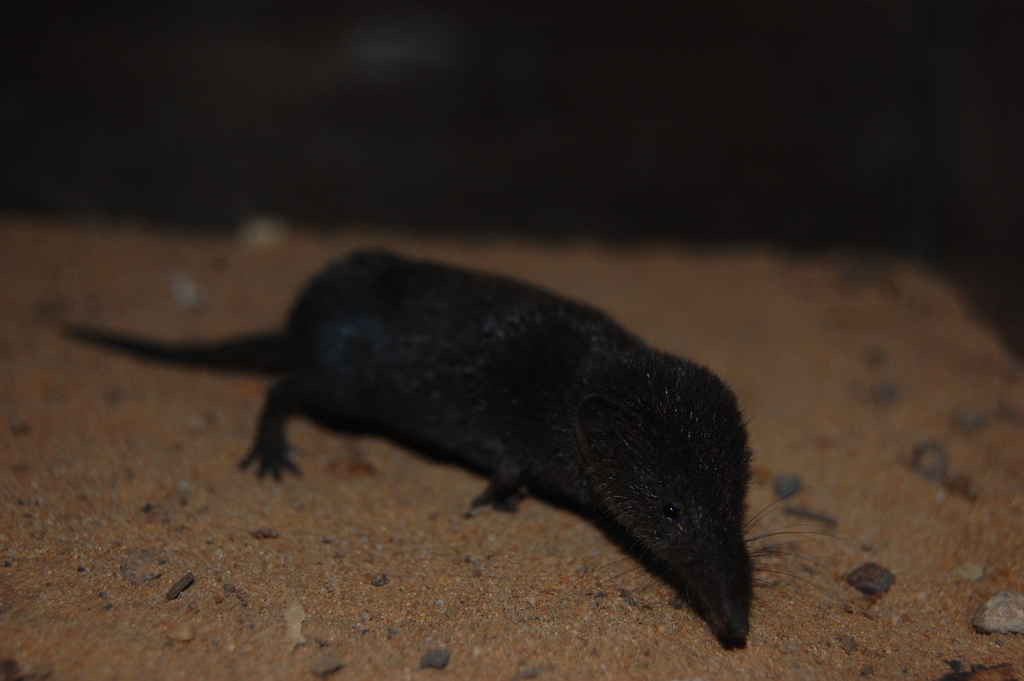
Swamp Musk Shrew
Crocidura mariquensis
The swamp musk shrew (Crocidura mariquensis), or musk shrew, is a species of mammal in the family Soricidae. It occurs in Angola, Botswana, Democratic Republic of the Congo, Mozambique, Namibia, South Africa, Eswatini, Zambia and Zimbabwe. Its natural habitat is swamps, and it is a common species in suitable habitats, with the International Union for Conservation of Nature listing it as being of "least concern".
From the article Swamp musk shrew on Wikipedia (CC BY-SA), quoted section by section
Description
This is a moderate-sized shrew growing to a head-and-body length of about 80 mm (3 in) with a tail of around 60 mm (2.4 in), males being slightly larger than females. The head is long and narrow, with a sharply pointed snout, small eyes and rounded ears. The dorsal pelage is blackish-brown tinged with rust, the individual hairs having greyish bases, brownish bands and brownish-black tips. The ventral surface is paler greyish-brown, there being no clear demarcation between dorsal and ventral fur. The tail is about 70% of the head-and-body length, and is partially haired and some shade of brown, sometimes paler below. Both fore and hind feet are yellowish-brown, reddish-brown or dark brown, and the digits of the hind feet splay apart when the animal is walking. There is considerable variation in colouring over the shrew's range.
Range & habitat
The musk shrew is native to southern Africa, where its range extends from Angola and the southern Democratic Republic of the Congo, through Zambia, northeastern Namibia and northern Botswana, to Zimbabwe, southern Mozambique, Eswatini and northeastern South Africa. It has a requirement for a wetland habitat and occurs in reed beds and semi-aquatic vegetation, in the vicinity of rivers and lakes and in seasonally flooded areas, with a marked preference for marshes and swamps.
Wikipedia: “Distribution and habitat”
What it does
The musk shrew is mainly nocturnal, although it may occasionally be active during the day. It clambers around among the aquatic vegetation with agility; it is not aggressive to other members of its species and does not scent mark its surroundings. In captivity it will feed on snails and termites, but does not dig into the ground to forage. In its natural surroundings, nests have been observed in grass tussocks and in debris above the surface of the ground. Breeding mostly takes place in the wet season, with litters averaging three to four young. It is predated upon by the southern fiscal, the barn owl and the African grass owl.
Wikipedia: “Ecology”
Listen
Looking for field recordings…
Where it lives
Recorded sightings
—
geo-referenced records in GBIF, from museums, herbaria and field observers.
Drag the globe to turn it. Dots are where records exist, not a range map; darker means more records.
In the stacks
Searching the stacks…
Every page naming Crocidura mariquensis in the Biodiversity Heritage Library →
This page is assembled live from iNaturalist, GBIF, Wikipedia, the Source Library and the Internet Archive. It is not yet part of the hand-edited codex. iNaturalist taxon 46612.