On eBird ↗
Australian Hobby
Live sightings near you, the range map, bar charts of when it is seen, and Macaulay Library photos and recordings.
Australian Hobby
Falco longipennis
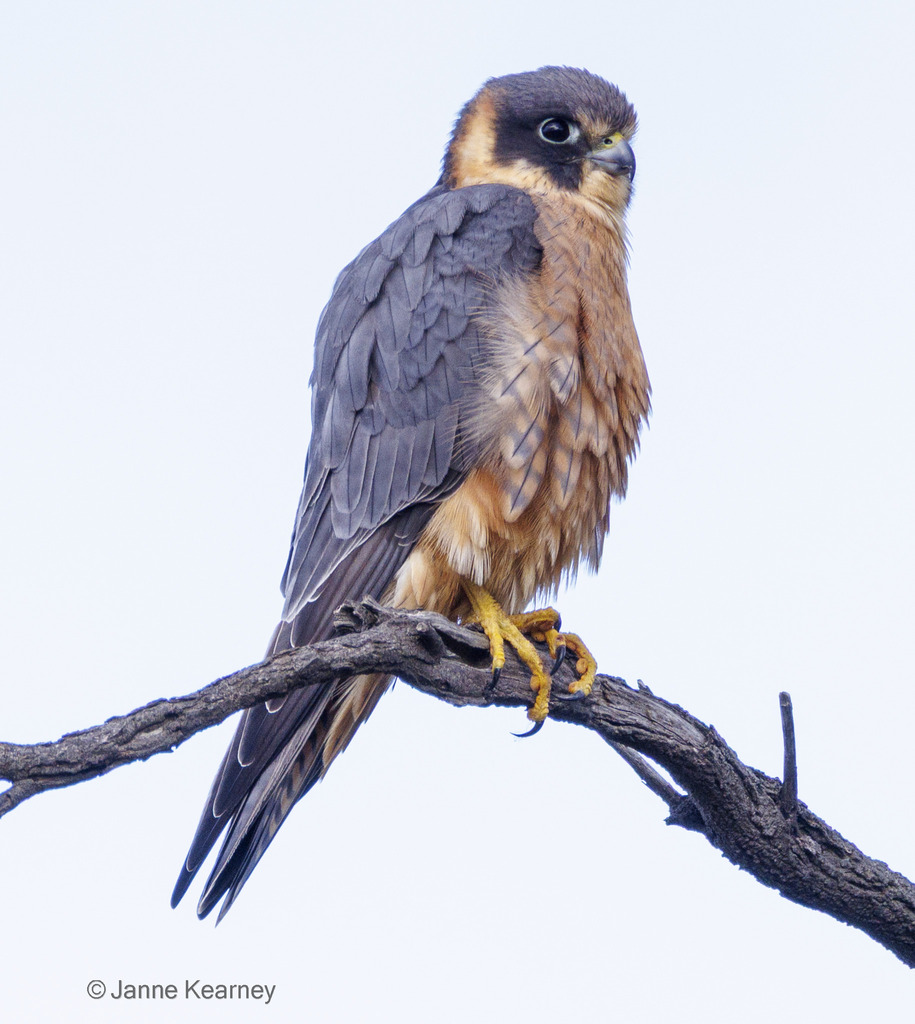
The Australian hobby (Falco longipennis), also known as the little falcon, is one of six Australian members of the family Falconidae. This predominantly diurnal bird of prey derives its name 'longipennis' from its long primary wing feathers. It occurs throughout Australia and other neighbouring countries with migrating individuals found on the islands of Indonesia and New Guinea.
From the article Australian hobby on Wikipedia (CC BY-SA), quoted section by section
Description
Smaller than other falcons, the Australian hobby is relatively slender and long winged. Its plumage varies in colour depending on sex, age and environment with a darker form in humid areas and a lighter form in drier environments. Generally the hobby displays a black cap and mask with a whitish forehead and half-collar. Underparts can be blue-grey or rufous and streaked darker. The cere in adults is a pale yellowish grey, the eye ring is pale blue, the eyes are brown and the feet are dull yellow. Females are larger in size between 34 and 35.5 cm and males are generally between 30 and 32 cm in length with a wing span between 66 and 87 cm. The Australian hobby is easily confused with the peregrine falcon (Falco peregrinus) however the hobby is more slender, with longer and thinner wings, and is a less powerful flyer.
Range & habitat
Hobbies occur throughout mainland Australia including offshore islands e.g. Lord Howe Island, however their range is restricted in Tasmania. Migrating individuals have also been recorded on the islands of Indonesia and New Guinea. Hobbies frequent most open habitats including open woodland, water courses and vegetated urban areas but are rarely recorded around cliffs or escarpments.
Wikipedia: “Distribution and habitat”
What it does
The Australian hobby has been recorded preying on avian species including the European starling (Sturnus vulgaris), house sparrow (Passer domesticus), crimson rosella (Platycercus elegans) and silvereye (Zosterops lateralis). Research suggests they tend to avoid large, dangerous, or agile species that forage close to cover, such as the common myna (Acridotheres tristis). Insectivorous bats and insects including beetles, cicadas, crickets and grasshoppers also form part of the hobby's diet.
Wikipedia: “Diet”
Listen
Looking for field recordings…
Where it lives
Recorded sightings
—
geo-referenced records in GBIF, from museums, herbaria and field observers.
Drag the globe to turn it. Dots are where records exist, not a range map; darker means more records.
In the stacks
Searching the stacks…
Every page naming Falco longipennis in the Biodiversity Heritage Library →
This page is assembled live from iNaturalist, GBIF, Wikipedia, the Source Library and the Internet Archive. It is not yet part of the hand-edited codex. iNaturalist taxon 4663.