On eBird ↗
Eleonora's Falcon
Live sightings near you, the range map, bar charts of when it is seen, and Macaulay Library photos and recordings.
Eleonora's Falcon
Falco eleonorae
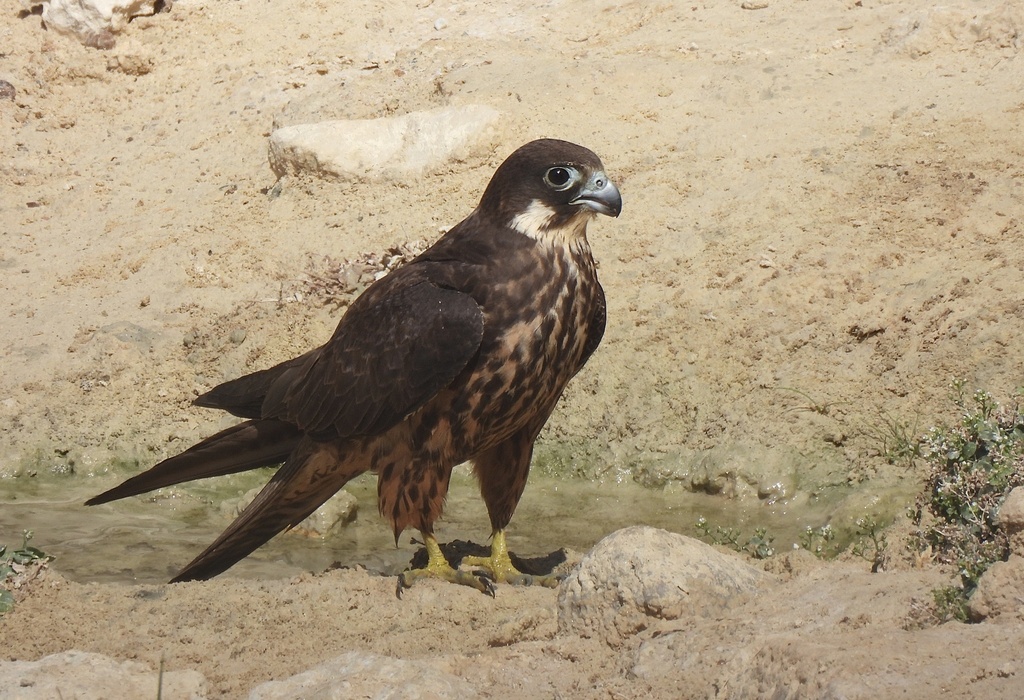
Eleonora's falcon (Falco eleonorae) is a medium-sized falcon. It belongs to the hobby group, a rather close-knit number of similar falcons often considered a subgenus Falco. The sooty falcon is sometimes considered its closest relative, but while they certainly belong to the same lineage, they do not seem to be close sister species. The English name and the species name eleonorae commemorate Eleanor of Arborea, Queen or Lady-Judge (Juighissa) and national heroine of Sardinia, who in 1392, under the jurisdiction conferred by the Carta de Logu, became the first ruler in history to grant protection to hawk and falcon nests against illegal hunters. The genus name Falco is from Late Latin falx, falcis, a sickle, referring to the claws of the bird.
From the article Eleonora's falcon on Wikipedia (CC BY-SA), quoted section by section
Description
Eleonora's falcon is a bird of prey, 36–42 cm (14–17 in) long with an 87–104 cm (34–41 in) wingspan. It is shaped like a large Eurasian hobby or a small slender peregrine falcon, with its long pointed wings, long tail and slim body. There are two colour morphs: The adult dark morph is all sooty brown, with black underwing coverts. The light morph is more like a juvenile Eurasian hobby, but has buff underparts, and also shows the contrast between the black underwing coverts and paler base to the flight feathers. Young birds are also like a large juvenile hobby, but the pale underparts contrast with darker wingtips and wing coverts. The call is a typical falcon kek-kek-kek.
Range & habitat
This species breeds on islands in the Mediterranean particularly off Greece (where two-thirds of the world's population breeds), but also in Cyprus, the Canary Islands, Ibiza and off Spain, Italy, Croatia, Morocco and Algeria. Tilos in the Dodecanese is the breeding area for 10% of the world population of Eleonora's falcons. Six hundred fifty pairs of this species breed on this island according to research conducted by the Hellenic Ornithological Society and the European Union LIFE-Nature program of Tilos. It is rare as a vagrant north of its range. It also lives on the coast of Madagascar and Mozambique.
Wikipedia: “Habitat and distribution”
What it does
It will take large insects, such as dragonflies, which are transferred from talons to beak and eaten in flight. It has also been recently observed catching and imprisoning small birds, removing their flight feathers and feeding them, sometimes days later, to their young. This is unique among bird species. Occasionally, it was observed as feeding on bats. This species has a delayed breeding season, in late summer, because it is a specialist hunter of migrating birds which pass through the Mediterranean islands at this time of year. It captures small birds in flight, using its speed and aerobatic skills. Birds spend much time cruising along coastal cliffs with steady wingbeats watching for tired incoming migrants. During a fieldwork study in Mogador Island, Morocco, researchers found that Eleonora's falcons are imprisoning live prey in rock crevices for later consumption. This falcon is unique in that it is one of the few species that breeds during early autumn, feeding its chicks with other migratory birds that are in abundance that period. It is also one of the few falcon species that creates breeding colonies. It nests on coastal cliffs, laying up to four eggs.
Wikipedia: “Feeding and breeding”
Listen
Looking for field recordings…
Where it lives
Recorded sightings
—
geo-referenced records in GBIF, from museums, herbaria and field observers.
Drag the globe to turn it. Dots are where records exist, not a range map; darker means more records.
In the stacks
Searching the stacks…
Every page naming Falco eleonorae in the Biodiversity Heritage Library →
This page is assembled live from iNaturalist, GBIF, Wikipedia, the Source Library and the Internet Archive. It is not yet part of the hand-edited codex. iNaturalist taxon 4671.